











A dynamic building calls for collaboration
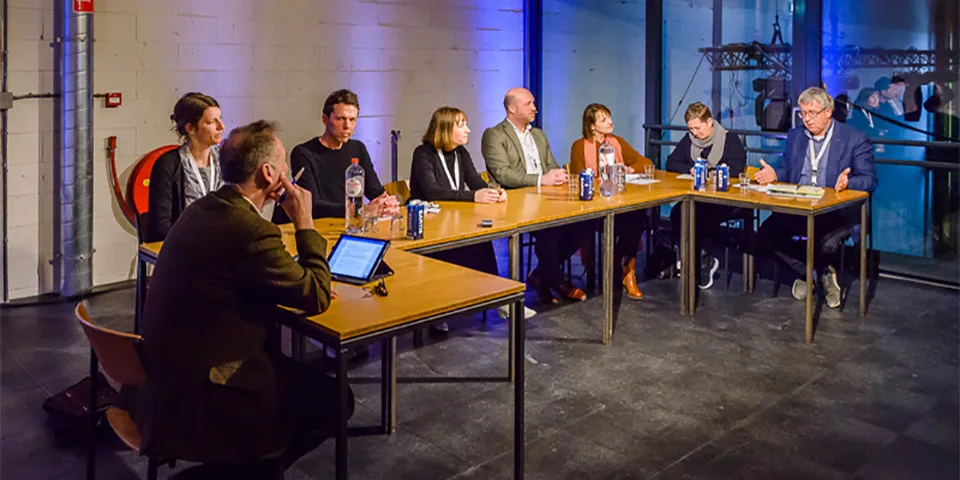
If you want to design a building that is dynamic and future-proof, you need to work together. Not just the architect and client, but also the material manufacturer, product designer and interior designer. And with a strong focus on the user. That was the conclusion of the round-table discussion on the theme ‘The Living Building, a building in constant motion’, which recently took place at IJver in Amsterdam. Prominent participants, including DDW Design Talent of the Year Simone Post and the much-lauded Ingrid van der Heijden of Civic public architecture, came up with some interesting ideas, such as the leased retail interior that Post wants to loan out for three years. Van der Heijden argued for high ceilings so that any building can easily be put to a different use. The event was organised by Forbo Flooring to mark the launch of the new Allura collection.
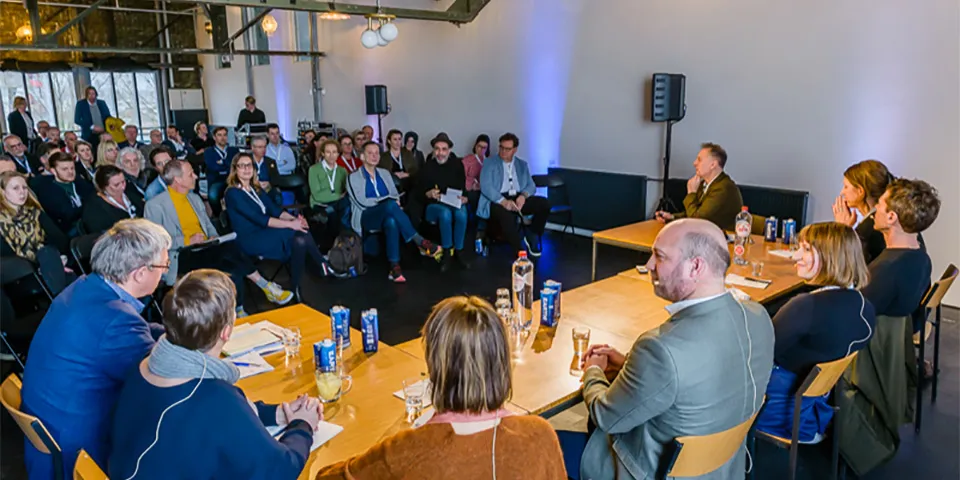
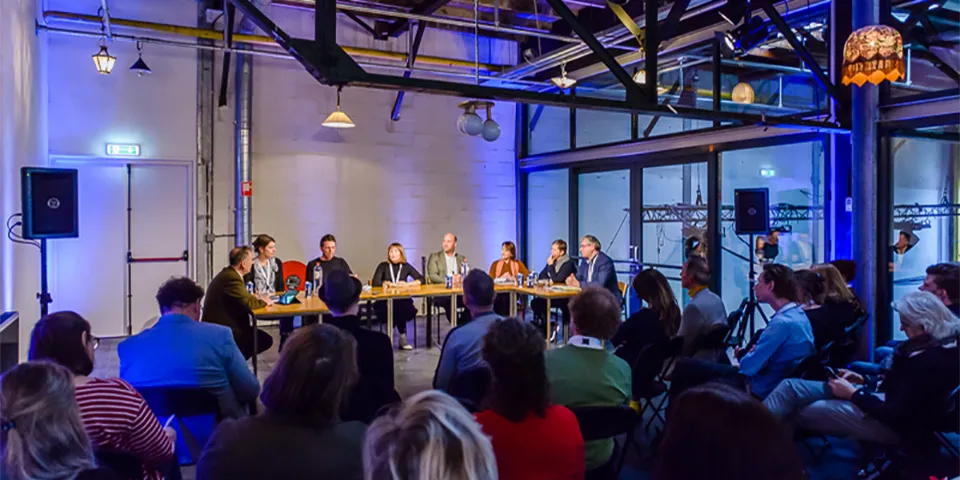
Forbo hosts round-table discussion ‘The Living Building’ to mark launch of new Allura collection
As well as Post and Van der Heijden, moderator Jeroen Junte was joined at the table by Jeroen Dellensen (interior designer/director, i29, which recently won a Dezeen Award as best interior design studio), Dorothé Kessels (Director Global Design, Forbo Flooring), Sebastiaan Lagendaal (Head of Facilities, De Nieuwe Kerk & De Hermitage Amsterdam), Marjolein van Gelder (Sustainability Programme Manager, Forbo Flooring) and Wim Pullen (Director of the Center for People and Buildings, TU Delft).
The dynamic building
For a dynamic building, one that can easily be transformed and given a different purpose in the future, building in extra capacity is a good starting point, according to Van der Heijden. ‘Make sure the shell is a good size and that the floors, for example, are at least 3.5 metres high. That way, you can always fit a restaurant or retail space in later.’ A beautiful, durable and robust exterior/envelope is also advisable.
This kind of building provides a good basis for change. And that is necessary, because buildings, and interiors in particular, are changing ever faster at a time when people are spending more and more time indoors. That may mean the interior designer has become more important than the architect, Junte suggested. Dellensen could not disagree. ‘People care enormously about interiors. You see shops and hospitality venues completely changing their interiors every few years. We try to build a great deal of quality into our designs so users come to appreciate them and the interior lasts longer.’
Scientist Pullen had a handful of examples to show that design often goes wrong. He argued that users should be central to both exterior and interior design ideas. Pullen said this certainly had not happened in the design of the former VROM building at Rijnstraat 8 in The Hague (now home to the ministries of Infrastructure and Water Management and Foreign Affairs, ed.). ‘At Rijnstraat 8, 40 per cent of the building caused problems. The meeting rooms, for instance, became a mess because the bins were far too small. After ten people had thrown away their cups, they were full, so the rubbish was left on the tables or ended up on the floor.’ According to Van Gelder, who worked at Rijnstraat 8 for Forbo, it was also ‘every person for themselves’ when it came to finding a workspace. Pullen said: ‘Our research consistently shows that employees and people in general do not like change, such as having to move desks, but they do like colour, beautiful things, greenery around them and, above all, a well-functioning interior.’ Pullen thus emphasised the importance of a skilled interior designer.
Lagendaal also had a ‘disaster story’. The architect responsible for the Hermitage renovation insisted on using marble from the Apennines in the basement. Lagendaal said: ‘The supplier had warned us about rising damp, but as the client we weren’t yet strong enough to say no.’ The entire floor now needs replacing.
Forbo’s design director Kessels said that as a manufacturer, she is keen to engage in dialogue with the client, the building and the (interior) architect, but noted that this is not always standard practice. ‘And ultimately, the customer is king.’
The personal building
To what extent can clients add their own identity to an existing building? That was the question put to Lagendaal, who, 15 years ago, bought an old, dark care home dating from 1683 from the municipality of Amsterdam for 5 euros, and transformed it into a magnificent museum on the canal. Lagendaal said: ‘The design is by architect Hans van Heeswijk, who wanted the old and the new to coexist. We started by installing one-metre-thick internal walls, concealing all the new services inside them. Then we brought light into the Hermitage with enormous light wells and a glass staircase. That is the foundation. Every six months, we transform the two large exhibition spaces into an entirely new experience, with a different interior, colours, walls and floors. We also realised about five years ago that our beautiful city-centre building sometimes stood empty for weeks when we had no exhibitions. We thought that was a waste. Since then, we have become a cultural hub, hosting films, jazz concerts and hospitality venues, as well as external tenants such as the Amsterdam Museum.’
Van der Heijden said: ‘You increasingly see this kind of building combining all sorts of uses. People still move to cities to learn and meet one another. That is the idea behind our designs too. We saw the LocHal (World Building of the Year 2019, according to the World Architecture Festival, ed.), for example, as a part of the city rather than a building.’ It is officially a library, but also includes a debate centre and exhibition spaces, among other things, and has become something of a living room for the city. Dellensen applauded the idea, saying that diversity is stimulating. ‘Different users can reinforce one another.’ Van der Heijden said: ‘And yet you still see monotonous housing developments springing up.’ Take a neighbourhood such as Zeeburgereiland, where everyone is bored stiff and sits staring at the ceiling.
Making an older building personal is not always easy. i29 is renovating Felix Meritis in Amsterdam, a place for free thinkers since 1777, which reopens in April. Dellensen said: ‘We had to deal with heritage preservation and municipal oversight. It was a tense struggle between old and new. Everything we added had to be clearly recognisable as new and removable.’ Knowing i29, the result will be one of simplicity, contrast and beautiful materials.
According to Kessels, buildings are becoming less uniform in identity and taking on more and more different functions, such as spaces where people can relax, eat or concentrate in seclusion as well as work. In other words, a building takes on multiple identities, and the experience of those spaces seems very important. Think of a gym in a hospital, a lounge with a coffee corner at a bank, or a hair salon & bar in a clothing shop. Kessels said: ‘We call these the five dynamics of a building. There are areas for receiving, moving, connecting, concentrating and recharging. Forbo responds to this with its flooring, which, for example, absorbs sound where concentration is important.’
Pullen made clear that not everyone understands the importance of receiving and hospitality, and a good entrance: ‘The original VROM building (the one before Rijnstraat 8, ed.) had a very large reception hall. You felt welcome. The entrance at Rijnstraat 8 offers very little space. To get an access pass, you have to go, just like at Schiphol, along a route cordoned off with straps, before reaching cramped turnstiles. As if they don’t want you to come in.’ He once again asked who we are building for. Pullen said: ‘The pupil or the teacher, for example? From what I see, sustainability, air-conditioning systems and a trendy colour seem more important than the teacher, who spends thirty years in the building and has recently been out protesting on the Malieveld more often than ever because they are dissatisfied.’
Van Gelder, whom Junte dubbed Forbo’s green police, said: ‘You can have both. A good indoor climate is very important in schools. Sustainability can also make a difference to how a space feels, its materials and atmosphere. If the products have also been made in a socially responsible way, I feel more comfortable in the environment.’ Van Gelder was already paving the way for the next topic, namely…
The circular building
How can you make a building sustainable for the long term? Post, who always thinks and works ‘green’ as a transformer at the intersection of product design and research, saw a gap in the market and said she wants to design interiors for shops or hospitality venues, for example, lease them out for three years and then take them back to make something else.
Van Gelder advised her that if you want to operate circularly, you should at least make sure that you do not combine different materials into a single product or glue them together. She also said that it can be quite complex for manufacturers to take products back from the market and make a contribution to sustainability, as Forbo is striving to do. Recycling sometimes uses more energy than it saves.
Many recycling processes currently involve pulverising the original product. This produces granulate, which is then mixed with a binding agent such as glue or bio-based resin to make something for a different use. But there are other ways, according to Post. For Adidas, she used pure but rejected waste materials to make a new shoe. The fact that they were a little off-colour was precisely what gave the new trainers their strength. Post said: ‘Aesthetics and sustainability can work very well together.’
Van Gelder also said that Forbo has fully CO2-neutral and natural products such as Marmoleum, as well as loose-lay systems such as the new Allura, which can easily be removed from a building. Van Gelder said: ‘Bio-based or vinyl, both are fine, as long as they are part of a closed loop.’
Lagendaal said: ‘The first thing we did in terms of sustainability was address the hardware: we made technical changes to the building, installing a heat and cold storage system and solar panels. We are now at the point where even the fit-out of the exhibition spaces is circular. The exhibition designers can do what they like, but they are required to reuse the old display cases and other items. They can then transform them to suit their own taste, add a coat of paint and so on.’
Modular and sustainable
The round-table discussion was organised by Forbo Flooring to mark the launch of its new Allura collection. The collection of luxury vinyl planks and tiles is not only made with Dutch passion, but also offers a sustainable answer to every flooring requirement, both now and in the future. This is because the flooring manufacturer’s Design Studio has taken the way people work, live, relax, learn and play as its starting point when developing its collections & designs. Forbo has observed, for example, that modularity is becoming increasingly important in the creation of buildings and spaces. The new Allura collection responds strongly to this trend with loose-lay systems that are easy to remove. Reuse and sustainability are, of course, crucial in today’s world. Forbo has therefore set up a recycling programme to take back both offcuts and used Allura flooring. For much more information, visit www.forbo-flooring.nl/allura
A business enquiry for Forbo Flooring? Get in touch
Companies in this story
Keep following this
Get an email when a new story is published. No account needed.
- ThemeInteriors for housing and care
- SubjectGeneral
- CompanyForbo Flooring







