Emergency lighting as a smart link in healthcare
Text Lieke Bousema Beeld HBI Bisscheroux

In sectors where buildings are taking on more and more functions and user expectations are constantly changing, future-proofing is a key design and management challenge. This is particularly true in healthcare, where flexibility, energy efficiency and a healthy living environment are becoming increasingly important. The question is not which emergency lighting performs best today, but how the installation can adapt to tomorrow’s needs.
According to Patrick Mestriner, consultant at HBI Bisscheroux, future-focused thinking starts not with the product, but with the question of what role emergency lighting should play in the long term. “Are you investing in a solution that will need replacing again in a few years? Or do you choose a system that can flexibly grow with changing requirements?” With wirelessly managed emergency lighting, HBI Bisscheroux offers a future-proof solution that can be easily adapted and expanded without major installation work. This allows the emergency lighting installation to grow effortlessly with the building’s changing needs.
A different way of looking at things
Healthcare faces major challenges. Regulatory pressure is increasing, qualified technical staff are scarce, and at the same time safety and business continuity must never be compromised. According to Mestriner, this calls for a different way of looking at emergency lighting. “Building owners, facilities managers and installers need to move away from selecting on the basis of product and purchase price. The future calls for lifecycle thinking: it is not the initial investment that matters, but the value a system can continue to deliver over ten to fifteen years.”
Developed for the healthcare of tomorrow
Future-proofing, scalability and safety are central to this. HBI Bisscheroux’s wirelessly managed emergency lighting system is designed to allow buildings to adapt easily to changing healthcare models and new functional requirements. Additional luminaires, sensors or functions can be added without major modifications. “As a building owner, you always remain in control,” Mestriner emphasises. “You can keep expanding, monitor more and more, and have continuous insight into the status of your installation.”

Open standard
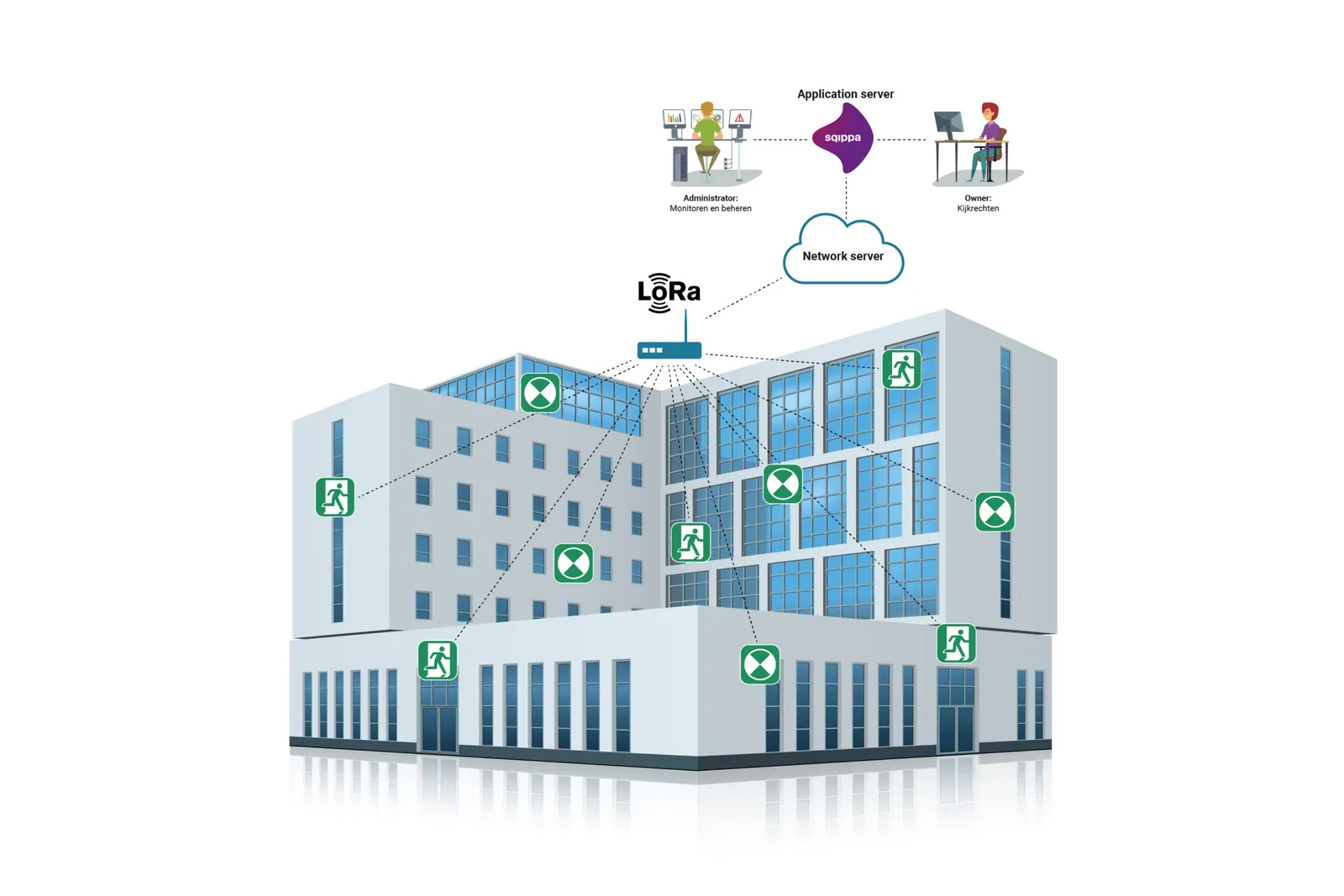
An important principle here is the choice of LoRaWAN, a globally used open standard for secure wireless communication. While many manufacturers use closed systems, HBI Bisscheroux has deliberately opted for a universal IoT platform that enables different building systems to work together. This provides insight not only into emergency lighting, but also allows other building data, such as CO2 and climate readings, energy use and water consumption, to be brought together on a single platform. This provides valuable information for integrated building management.
Continuous insight
For healthcare organisations, this means more than just more efficient maintenance. The status of every luminaire is automatically checked several times a day via the Sqippa Online monitoring platform, using eighteen relevant data points. Mestriner cites battery status and the results of function and duration tests as examples. “Deviations, faults and even installation errors become visible immediately. This gives continuous insight into the safety of the installation, rather than the traditional snapshot taken during periodic inspections.”
Predictive maintenance
It is precisely this continuous flow of data that makes predictive maintenance possible. “The key is to collect as much data as possible and identify correlations,” says Mestriner. “AI helps with that. By analysing patterns, you can make increasingly accurate maintenance predictions and shift from reactive to proactive management.” This avoids unnecessary inspections while demonstrably increasing the reliability of the emergency lighting.
Less disruption on the care floor
For healthcare, this has an important added benefit. Maintenance technicians no longer need to check every luminaire manually as a matter of routine. They only intervene when the system detects a deviation or a physical inspection is required. This saves time and money, while also reducing disruption for patients, service users and healthcare staff. Long rounds with ladders and toolboxes are largely a thing of the past, so day-to-day care processes are less disrupted.
Compliance demonstrably assured
Increasingly stringent legislation and regulations also make digital management an attractive option. Automatic recording and continuous monitoring make it easy for organisations to demonstrate that they comply with applicable requirements, including the Environment and Planning Act, ISSO 79 and NEN-EN 50172. “More and more is being expected of building owners and maintenance companies,” says Mestriner. “Wirelessly managed emergency lighting gives you continuous insight into the installation and makes it possible to demonstrate that safety is assured.”
An investment in the future
According to Mestriner, investing in smart emergency lighting management is above all an investment in the future of healthcare. “Our built environment is rapidly becoming digitalised. Choosing wirelessly managed emergency lighting now means investing not only in safety, but also in a future-proof building that is ready for staff shortages, stricter regulations, energy savings and data-driven building management.” Smart emergency lighting is therefore not just a mandatory safety feature, but also an essential building block for more efficient, sustainable and future-proof healthcare buildings.
Een zakelijke vraag aan HBI Bisscheroux? Get in touch
Companies in this story

Keep following this
Get an email when a new story is published. No account needed.
- ThemeSafe and reliable healthcare buildings
- SubjectZorgTech
- CompanyHBI Bisscheroux