Smart armband gives nurses (proven) more time for post-operative patients
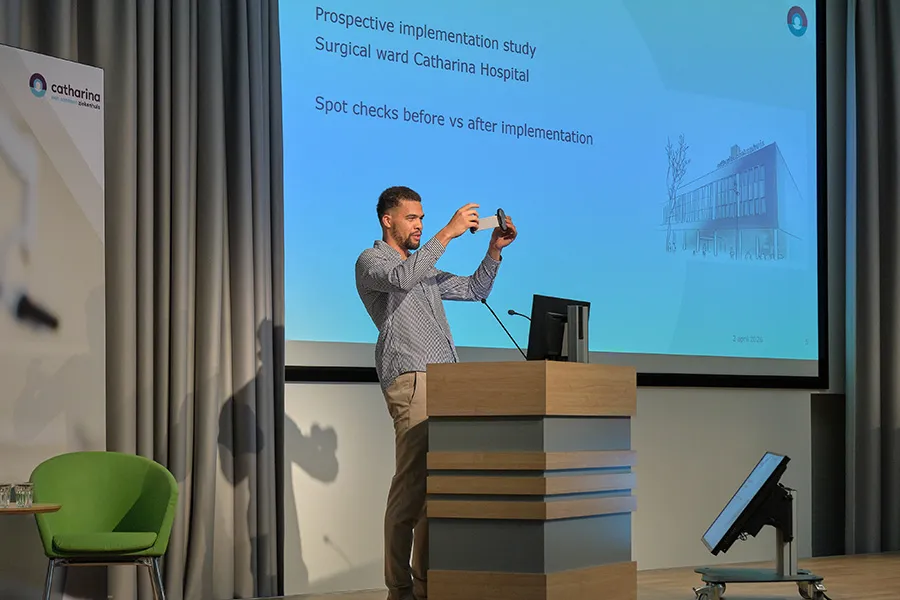
Publication in World Journal of Surgery
Patients on surgical wards at Catharina Ziekenhuis are increasingly being monitored using a smart armband. This means fewer separate bedside checks are needed.
A patient who has just undergone surgery is checked several times a day. What is their heart rate? Is their breathing steady? Is there enough oxygen in their blood? These measurements are important. They help nurses and doctors quickly assess how a patient is doing. But they also take a lot of time, particularly on busy wards.
At Catharina Ziekenhuis, surgical research doctor Ephrahim Jerry therefore investigated whether a smart armband could help. The device, called viQtor, is a medical device worn on the upper arm. It automatically measures heart rate, breathing and blood oxygen levels. These readings are then automatically entered into the patient record.
392 patients and 54 nurses
“The aim was not to reduce the amount of time nurses spend with patients,” says Jerry. “Hospitals are full, patients are becoming more complex and nurses have much more to do. That is why we need to find ways to reduce their workload. Not to reduce the number of staff, but to give nurses more scope to provide truly valuable care.”
A total of 392 patients on surgical wards at Catharina Ziekenhuis took part in the study. A further 54 nurses completed questionnaires. The findings are clear: using viQtor reduced the need for manual checks by 62,7 per cent. That saves around ten minutes per patient per day. A nurse caring for four patients therefore gains around forty minutes per shift.
That may not seem like much, Jerry acknowledges, but it makes a difference on a busy ward. “A nurse starts the morning by giving medication, washing patients, carrying out checks and answering their questions. If those tasks keep taking up time, there is less room in the shift. That makes it easier to spend just a little longer with a patient.”
Clinical judgement remains essential
The smart armband does not replace contact between patients and nurses. This is an important point, the research doctor stresses. “A device cannot see how someone is doing. A nurse can. Clinical judgement remains essential. But not every check has to be done manually. This allows nurses to use their time differently.”
According to Jerry, patients are generally positive about it. Some notice the band when they sleep, because it is worn on the upper arm. But most patients are fine with it. “What we often heard was: ‘If this helps me, or helps the doctor and nurse, then it’s not in the way.’”
Notably, healthcare professionals’ attitude has a major influence on how patients experience the armband. When a nurse explains the device with confidence, patients are more likely to accept it. “Patients can tell straight away when a healthcare professional is unsure,” says Jerry. “That is why it is important to introduce new technology step by step. Not impose it, but learn to use it together.”
A gradual introduction was necessary. At first, viQtor actually took more time. Nurses had to learn how the armband worked, how to charge it and where to find the readings. Doctors also had to get used to the new way of taking measurements. “If one doctor still asks for the old measurements and another doesn’t, it gets confusing. Nurses then feel as though they are doing the work twice. So you have to bring the whole team on board.”
How to expand its use
The study has been published in the international scientific journal World Journal of Surgery. Other hospitals are also showing interest in Catharina Ziekenhuis’s approach. Work is now under way to explore how the smart armband can be used more widely.
For Jerry, the value lies above all in its practical application. “Care is becoming increasingly complex. Patients are often sicker and nurses have a lot to do. We need to find tools that genuinely help. Not because technology is exciting, but because it can make care better and more humane for patients.”
Work is now under way to explore how viQtor can also be used on other wards, including in connection with other surgical specialities. The study is part of a wider project at Catharina Ziekenhuis to monitor patients more intelligently around the time of surgery. Surgeon Simon Nienhuijs and anaesthetist Arthur Bouwman have been closely involved in introducing this way of working from the outset.
Question about this story? Ask your question
Keep following this
Get an email when a new story is published. No account needed.
- SubjectZorgTech