‘Certified sustainable buildings often underperform’
Text Maya Debie Beeld Next Sense
AI agents and human experts turn untapped building data into energy savings and better performance
A building can achieve the highest sustainability certifications and still perform significantly worse in practice. This leads to unnecessary energy use, higher costs and lower occupant comfort. However, it is difficult to pinpoint exactly what causes this performance gap.
Across more than 200 commercial buildings worldwide, Amsterdam-based scale-up Next Sense found opportunities to improve performance in every building it analysed. Even buildings with prestigious sustainability certifications, such as BREEAM Outstanding and WELL Platinum, still have untapped potential to perform better. “The gap between potential and day-to-day reality exists because buildings are incredibly complex systems,” says Ferdinand Grapperhaus, CEO of Next Sense. “The data needed is spread across different installations. Without detailed building data, it is difficult to see how all these factors interact, and you do not get a complete picture of how a building actually performs.”
From blind spots to insight and action
To close this gap, Next Sense is launching the Building Intelligence Center (BIC). The platform is built around a network of specialised AI agents, developed by Next Sense, that continuously analyse building data. Drawing on more than 2.1 million data points a day from over 33,000 connected devices, the agents provide insight into energy use, comfort and occupancy, flag anomalies and investigate their causes.
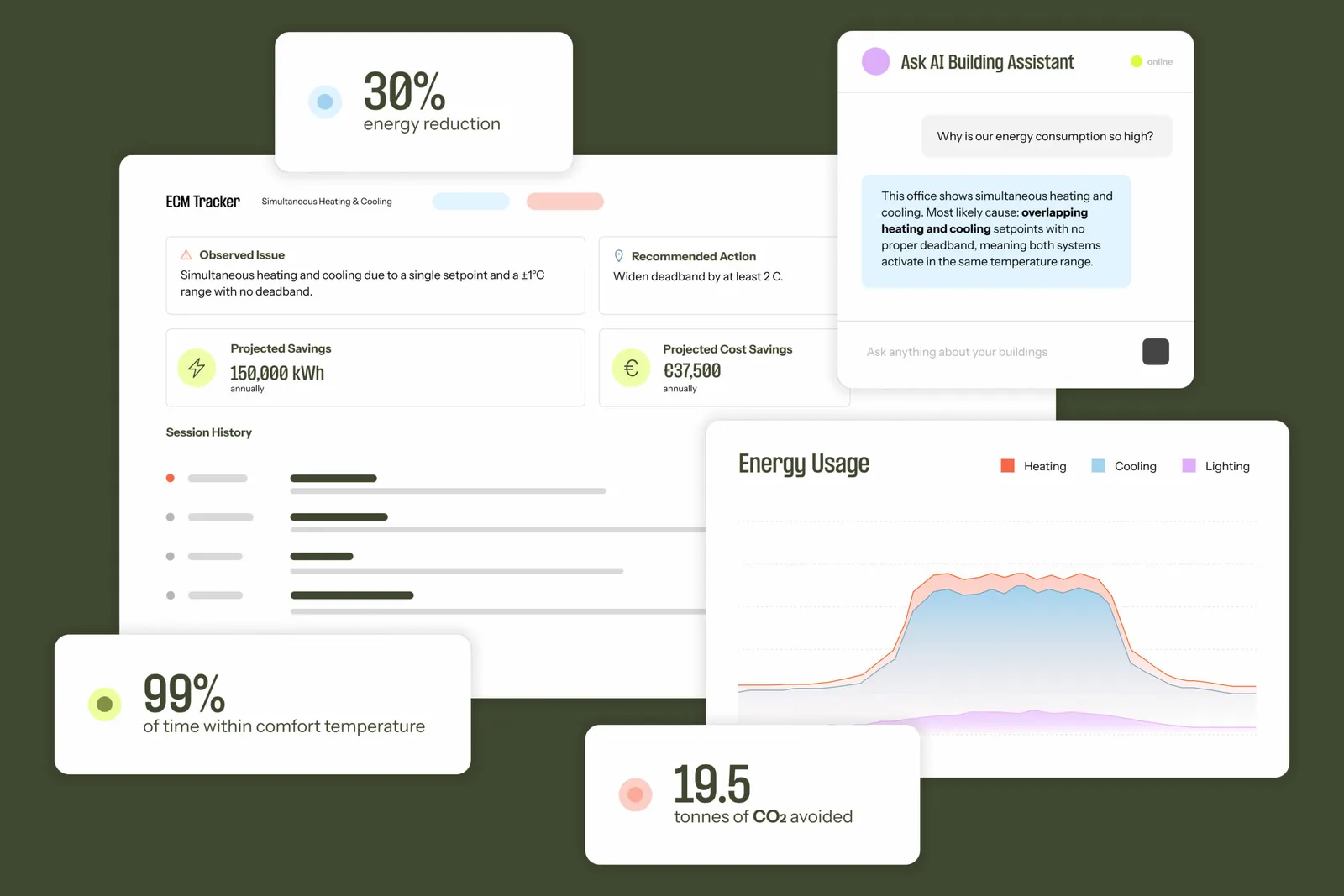
With the BIC, understanding a building’s performance is as simple as asking the building a question. The AI agents can answer questions, recommend specific actions and identify opportunities for improvement before unnecessary costs arise. For example, the BIC can detect when heating and cooling are operating at the same time, investigate the cause and recommend how to resolve the issue. An analysis that previously took around two weeks can now be completed in a single day.
Agentic AI for better performance
The BIC uses an agentic AI approach, in which specialised AI agents each carry out their own tasks, use the data and tools they need, and work together to investigate a building’s performance. Unlike a chatbot that only responds to questions, these agents can also operate autonomously: they monitor buildings and flag problems without being prompted. AI is at the heart of the system. The agents have been shaped by the knowledge of Next Sense’s Building Performance Experts, specialists in building physics who apply their expertise to determine how the agents analyse data and investigate performance issues. “We have designed the system so that each agent only has access to the data and tools required for its specific task, and every step can be checked,” says Pim Rutgers, Chief AI Architect at Next Sense. “This allows us to use AI where it excels, while ensuring that answers are always based on actual building data.”
Because the BIC is used to inform decisions about real buildings, reliability is essential. With a dedicated technical monitoring system, Next Sense can check every step of the AI agents’ work. In addition, various validation mechanisms ensure that answers are always checked against the underlying building data. The Building Performance Experts add a layer of human oversight, reviewing recommendations before they are put into practice. This combination of technical checks, data validation and human expertise reduces the risk of hallucinations and ensures that the findings reflect what is actually happening in a building.

Performance beyond certification
Next Sense now works with more than 200 buildings, representing over 1 million square metres of commercial real estate in more than 20 countries. Across clients’ building portfolios, total energy use has fallen by an average of 18% after inefficiencies were identified and addressed. Savings for individual installations or energy sources can reach 40%. “Buildings are incredibly complex, and the people who manage them have to deal with more data, systems and requirements than ever,” says Grapperhaus. “There simply isn’t enough time to continually connect all that information and identify every opportunity for improvement. That is exactly why we developed the BIC: to continuously analyse what is happening in a building and help people understand where they can make a real difference.”
About Next Sense
Next Sense is an Amsterdam-based scale-up that combines data, agentic AI and human expertise to optimise building performance in terms of energy, comfort, occupancy and costs. Founded in 2024, the company is B Corp- and ISO 27001-certified. Next Sense operates worldwide and works with more than 200 buildings for clients including EDGE, Just Eat Takeaway, Ardian, Timeless and Vastint.
Question about this story? Ask your question
Keep following this
Get an email when a new story is published. No account needed.
- ThemeSustainable healthcare buildings
- SubjectZorgTech