











A green revolution in healthcare and the living environment
Text Maarten van VlietImage Judith van der Poel, Floriade, Niek Roozen Landscape & VieCuri Medisch Centrum
How medicine, too, is embracing the benefits of more green space
Efforts to keep healthcare costs under control will see a major shift towards health based on lifestyle, prevention and early diagnosis in the years ahead. For a long time, mainstream medicine steered well clear of anything to do with green space and nature, especially in hospitals. But in recent years, there has clearly been a change of direction. Dr Jolanda Maas, associate professor at VU Amsterdam, and landscape architect Judith van der Poel share their insights.
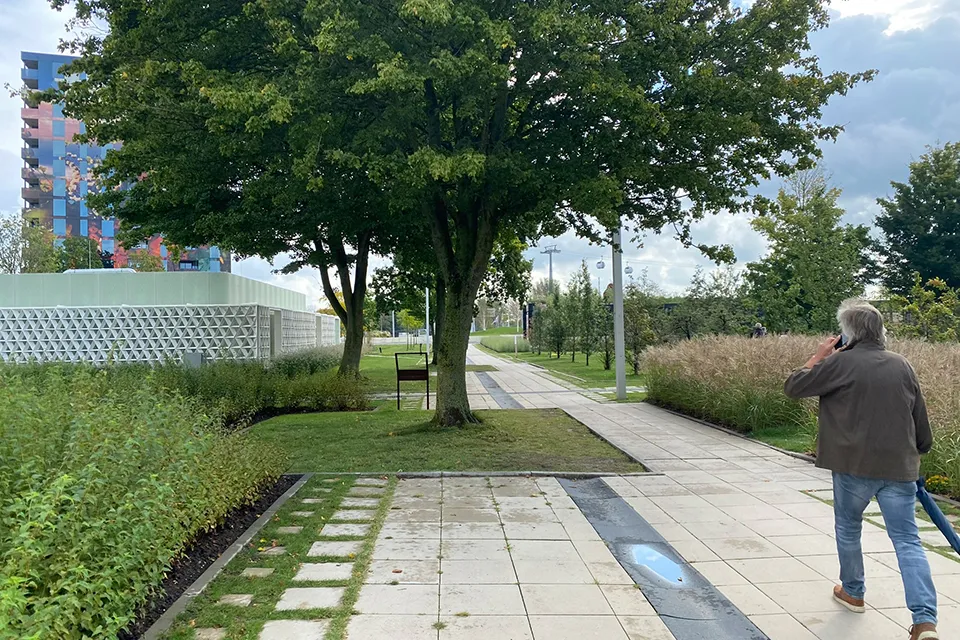
When gardens and public green spaces are designed and laid out, aesthetics are very often the main consideration. The same is certainly true of greenery indoors. Yet a remarkable shift is now under way, with the emphasis moving towards functional green space. The focus is on greenery as a defining factor in a healthy living environment, and even as something that can help heal body and mind. Two major societal challenges are driving this green revolution: rapid climate warming and ever-rising healthcare costs. Together with De Bloeimeesters, a group of experienced garden specialists with an impressive depth of plant knowledge, Greenpro brought together experts from healthcare, construction and the green sector for a special feature on ‘Greenery in healthcare’. The following pages present the results. Green space is an investment that pays off in several ways, perhaps above all.
A counter-movement
After greenery had almost completely disappeared from hospital environments over the course of the previous century, a counter-movement emerged at the start of this century. This was partly influenced by Planetree in America, which had been advocating the transformation of hospitals into ‘healing environments’ since the 1970s. In the Netherlands, there was also a reaction against the rise of vast, technocratically designed hospitals, where the human touch was entirely absent. A new approach to hospital design began to take shape, with a clear increase in the number of green elements in and around buildings. One particularly striking example came last summer, when it was reported that Rijnstate hospital in Arnhem had created space for two intensive care beds on an outdoor balcony.
Dr Jolanda Maas, associate professor in the Clinical Psychology section at Vrije Universiteit Amsterdam, was closely involved in the research behind this work. A few years ago, she worked with environmental psychologist Dr Agnes E. van den Berg and Dr Karin Dijkstra, Professor of Health Promotion in the Living Environment, to compile the evidence-based guide ‘Greenery in and around hospitals’ (2021). It incorporates findings from the ‘Green Healthy Hospitals’ research programme, carried out between 2015 and 2020. The programme examined the effects of green interventions in five hospital departments. “A great many green interventions have indeed been put in place in recent years,” Maas says, “but there is still a problem: in general, they are used only to a limited extent. As a result, their impact remains limited, making it harder to justify the investment. The fact that they are not working as they should is down not only to design, but also to the fact that these facilities are not really integrated into healthcare. So there is still plenty of room for improvement.”
What is striking is that the issues are often quite straightforward. Maas says: “To make sure people use the green space, it needs to be easy to access. People need to know where to find the entrance. It is also important to establish in advance how the intended users would like to use the garden and what facilities they will need. Staff should also be given the chance to experience the value of the green space. When designing it, you need to make sure that the surface beside an oncology department is suitable for people with IV poles, and that a geriatric department needs more benches, including higher ones. This is still not happening often enough.”
Training
Maas says it is hard to explain why implementation goes wrong: “It is still quite new, healthcare staff are extremely busy, and for most garden designers and landscape contractors these are also new user groups. It is a little like the process of creating green schoolyards. Things often have to be done quickly and on a limited budget.” Fortunately, she notes, more and more designers are getting it right. “But they need to get on the radar of healthcare institutions. These institutions often have existing contracts with grounds maintenance providers, who are then also brought in for a green intervention, even though they may not have the necessary expertise. Ultimately, both hospitals and garden designers and landscape contractors will need training in this area. Both sides need to realise that, with a few extra steps, they can create something of real value, rather than what it often is now: a pleasant decorative feature.”
Excellent examples
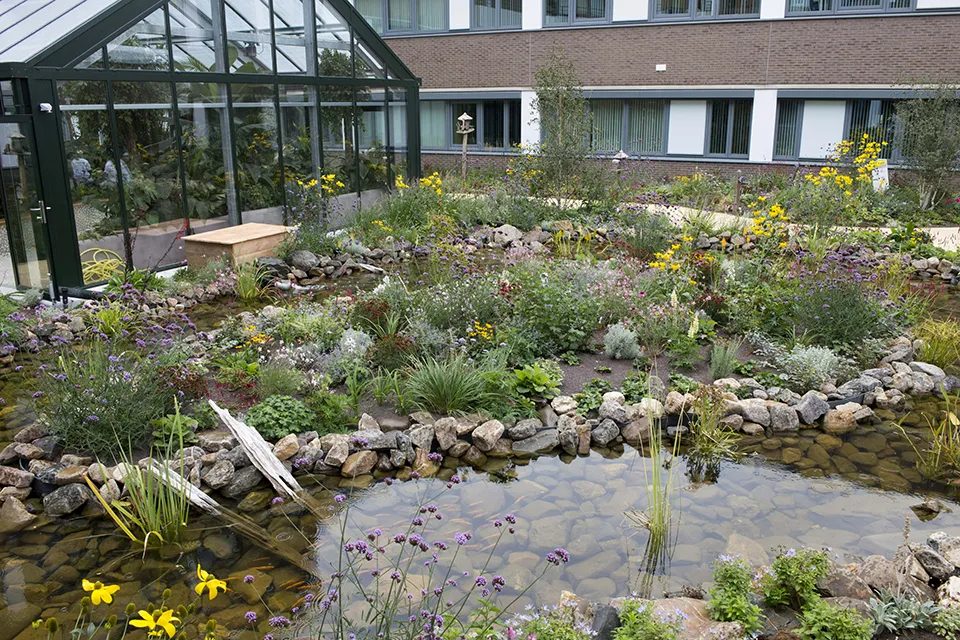
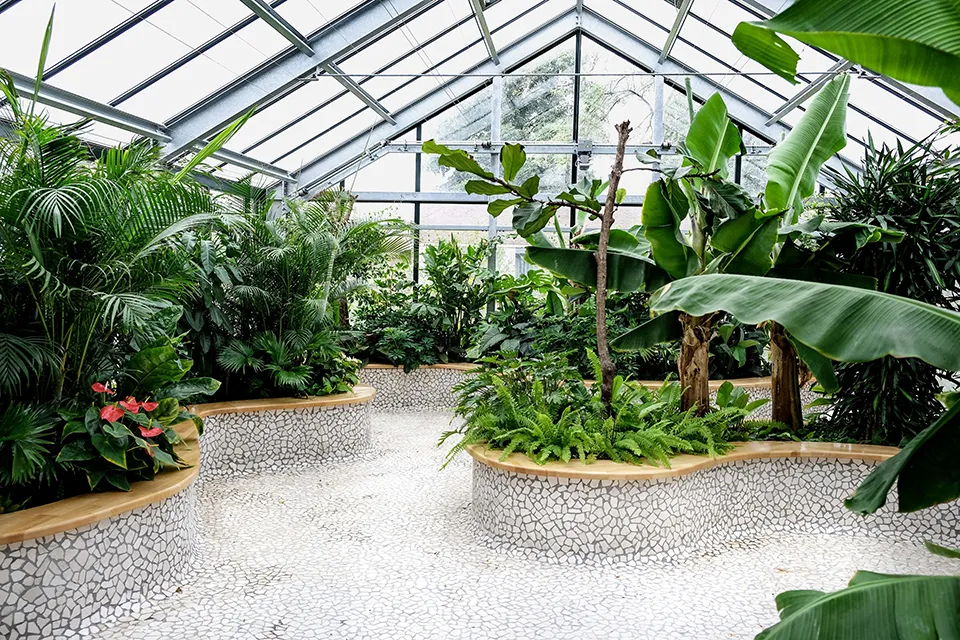
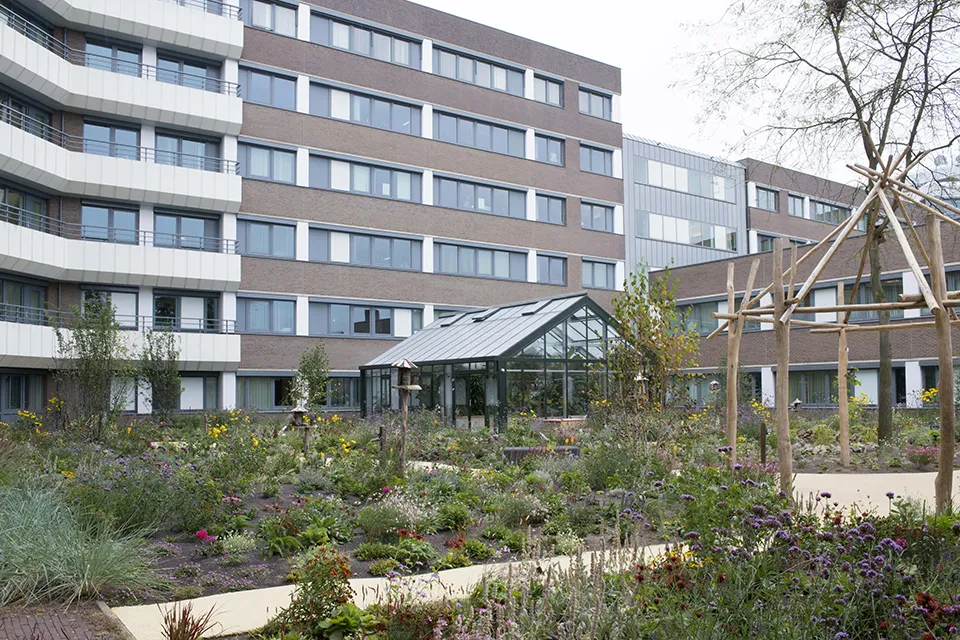
The VieCuri Medisch Centrum in Venlo is an excellent example of greenery in a hospital. Its Oncology Centre has the BuitensteBinnenTuin, complete with an attractive greenhouse. Maas says: “It is a beautifully designed sensory garden for patients and visitors. Unfortunately, they are also finding that it is not being used as much as expected. We are now investigating why.”
Something similar happened at Isala hospital in Meppel and Medisch Centrum Leeuwarden, both of which had gardens that were barely used. “That is why we redesigned the gardens together with a team of professionals, including people who work at the hospitals themselves, using our design and implementation model,” Maas says. “We also set up a process to ensure that healthcare professionals integrate the garden into their working practices. Only then can a garden really add value.”
Limited research
It is not easy to substantiate health claims, as little research has been done so far. Maas says: “The general literature suggests that a garden like this reduces stress, provides a welcome distraction for healthcare staff and also makes their work more enjoyable. I think the story you tell around it is very important. I see these green spaces as a kind of refuge for the mind: a chance to step away for a moment, to get away from a stressful environment.” It is therefore not just a matter of implementing a green project properly, but also of gaining a clearer picture of its effects on health and wellbeing. Maas says: “Absolutely. And not just the effects on patients, but on staff and visitors too. I think that is just as important, given the growing shortage of healthcare workers and the high levels of absence due to stress and burnout.”
Green City Guidelines
What applies to healthcare settings on a small scale also applies, in a sense, to the wider living environment. But what does a healthy living environment look like in our increasingly built-up country? To find out more, we spoke to Judith van der Poel, landscape architect and director of Niek Roozen Landscape.
Van der Poel succeeded the practice’s namesake, Niek Roozen, in 2019. She studied Garden and Landscape Design at Van Hall Larenstein University of Applied Sciences in Velp (2001), then trained as a landscape architect at the Amsterdam Academy of Architecture. Niek Roozen, known in part for his work on the Floriade, has been championing urban greening since the last century, with the aim of creating a healthier world. Van der Poel says: “With input from researchers, government bodies and institutions, we published ‘The Green City Guidelines’ in 2011. We are increasingly finding that this approach is highly relevant today, including from a healthcare perspective.”
“Around 10 years ago, we worked with Wageningen University and Research (WUR) to write The Green City Guidelines, which contain a wealth of facts. It is true that hospital patients recover more quickly when they have a view of greenery. There is a genuine scientific basis for the positive effect of greenery on health, which is of course good news for our field.” The collaboration with WUR yielded important new insights, for example into the benefits of greenery for air purification. And now there are the findings of a study suggesting that thousands fewer people would die from heat stress if cities had 30% tree canopy cover. Van der Poel says: “There are compelling arguments for greening our surroundings on a large scale and preserving existing green spaces. Large trees are still far too easily felled, even though we now know that a 20-year-old tree provides as many ecosystem services as 400 small trees. Twenty years ago, greenery was just a nice finishing touch added to a plan, but things have really changed. I find that, as a landscape architect, I am increasingly having a say. In the past, you were only brought in when the houses were more or less already built.”
New care centre
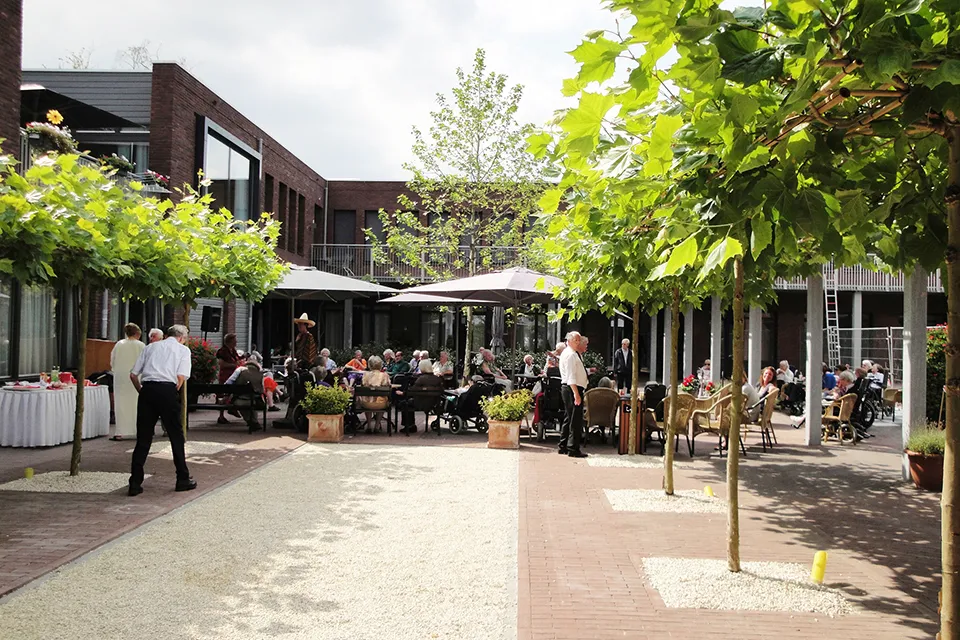
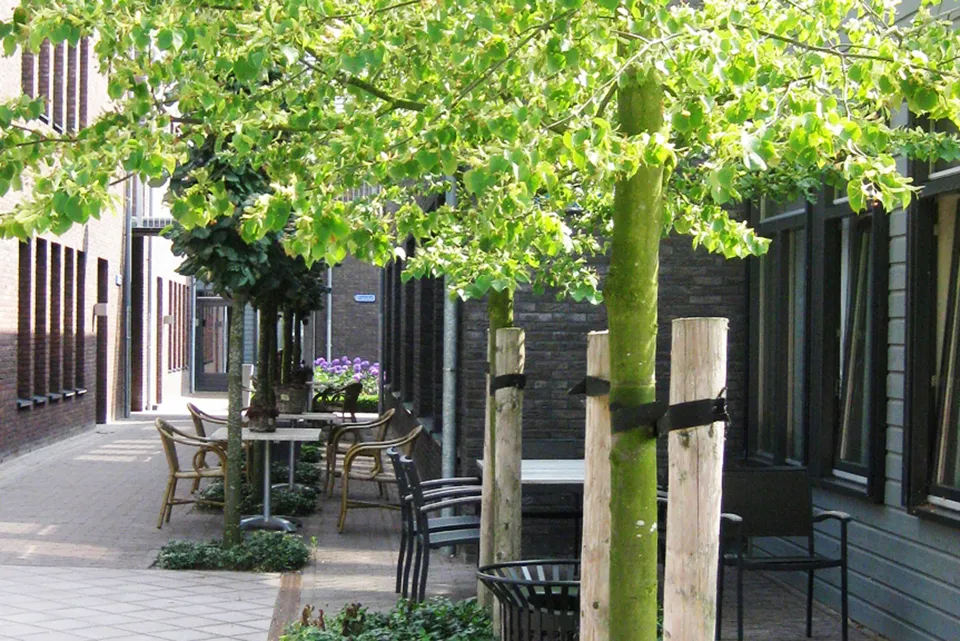
Her practice worked with an architect to develop De Hogeweyk, a new care centre for people with dementia run by Vivium Zorggroep. Van der Poel says: “It used to be a block of flats with some green space. After the old building was demolished, it was replaced by a complex of low-rise buildings, two or three storeys high, with a range of courtyard gardens linked to the different lifestyles that residents still feel strongly connected to from their earlier lives. This created a walking route. It has become a very special and unique project, which has attracted considerable attention in the care sector.”
Vivium aims to normalise care for people with severe dementia. This called for a completely new approach, shifting the emphasis from the medical to the social: instead of large nursing units, residents moved into smaller groups of seven, and were given the freedom to do what they wanted, without assistance or supervision. This places particular demands on the surroundings. Van der Poel says: “The design took the residents’ different backgrounds into account. For example, people from the city are given an urban-style home on a small square, while there are houses with a distinctive interior and an Indonesian garden for people of Indonesian background. The design helps new residents feel at home very quickly.”
Outlook for the sector
While the vision behind De Hogeweyk emerged from day-to-day care practice and was not scientifically underpinned in advance, residents at this new care centre turn out to live an average of 2.5 years longer and also need fewer medicines. Van der Poel: “One explanation is that residents become more active and their senses are stimulated more. They can take a walk through the green spaces, go to the hairdresser and the local supermarket, and even do a little gardening. Because visitors also come and go, residents feel as though they are still part of normal society. And this clearly makes an impression: not only is there a long waiting list, but experts from all over the world also come to see it.”
Question about this story? Ask your question
Keep following this
Get an email when a new story is published. No account needed.
- SubjectGeneral







