











Aqua ViVa: A caring home in Nijmegen, surrounded by peace and space
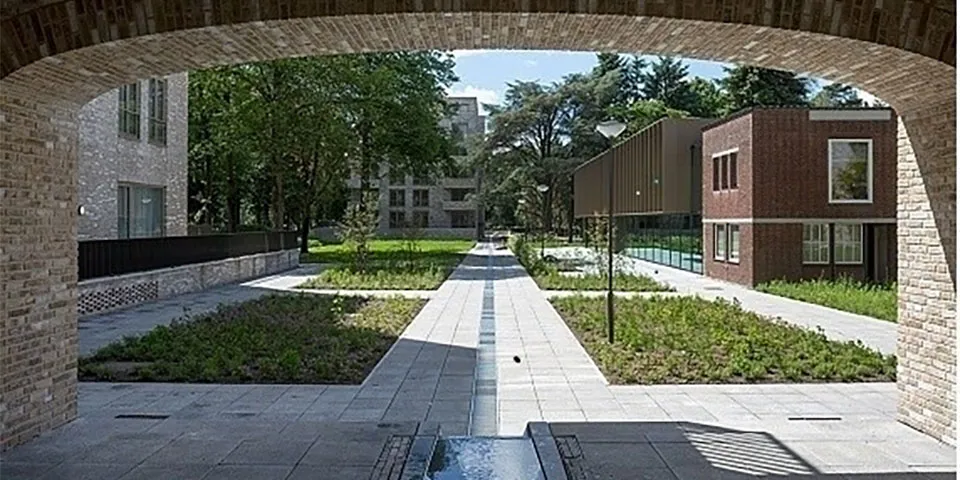
‘There is no such thing as coincidence’, Eduard Kimman S.J. must have thought when, in 2012, he was walking through Nijmegen and passed a construction site on Heyendaalseweg. A large Ballast Nedam sign announced an apartment development. It was a time of crisis, sales had stalled and construction had ground to a halt. Kimman, bursar of the Dutch Jesuits, was looking for new accommodation for the elderly priests who were still living at Berchmanianum on Houtlaan in Nijmegen. Neighbouring Radboud University wanted the building. Ballast Nedam’s development site was 700 metres away.
“Between 1929 and 1967, Berchmanianum served as a training house, after which it became a residential care home for clergy. Around 1978, the Catholic University secured an option to buy it if Berchmanianum ceased to operate as a care home. So that option had been in place for about 34 years,” says Kimman. “When I discovered Ballast Nedam’s abandoned project, I started making calls. We quickly reached an agreement. The priests moved in December 2016.”
From planned apartment block to full care complex
Joining Eduard Kimman are Hans Vroom, project manager at the Dutch Province of the Jesuits, and Fons te Braake, director of ATB Bouwontwikkeling. Te Braake managed the project when it was still called ‘Kloostertuin’. After retiring, he began working freelance for the Dutch Jesuits. He says: “We had to turn plans for an apartment block into plans for a care complex: quite a challenge.” Kimman adds: “The care requirements called for a new purpose. The exterior remained almost unchanged, but the interior architecture needed considerable modification.”
The complex consists of two buildings. Care is provided at Aqua Viva, a building with 98 residential units. A second building, the Parkgebouw, stands in the grounds and was built according to the original plans. Convenient parking has been created on two underground levels of the car park. Around 60 priests have now moved into the apartments: Jesuits, Dominicans and others. “There are also apartments for non-religious residents,” Kimman adds, “so-called laypeople. These apartments are also intended for people who need care or are likely to need it.” There are 24 residential units specifically designed for psychogeriatric care; the remainder provide residential care. Asked who can apply for the various apartments, Kimman replies: “People can apply from anywhere in the country. We also receive applications from clergy returning to the Netherlands after years of working abroad and looking for somewhere to live.”
The old printing works help bring people together
Ballast Nedam was unable to buy the adjoining printing works. Hans Vroom says: “Unfortunately for the printer, the business closed in 2014, which meant the building could still be included in the overall development plan.” The printing hall has now been converted into a dining room, or refectory, for the religious residents. A corner has been set aside for a ‘laypeople’s restaurant’. Te Braake says: “The decision was made to bring the two groups of residents into contact with one another. What is more, visitors are also welcome to eat and drink here. The connection this creates with the immediate surroundings is important.”
Understated beauty and functionality go hand in hand
The industrial character of the former printing works complements the new building. The complex is full of surprises. The ground-floor flooring in the new building is made from black bluestone and red marble from the Ardennes: a work of art by Jorg Barten. The wooden staircase invites people to take the stairs rather than the lift for a change. Unassuming, yet distinctive. “Designed by Jeroen Helsloot,” Kimman explains. “You want to climb those stairs, it keeps people moving!”
Outside, on the terrace floor and on a side wall facing the park, are two texts by Baltasar Gracian, a seventeenth-century Spanish Jesuit. They are rendered in letter tiles. Vroom explains: “A tribute to the old printing works. The tiles evoke old type cases and lead type. A work of art by Marc Ruygrok.”
SolarEis puts sustainability centre stage
Te Braake says: “This building is at the forefront of sustainability.” Heating and cooling are provided by the innovative SolarEis system. In the warmer seasons, solar energy is stored in a large volume of water at a low temperature. The surrounding geothermal energy enables long-term storage. When the heating season begins, heat is extracted from the underground storage and delivered to the heating system via the heat pump. During the controlled phase transition from water to ice, large quantities of crystallisation energy are released. The ice can be used for passive cooling the following summer. The hot-water buffer stores the heat needed for the hot-water supply. A heat pump transfers heat from the underground SolarEis buffer to the hot-water cylinder and heating system. Kimman says: “This closed energy system does not affect groundwater quality. We are in a water extraction area. The system is highly efficient, and energy consumption and CO2 emissions are extremely low.”
Draped to provide carefully controlled light
Seen from outside, Aqua Viva presents a pleasingly uniform appearance. All the windows in the façade look the same. “That is thanks to the Prisma voile,” says Jacco Seldenthuis of Artimo Textiles. An experienced specialist supplier of permanently flame-retardant curtain and upholstery fabrics, Artimo has been supplying the healthcare sector for more than 40 years.
“We were able to supply all the curtains at Aqua Viva, for the consultation rooms, lounges and bedrooms. The voile is uniform, while the curtains vary from floor to floor, although you can’t see that from outside,” Seldenthuis continues. “The aula has Audius CS, a special acoustic voile. This fabric provides sound absorption comparable to that of a heavy curtain.”
Artimo also has its own collection of roller blinds. The Topic roller blind, for example, is used in the refectory. “The Aqua Viva team carefully selected everything supplied in our showroom,” Seldenthuis concludes.
Een zakelijke vraag aan Artimo Textiles? Get in touch
Who worked on it
Aqua Viva in Nijmegen
- curtains
 Artimo Textiles
- Project managementATB Bouwontwikkeling
Keep following this
Get an email when a new story is published. No account needed.
- ProjectAqua Viva
- ThemeInteriors for housing and care
- SubjectGeneral
- CompanyArtimo Textiles
- CompanyATB Bouwontwikkeling







