











Case for smart scale and mixed-use design in headline debate at Expo 60+
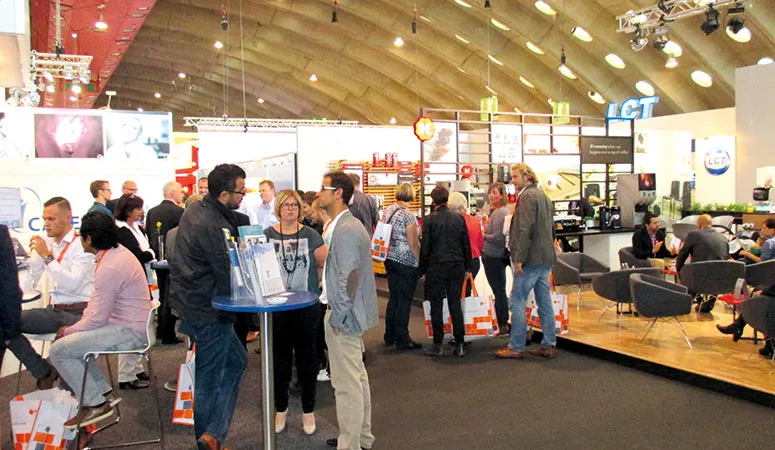
The future of elderly care in Flanders is one of the most complex questions facing government and the care sector over the coming years and decades. Expo 60+, the well-known trade fair for residential care professionals, held in Mechelen late last week, provided the perfect opportunity to explore the issue in greater depth. Fair organiser Probis brought together architect Jorden Goossenaerts (Conix-RDBM), VIPA policy adviser Christophe Cousaert and retired journalist Guy Tegenbosch for a headline debate.
How do you assess the current provision of residential care facilities in Flanders?
Jorden Goossenaerts: “A great deal has happened in the residential care home sector in recent years, but I still think there is a lack of new forms and concepts that combine different functions. We regularly see other community functions integrated into residential care homes, for example a brasserie open to the public or a neighbourhood café, but I think we should do even more of this in the future.”
Christophe Cousaert: “In any case, we are already much further along than ten to fifteen years ago, when there were essentially only nursing homes. Nevertheless, I think it is high time for a change of direction and a much stronger focus on community care and community centres. We also need to ask ourselves the fundamental question of how to design our buildings, infrastructure and public spaces so that people can continue living at home for as long as possible. Secondly, there needs to be greater variety in housing typologies. In this respect, Flanders is stuck in a ‘box-ticking mindset’. We have plenty of residential care homes and assisted living facilities, but that is where it ends. We must also put care on the agenda of other policy areas and pursue fruitful synergies with housing and spatial planning. One final point is that we need to broaden the spectrum of care: it is not just about people over 85, but also younger people who need care or support.”
There are frequent calls to break down the strict divisions between different people in need of support, abolish special units for people with disabilities or dementia, and create synergies with the wider community. How can we make this a reality?
Jorden Goossenaerts: “First of all, we need to take a very open approach to planning property in general and care infrastructure in particular. If we can devise a care operating model that also makes it possible to involve other target groups, we are already on the right track. We can use the need for care property to generate added value in other areas too. One of the buzzwords of recent years has been small-scale provision. In itself, that is a good principle, but to me it is always one element of a programme, never an end in itself. You can certainly integrate small-scale concepts into a large-scale whole, the two are not mutually exclusive. However, we need that larger scale to generate appeal. That is why I also advocate for elderly care in city and village centres.”
Christophe Cousaert: “A great deal of work is being done to integrate elderly care into the community, but for many people it is still a huge step to visit facilities open to the public on residential care sites, especially if they have no family living there. If the construction of residential care homes can be part of larger developments that also include housing, a community centre or a supermarket, that barrier is already much lower. I think there is definitely a future in that.”
Speaking of the future, how do you see residential care evolving over the next ten to twenty years?
Guy Tegenbosch: “The nursing homes we knew and the residential care homes we know today will be a thing of the past. They will be replaced by care centres where care is delivered within ordinary living spaces. Residential care homes will become the exception rather than the rule. The problem, however, is that it is currently difficult to combine different care and other functions because of the volume of regulations. The rules governing a cafeteria in a nursing home are completely different from those for a community centre. The quality of our care is good, but we still think too much in terms of institutions.”
Jorden Goossenaerts: “I think the future offers enormous opportunities. We have learned from the past and are moving away from monofunctional complexes towards flexible property structures that can accommodate functions other than care. Care is increasingly about housing. We all want to continue living at home for as long as possible, so we need to be able to access care efficiently wherever we live. That is why we need the courage to deliver large-scale developments. As I said earlier, this does not have to mean that they feel large-scale or cannot incorporate smaller-scale elements. Architects can provide the solution. But by thinking at scale, we can create places where we can meet needs that we do not yet know about, in our own communities.”
What should government do to improve the quality of care for older people? Do you have a practical tip for Minister Vandeurzen?
Jorden Goossenaerts: “Private ownership is an obstacle to flexibility and long-term property value. We should not abolish it, of course, but we should rethink it. If we could build developments in which, for example, we sell floors rather than flats or housing units, it would remain possible to reconfigure the floor at a later date.”
Christophe Cousaert: “Thanks to the sixth state reform and the opportunities Flanders has in the area of elderly care funding, we can make fundamental choices. And with the mixed-use options and alternative forms of housing now available, we can really give experimentation a chance. Minister Vandeurzen has already done so over the past four years through the care pilot projects, but I hope this was not a one-off. That way, we can continue testing innovative models and concepts within a regulatory sandbox.”
Guy Tegenbosch: “My advice has two parts. On the one hand, tackle loneliness, as it is one of the greatest threats to our overall wellbeing. On the other, create synergies with policies on spatial planning, housing and education. Why not include voluntary elderly care in school curricula? We need to break down these closed circuits and create added value by combining different aspects intelligently.”
Text: Tim Janssens
Question about this story? Ask your question
Keep following this
Get an email when a new story is published. No account needed.
- SubjectGeneral







