











End-of-life conversations in palliative care
Text and images Stichting PZNL
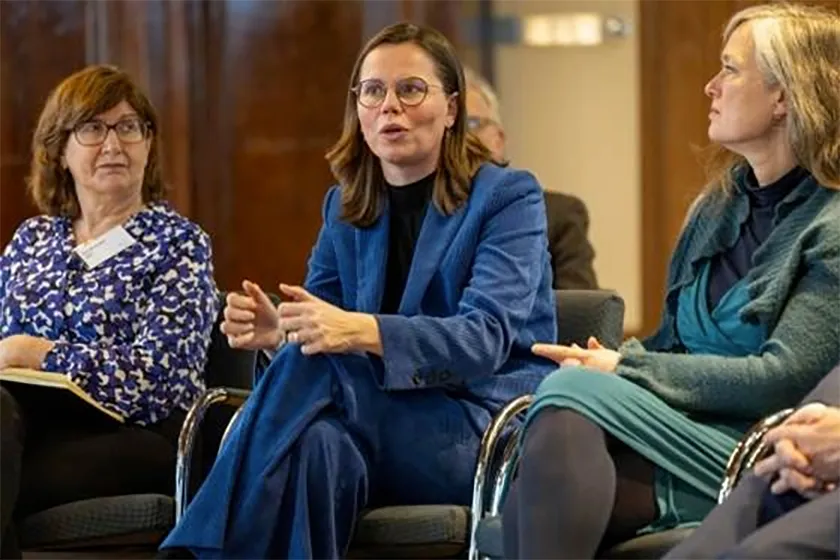
‘Patients themselves also have a responsibility in this’
“Of course, healthcare professionals can offer their patients the opportunity to think about the end of their life and the future, but people themselves also have a responsibility.” This was said by MP Mirjam Bikker (ChristenUnie) during a dialogue session with MPs on palliative care, recently held at Het Nutshuis in The Hague. Ria de Korte (NSC), Folkert Thiadens (PVV), Elke Slagt-Tichelman (GroenLinks-PvdA) and Harry Bevers (VVD) also took part.
Preventing crisis situations
The meeting, organised by the National Programme for Palliative Care II and various partners, brought together healthcare professionals, volunteers, patients, bereaved relatives and MPs to discuss opportunities and challenges in palliative care. So-called end-of-life conversations, in which healthcare professionals and their patients discuss treatment wishes and limits, are an important part of palliative care. These conversations enable healthcare professionals to provide appropriate care. When held consistently, they help healthcare professionals and patients prevent crisis situations.
Ria de Korte (NSC) also pointed out that citizens have a responsibility to make an appointment with their GP to discuss their wishes in good time, while there is still time. On the other hand, “a GP could offer this more often. But the same applies to the district nurse who visits patients at home. They are not there for nothing: they are there to provide care. Offering end-of-life conversations can be part of that care.”
‘Just a step too far’
PVV MP Folkert Thiadens was more cautious: “I think it goes a little too far to expect this of citizens. Of course it is important that they are actively involved in their own palliative care, but placing the onus on them to initiate end-of-life conversations is just a step too far for me.”
The role and value of volunteering, informal care and aftercare
The meeting began with an informative session in which GP Suzanne Pruijssers and Sven Zeilstra (Network Coordinator for Palliative Care Haaglanden) discussed the practice of palliative care. They used the fictional journey of a patient to provide concrete insight into care pathways and the obstacles patients and healthcare professionals encounter. In the subsequent interactive session, NPPZ ambassador Kasper Klaarenbeek, himself a patient in the palliative phase, led a dialogue on current propositions and areas for improvement in palliative care. As well as end-of-life conversations, the discussion covered the role and value of volunteering, informal care and aftercare. MP Elke Slagt-Tichelman (GroenLinks-PvdA) stressed the importance of good aftercare. In her view, it should be comparable to the care provided around childbirth. “After a birth, good aftercare is available. We take that for granted, and rightly so. Yet, like a birth, a death is a transition. After a death, aftercare should be just as much a matter of course.”
‘Big bad wolf’
The MPs also briefly discussed the recent controversy over possible care caps imposed by health insurers, which could sometimes prevent care providers from delivering adequate palliative care at home. MP Harry Bevers (VVD) was willing to accept that things did not always go well, but felt that insurers were making considerable efforts to ensure that care was funded as well as possible. “Health insurers are sometimes too easily cast as the big bad wolf.”
Question about this story? Ask your question
Keep following this
Get an email when a new story is published. No account needed.
- SubjectGeneral







