











Healthcare innovators connect at a fast-paced Health & Care Day
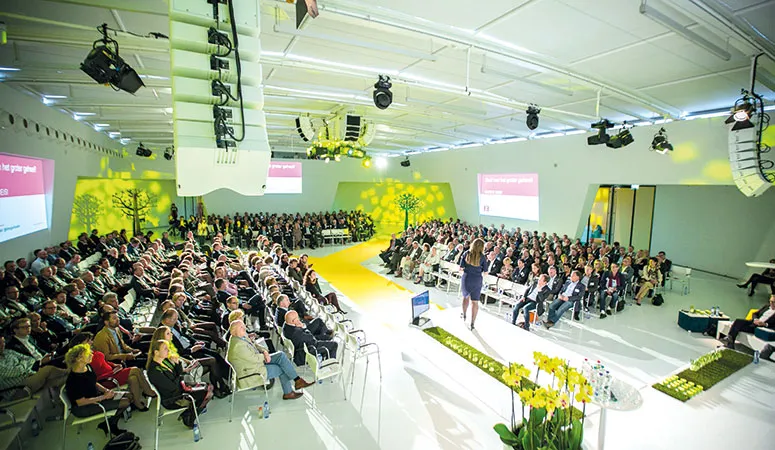
Healthcare conferences are rarely dull and long-winded, but few are as slick as Health & Care Day 2015. Speakers were introduced in DWDD style at Jaarbeurs Media Plaza, to rousing music and subdued lighting. The ‘inspiration event’ for healthcare executives and decision-makers, featuring both practice managers and digital innovators, also offered plenty of substance. The key message of Health & Care Day: change is positive. In short: ‘Shift Happens’.
Change management is part and parcel of healthcare: shrinking budgets call for more intensive use of staff, while self-managing teams are springing up everywhere. At the same time, the healthcare environment is rapidly going digital. Lucien Engelen, director of the REshape Center for Innovation at Radboudumc, gave an account of developments that was enough to make your head spin. An intelligent patch that takes ECG readings? The technology is there and patients are keen to try it, but healthcare professionals are the bottleneck when it comes to introducing innovations of this kind, Engelen said. And by the time Dutch whizz-kids develop something, Silicon Valley has already come up with something better. “In the San Francisco Bay Area, 38% of medical graduates are already going into digital healthcare.” For professional innovators, standing still naturally means going backwards. Engelen feels that progress on patient data is far too slow. He even speaks of a ‘privacy mafia’ in this context, while arguing that the changes in healthcare go well beyond fixing digital problems. “‘Solving’ must give way to ‘prevention’. Collecting patient data can make a major contribution to this. Patients, currently passive, will soon be in the driving seat themselves.”
‘Practice before plans’
Engelen takes a global view of healthcare in the Netherlands, which is already undergoing a massive transition. Jan Valkenborgh, director of Daelzicht in Maasgouw, Limburg, heads a care organisation for people with intellectual disabilities that faces the challenge of moving from ‘caring for’ to ‘caring with’. Rather than resorting to mantras such as the ‘participation society’, Daelzicht approaches the new healthcare landscape from a practical perspective. Staff learn as much as possible on the job, and activities also organised by community centres or sports clubs can be linked in. Practice comes before plans, says Valkenborgh, who worked his way through every level of care organisations as an employee. “We only write it down once it works.” The next step in the intensive morning programme, which lasted more than two hours and featured five speakers, was innovation in practice followed by reporting. Dominique Vijverberg of IVV, a collective of healthcare employers and employees, presented a benchmarking report based on input from 9,300 healthcare workers. The report shows that the relationship between employees and their managers is an important area for improvement.
Healthcare Manager of 2015
Anja Schouten of Zorgbalans is Healthcare Manager of 2015. She too is using organisational downsizing as an opportunity to improve services. “People thrive in communities,” says Schouten. “Care organisations are in the habit of telling clients: ‘Welcome to our system’, when what matters is quality of life. I believe in consistency: what you expect from staff as a manager, you must also provide.”
Zorgbalans, a large care organisation in and around Haarlem, must reduce its capacity from 1,500 to 1,000 places, mainly in poorer neighbourhoods. This offers opportunities to strengthen social cohesion, says Schouten. “If you downsize, you have to work together.” Supported-living apartments were made independent, based on the budget of older people whose only income is the state pension, a plan which Schouten says required convincing the housing association.
Zorgbalans is reducing its workforce by 25%, uses strategic workforce planning based on ‘employment guarantees’, trains people to prevent surplus staffing and believes in ‘spending locally’: both staff and products are sourced from the neighbourhood as much as possible. “Where you spend your money is where you belong. We are here for everyone; that builds a good reputation, which creates trust and stability. Make use of what is already there.”
‘Airbnb is moving into healthcare’
At the end of the morning, Yuri van Geest, a revolutionary from the ‘digital age’, was given the floor to share his thoughts on healthcare. “In the long term, hospitals will disappear,” says the ‘Dutch ambassador’ of Singularity University, whose main areas of focus are bio-, nano- and neurotechnology, artificial intelligence and robots. Everything is already digital; now healthcare must follow, potentially the biggest e-market of them all. Van Geest’s presentation did not fully answer the questions he raised about the disappearance of hospitals. However, he made it clear that “in the future, care will be everywhere; it will become decentralised and democratised.” If the Apple Watch can create your DNA profile, it can offer a personalised nutrition programme or even predict cancer. Airbnb is moving into healthcare, drawing on its acquisition of Lapka, which will use sensors to measure conditions in the home relating to safety, helping homes meet statutory requirements for care provision.
‘Ryanair of healthcare’
Does that still not go far enough? According to Van Geest, the digital revolution means that software will soon be able to make a better diagnosis than a doctor. “As a result of artificial intelligence, 80% of paid jobs in healthcare will disappear.” In the afternoon plenary session, private healthcare entrepreneur Loek Winter and DSW chair Chris Oomen each presented their familiar views. Winter, who owns Slotervaart Ziekenhuis among other things, argues for a focus on clinical services and growth in patient volumes. “I want to be the Ryanair of healthcare, get volume discounts and pass them on to the customer.” Oomen, who always stands up for his policyholders as the ‘biggest small insurer’, said: “I would rather see stronger links between primary and secondary care than bigger hospitals.” Motivational speaker Marc Herremans, who has been paralysed since 2002 and won the Ironman Triathlon in Hawaii, was given the final slot. It will come as no surprise that Herremans has always regarded adversity as a challenge, and still does. A fitting end to a fast-paced inspiration event.
Words: Jan-Kees Verschuure
Photos: Floris Heuer, Zorgnetwerk Nederland
Question about this story? Ask your question
Keep following this
Get an email when a new story is published. No account needed.
- SubjectGeneral







