











‘Improving the quality of prepared meals’
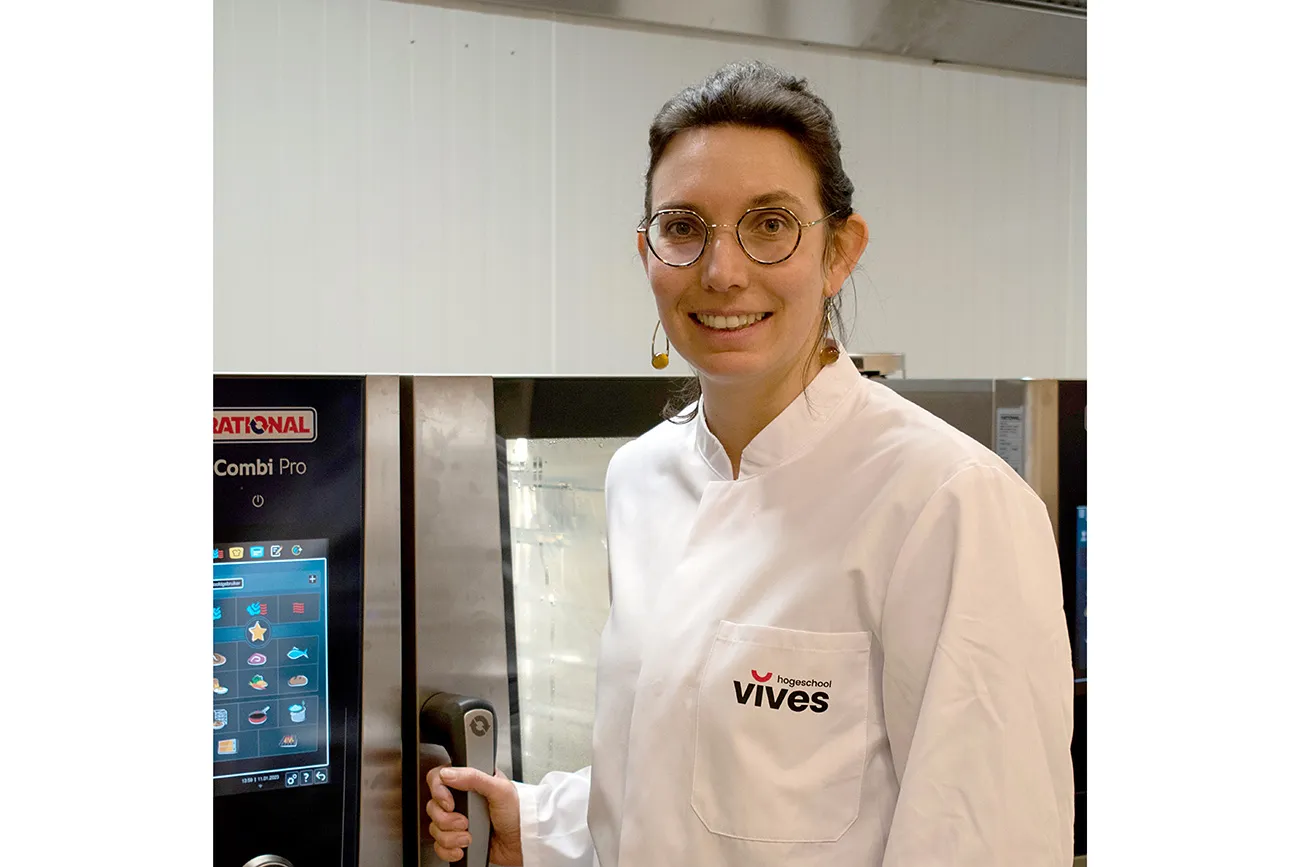
By 1 March, the Flemish university of applied sciences Vives will be moving its FoodLab into a brand-new building, the first on the Food Innovation Park in Roeselare. The lab includes the Food Research and Development Hall, a semi-industrial kitchen where research is carried out into the quality of meals and meal components. FoodLab Coordinator Lien Van den Broeck explains the opportunities this offers for the care sector.
Lien Van den Broeck (Vives FoodLab),
- Bachelor’s degree in Nutrition and Dietetics (Hogent, Ghent)
- Master’s degree in Nutrition and Health (Wageningen University & Research)
- Teacher training (CVO Kortrijk)
- Customer Service, Laboratorium Ecca (Merelbeke), 2011-2012
- Researcher, Expertise Centre for Agro- and Biotechnology (Vives, Roeselare, 2012-)
- FoodLab Coordinator (Vives, Roeselare, 2020-)
Care institutions serve large numbers of meals every day. Most are consumed at peak times. “Care organisations can choose to prepare these meals and keep them hot until serving, or to prepare them earlier, or have them prepared, then chill and reheat them. We can replicate these processes very closely. Among other things, we are looking for the ideal time and temperature combination for regeneration. This can vary depending on the type of food. In our laboratories, we investigate the impact of hot holding and reheating on meal quality. As well as the product’s physical characteristics, such as colour, texture and moisture content, we also assess its organoleptic properties, such as taste, smell and texture. In short, we look at how regeneration affects food quality. The scientific evidence can help care institutions choose between a hot and/or cold meal service.”
Sensory booths
“We use test subjects for this, among other things, in sensory booths (sensory labs). One of our ongoing studies is looking at how to prevent broccoli from becoming dull in appearance during regeneration. We are seeking the optimum combination of regeneration time and temperature. For example, the right pre-treatment can prevent chicken from drying out, even if it is kept hot for hours. We have also found that breaded products stay nicely crisp when they are kept hot without a cover.”
Each method of meal preparation comes with its own challenges, but all large-scale kitchens share the same ultimate goal: to provide tasty meals tailored to nutritional needs. “We can offer them advice based on our findings. We also give this advice to producers of pre-cooked and ready-to-eat food products. They can use it to decide whether to adapt their production processes.”
Sarcopenia
The FoodLab also includes a gym and various devices for measuring people’s body composition. “We use these in research into sarcopenia, the loss of muscle strength and muscle mass due to age or an underlying condition. Strength training combined with extra protein is the key to success.”
Future prospects
Older people need extra protein. “That is why we develop foods tailored to specific target groups. We investigate the effects of adding protein to food products on their nutritional value, appearance and aftertaste. We also focus on chewing and swallowing difficulties. To address these, we also try to modify the texture of food products, for example by thickening or finely grinding them.” Another project looks at using yacon tubers as a sugar substitute. “This opens up interesting prospects for people with diabetes.”
Vegetables from the sea
“Vives works with the various stakeholders in the sector. Alongside nutrition and health, sustainability is also an important theme. In this context, Vives is conducting research into new potential plant-based protein sources to replace proteins of animal origin. We are researching macroalgae, the so-called vegetables of the sea. They are already used to a limited extent in the food industry. In addition to their nutritional contribution, we are investigating, among other things, the extent to which their foaming properties can be used in food products.”
Question about this story? Ask your question
Keep following this
Get an email when a new story is published. No account needed.
- SubjectGeneral







