











Medical transport drone test flights get under way
Text and images Isala
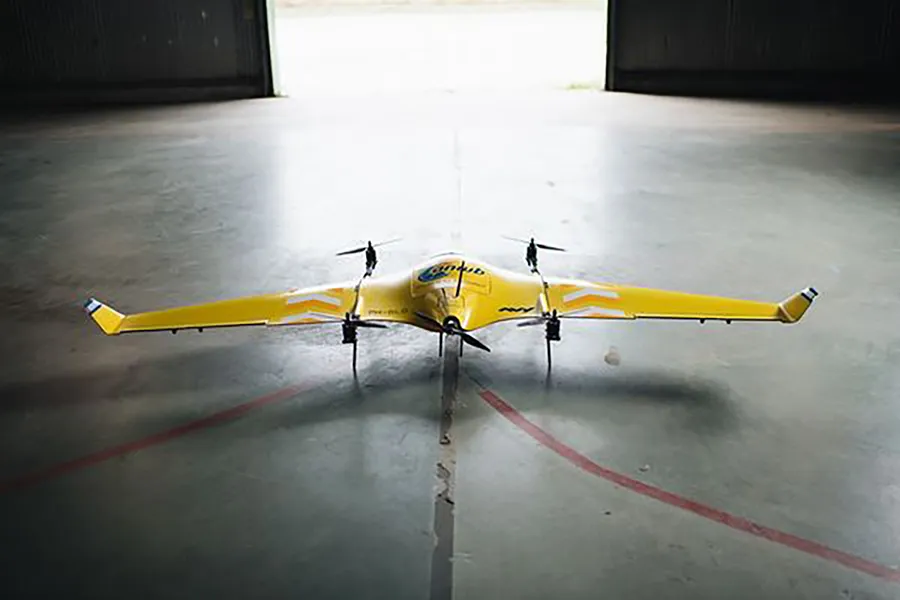
Test flights for urgent medical transport by drone between Isala hospital locations in Meppel and Zwolle will begin in the coming months. Drone transport can be faster, safer and cleaner than road transport, and is intended to help ensure the right care is provided in the right place. It will be the first time in the Netherlands that a medical drone flies a long distance over a sparsely populated area.
The development of drones for medical transport is gathering pace. Through the Medical Drone Service initiative, ANWB and PostNL, together with medical partners Erasmus MC, Isala, Sanquin and Certe, and technology partners Avy and KPN, are investigating the use of drones to transport urgent medical consignments, such as blood, medicines and diagnostic samples, to patients and healthcare locations. The speed of drone transport is intended to improve care and services for patients. Over the next three years, the partners will investigate how to operate flights safely and reliably.
Fast and efficient diagnostics
The use of medical drones supports Isala’s ambition to continuously improve care. After blood is taken in Meppel, a scheduled drone service can transport it quickly to the laboratory in Zwolle for testing. It may also be more efficient to centralise more complex or less common blood tests at a single location.
What will happen
Parts of the planned Meppel-Zwolle route will be tested until mid-2021. The Human Environment and Transport Inspectorate has granted exemptions for these test flights.
Flights will take place on weekdays only, near Isala’s Meppel location and towards Zwolle, with a landing in a field north of Zwolle. The drone will fly 15 km over sparsely populated agricultural land. The final part of the route to the hospital in Zwolle passes through a built-up area and will be carried out at a later stage.
No medical goods will be transported on these flights. Their main purpose is to gather important information to further develop this service for the medical sector. This will make it possible to establish a safe drone network in the future.
Safety
Safety is the top priority for the flights. The drone will not fly over houses or farms and is equipped with various systems to ensure safety on the ground and in the airspace. The drone flies autonomously, but each flight is monitored. Control of the drone can be taken over at any time. The airspace will be temporarily closed to other air traffic during test flights. Flights will not take place in bad weather.
Drone
The drone, specially developed by Avy, has a wingspan of 2.4 metres. It is remotely piloted by a pilot on the ground and flies using KPN’s mobile network. ANWB, which also operates trauma and ambulance helicopters, will carry out the flight operations. The drone takes off vertically and then continues its flight horizontally. It flies at an altitude of approximately 100 metres at a speed of 75 km/hour. A flight between Meppel and Zwolle takes 15 to 20 minutes. The drone is electrically powered and quiet.
The future
The partners are investigating how drones can be used for medical transport on a large scale. These test flights will be followed by an evaluation, and further consideration will be given to how hospitals and other healthcare institutions can take part. Earlier, extensive tests were carried out flying the drone over uninhabited areas.
More information
Question about this story? Ask your question
Keep following this
Get an email when a new story is published. No account needed.
- SubjectGeneral







