











New SAZ direction for accessible regional healthcare
The current healthcare system is under pressure. The 28 SAZ hospitals, united in the Samenwerkende Algemene Ziekenhuizen (SAZ), are setting out a strategic direction for the coming years. They are taking responsibility and ownership to keep high-quality regional healthcare accessible, make coordinated referrals where needed, and use people and resources sustainably.
“90% of hospital care in the Netherlands is broad-based medical specialist care,” says Bert Kleinlugtenbeld, chair of the Samenwerkende Algemene Ziekenhuizen. “Together with our regional partners, we promote prevention, health and wellbeing, and ensure our medical specialist care is aligned with these as closely as possible. This helps improve the wellbeing of local people. We provide care at the points in their lives when they need it, from birth through to the final stages of life. Our strength lies in our relationships, our personal approach and our connection with our regions. For this type of care, the integrated approach taken by regional hospitals is the best and most affordable option. In this way, we are giving concrete and substantial shape to the Integral Care Agreement and the Appropriate Care framework.”
The SAZ hospitals had already embarked on the shift now set out in the IZA: working with care and welfare partners in the region to redirect demand for care by improving local people’s health, providing care themselves where possible and appropriate, at home, digitally or closer to home, and referring patients for highly complex care where necessary, then welcoming them back with a “warm” handover. In this way, working in a network with general, STZ and academic hospitals, we can deliver the right care in the right place.
Mariska Shekary-Moonen is a member of the Executive Board of Curamare and was closely involved in developing the updated direction. “As an association of regional hospitals, we are joining forces to make a difference. The SAZ hospitals are pushing boundaries and forging connections, with the courage to move from being hospitals to becoming health organisations, working closely with GPs, (para)medical professionals, care organisations, VVT, the social domain, local authorities, education and businesses. This direction shows how we are discovering, innovating, facilitating and sharing knowledge together. That is precisely the strength of our SAZ hospitals, with due regard for the regional context.”
Networked care
“The regional hospital plays a crucial role in the wider network of care and welfare. It is not about the hospital itself, but about creating a network that promotes prevention and a healthy lifestyle, driven by a shared sense of urgency,” says Pauline Terwijn, CEO of Pantein, which is working with Mooi Maasvallei to build a healthy, thriving region. There are many other inspiring examples of SAZ hospitals already taking significant steps towards a network of integrated care and welfare.
“We can only do things differently if we look at things differently and think differently. This requires every stakeholder in healthcare. We can only solve the problems in healthcare, delivering twice as much care with the same number of people, if organisations work together more effectively. When people need care, it must be organised around the individual, in a network that spans sectors. We think in terms of the ‘journey through life’, not the ‘patient journey’.
Networked care will only take off if all parties make a substantive contribution. It also requires a different funding model. Transition has financial implications, and we must be willing to face them together,” says the SAZ. It also takes new leadership and the courage to develop the new form of governance required in a network.
The strength of the region
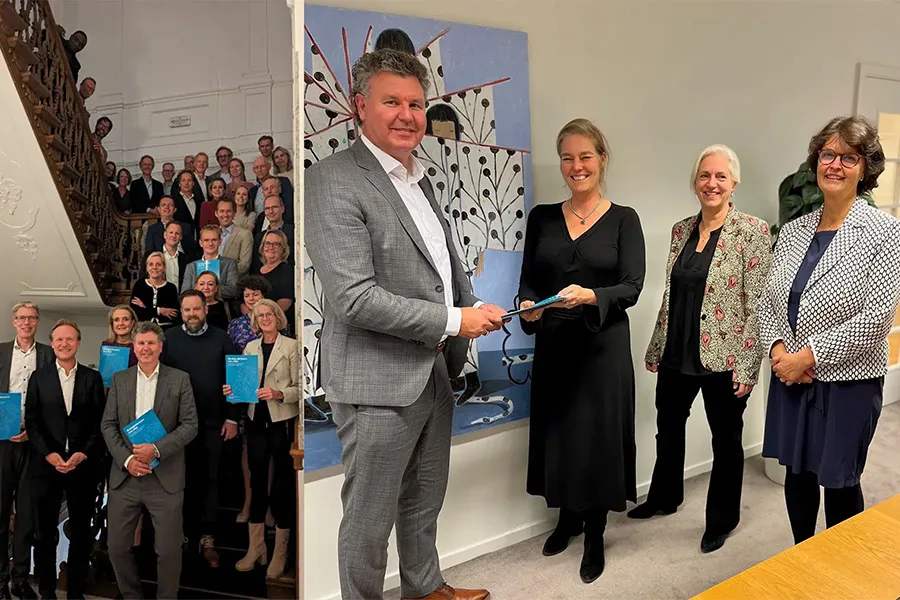
The strategic direction of the Samenwerkende Algemene Ziekenhuizen was presented to Barbara Goezinne, Director-General for Curative Care at VWS: “The fact that 28 regional hospitals are jointly taking up the challenge and pooling their strengths, looking at what is needed in their regions to drive the transformation, is entirely in line with the policy being pursued. The strength of the region and keeping broad-based medical specialist care accessible and close to local people are hugely valuable,” says Goezinne.
By and for healthcare
SAZ hospitals take an adaptive and innovative approach to ensuring the availability of care and making it fit for the future in their own regions. They work intensively in regional networks that span sectors, and jointly develop innovative products and services that benefit patient care. For example, they pool their knowledge and ambitions to develop scalable predictive models using suitable software and sufficient data, co-created with healthcare professionals: “by and for healthcare” at the Expertisecentrum Zorgalgoritmen. The SAZ previously used the same approach to launch BeterDichtbij, a national communications platform for healthcare that is now widely used by 50 care organisations (hospitals, VVT, rehabilitation and mental health services).
To find out more about the SAZ’s strategic journey and how its hospitals are putting it into practice, read the full strategy here, including a practical example from each hospital.
Question about this story? Ask your question
Keep following this
Get an email when a new story is published. No account needed.
- SubjectGeneral







