











Robot drills through real brain tissue for the first time
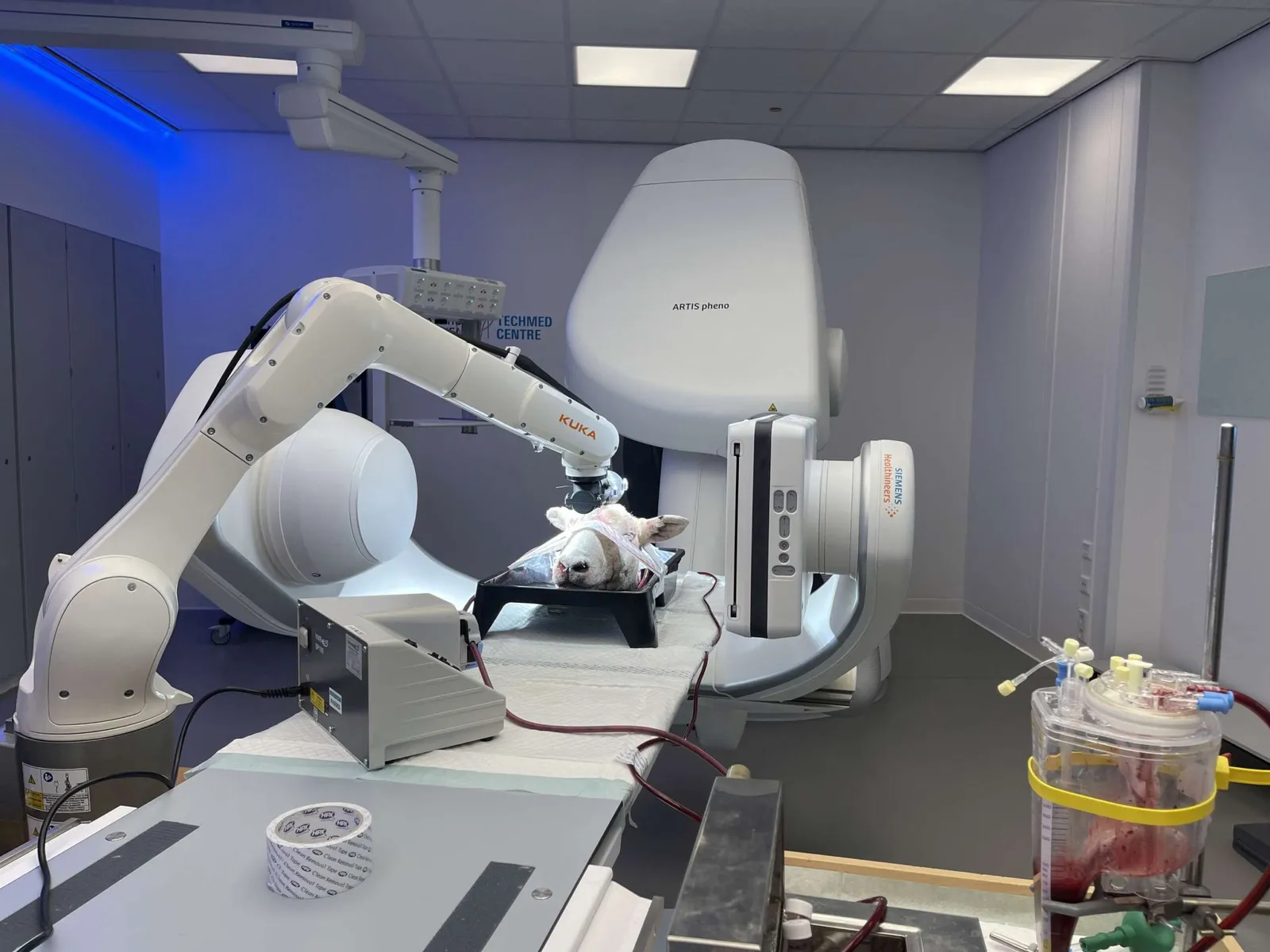
Researchers at the University of Twente and Radboudumc have guided a tiny, screw-shaped robot through real brain tissue using only a magnet outside the body. The test was conducted in sheep brains in the lab. The team developed a model that accurately predicts when the robot loses control: a step towards treating strokes and tumours deep in the brain without open surgery.
Deep-seated brain lesions, blood clots following a stroke, tumours and vascular abnormalities are often difficult to reach without opening the skull. The research team envisages an alternative route: a robot that travels through the bloodstream to the right location, drills through the blood vessel wall and then continues into the brain tissue to reach the lesion directly.
Predicting when the robot loses control
A magnet outside the body makes the robot spin, allowing it to drill forwards like a screw. The faster the magnet turns, the faster the robot moves, up to a certain point. Beyond that point, known as the step-out frequency, the robot can no longer keep pace. It slips, stops or moves unpredictably. The researchers can now predict when this will happen using a new model.
The researchers built their model using Buckingham Pi theory, a method that reduces a complex physics problem to a handful of dimensionless numbers. It combines the robot’s dimensions, the strength of the magnet and the stiffness of the tissue in a single formula. This tipping point depends on the stiffness of the surrounding tissue. In soft tissue, the robot kept pace with the magnet up to around 30 revolutions per second. In the stiffest tissue tested, this fell to less than one revolution per second.
“If you drive a magnetic robot too fast, you lose control of it with the magnet,” says Ewout Ligtenberg, first author of the study. “We can now predict exactly when that happens for each type of tissue, using just one measurement. That cuts out a lot of guesswork when designing robots for the brain.”
One measurement is all the model needs to predict the rest
Once the model has been calibrated with one measurement in tissue of known stiffness, it predicts how the same robot design will behave in any other tissue, without further testing. The team validated the model on four robot designs in gelatine, and then in real sheep brain tissue. In the absence of blood flow, the robot kept pace with the magnet up to around 1.8 revolutions per second. Once blood was pumped through the vessels, mimicking a living brain, that limit fell below 0.45 revolutions per second. The tissue was under pressure and offered greater resistance.
The robot drilled into the brain tissue at 0.2 millimetres per second. On the way back out, it followed its own channel at 2.9 millimetres per second: much faster, because it no longer had to drill a new path. Using cameras to monitor it in real time, the team also guided the same robot design towards specific targets in a soft gel model of the brain. In some cases, the robot reached these targets with an accuracy of less than one millimetre.
About the study
The study was conducted by UT researchers at the university’s TechMed Centre and MESA+ research institutes, in collaboration with Michiel Warlé’s team at Radboudumc. The robots’ biocompatible coating was developed with Enschede-based company LipoCoat B.V. International partners included the German University in Cairo, Triticum Medical and the Hebrew University of Jerusalem.
The researchers published their work, entitled ‘Performance estimation and ex vivo validation of untethered magnetic robot in soft tissue’, in the scientific journal Advanced Science. The work was funded by NWO’s Open Technology Programme, the Health~Holland PPS allowance, the Twente University Fund and the EFRO-OOST programme.
DOI: 10.1002/advs.77011
Question about this story? Ask your question
Keep following this
Get an email when a new story is published. No account needed.
- SubjectGeneral







