











Single-arm surgical robot opens up new possibilities for transoral surgery
Text and images UZ Leuven
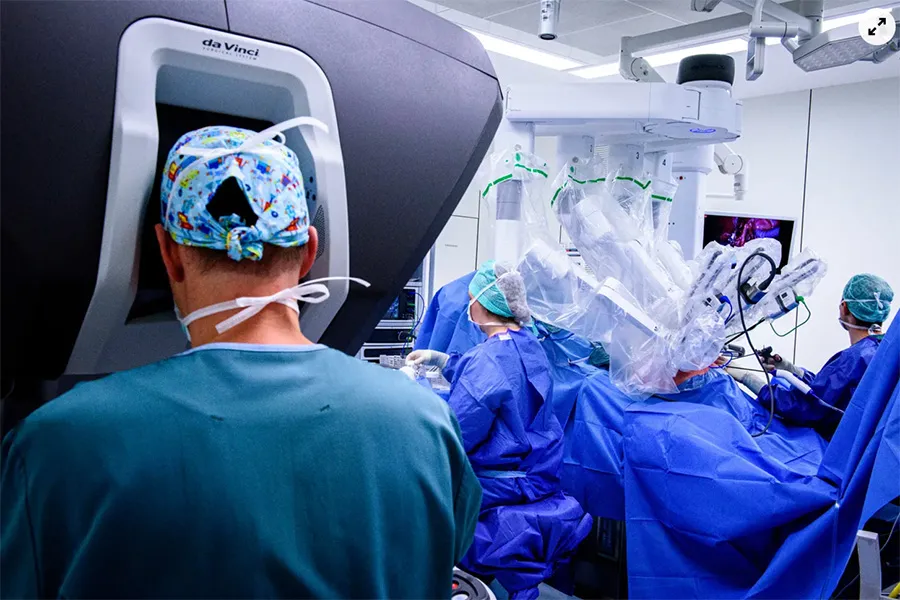
With an investment in 4 new surgical robots, including an innovative single-arm robot, UZ Leuven is fully embracing robotic surgery. As a university hospital and the largest training centre, UZ Leuven will extend the use of the latest robotic technologies to almost all surgical disciplines.
When robotic surgery began in 2007, UZ Leuven performed 200 procedures a year. In 2023, 1,200 robot-assisted operations were carried out in Leuven. Demand for robotic surgery is increasing, prompting the hospital to make a substantial investment in the latest technology. UZ Leuven has just acquired four additional surgical robots, including an innovative single-arm robot. With six robots in total, one of which is used at AZ Diest, almost all surgical departments at UZ Leuven will now be able to use robotic surgery. The new robots will be used in urology, ear, nose and throat, facial and head and neck surgery, gynaecology, abdominal surgery, cardiac surgery and thoracic surgery. The robot will also be used more frequently in plastic and reconstructive surgery.
As a university hospital, it is our responsibility to scientifically evaluate robotic technology and investigate which procedures can genuinely benefit from this new, but also expensive, technology
, Prof. Dr Wouter Everaerts
However, the university hospital also wants to offer a critical perspective. The high cost of robotic surgery, which can be €1,000 to €3,000 more than conventional surgery, calls for careful selection of the procedures that can and cannot be performed using a robot. Robotic surgery is not currently reimbursed, with the exception of prostate removal. The hospital bears the costs itself. Comparative studies into recovery time, likelihood of recovery and the cost-benefit ratio of robotic surgery versus conventional procedures are needed.
Complex procedures
Robotic surgery follows the same principles as keyhole surgery: instead of a large incision, the operation is performed through small incisions measuring 5 to 12 millimetres. In robotic surgery, the surgeon controls a robot from a console, enabling highly precise movements. The specialised camera also gives the surgeon a crystal-clear 3D view of the operating field.
For many conditions, robot-assisted surgery can offer benefits to patients. The robot enables many more complex procedures to be performed using keyhole surgery, resulting in less blood loss, shorter hospital stays and faster recovery. For example, after robotic prostate removal at UZ Leuven, patients can go home within 24 hours, whereas they used to spend 5 days in hospital. Patients undergoing coronary bypass surgery with robotic assistance spend less time in intensive care and experience less blood loss and fewer complications than with conventional surgery.
The most common robot-assisted procedure today is radical prostatectomy, which at UZ Leuven is performed almost exclusively with a robot. Other frequently performed robotic procedures include removal of kidney tumours, bladder removal, uterine surgery, abdominal wall surgery, bariatric surgery, removal of lung tumours, throat tumours and tumours in the pancreas, liver, stomach and intestines, as well as cardiac bypass surgery.
Innovative single-arm robot
One of the four new robots at UZ Leuven is the so-called single-port robot, or single-arm robot, which has only been available in Europe since January 2024. Conventional robots have four arms for operating and require four incisions. The single-port robot has one arm and can perform procedures through a single small incision, making it ideal for surgery through natural orifices such as the mouth or anus. In early November, UZ Leuven became the first hospital in Belgium to perform a transoral operation, through the mouth, using the single-arm robot to treat a tumour in the pharynx.
Prof. Dr Wouter Everaerts, urologist and chair of the robotic surgery working group at UZ Leuven: “We are pleased to be able to use the single-arm robot too. It could offer interesting possibilities for tumours in the pharynx or rectal tumours, where surgery can be performed through a natural orifice. In urology, we now also use this robot to remove prostate and kidney tumours, but it is not yet clear whether the single-arm robot offers patients any real advantages over the four-arm robot for these procedures. We want to try out these technological innovations and compare them scientifically. As a university hospital, it is our responsibility to scientifically evaluate robotic technology and investigate which procedures can genuinely benefit from this new, but also expensive, technology.”
Training centre
As a university teaching hospital, UZ Leuven will also train all future surgeons, including urologists and gynaecologists, to use the robot as part of their training. After initial theoretical sessions, trainee surgeons receive practical training. They learn how the robot works by practising on training models and virtual simulators before working with real patients. The four-arm robots at UZ Leuven have a control system for 2 people. This ensures the experienced surgeon retains 100 per cent control over the operation, while a trainee surgeon performs a small part of the procedure under supervision. Over time, the trainee learns to carry out more complex steps.
This gives trainee surgeons the opportunity to gain experience in a wide range of robotic procedures, including more complex conditions and multidisciplinary operations. Robotic prostate surgery is now standard practice in hospitals that have a robot, but UZ Leuven is a pioneer in using robots for cardiac surgery, plastic surgery and ear, nose and throat procedures. The robotic surgery centre works closely with engineers at KU Leuven, who have developed robotic applications for areas such as ophthalmology, gynaecology and ear, nose and throat disorders. As a result, civil engineering students also regularly observe procedures in the operating theatre.
Question about this story? Ask your question
Keep following this
Get an email when a new story is published. No account needed.
- SubjectGeneral







