











‘The bed is undervalued as a medical device’
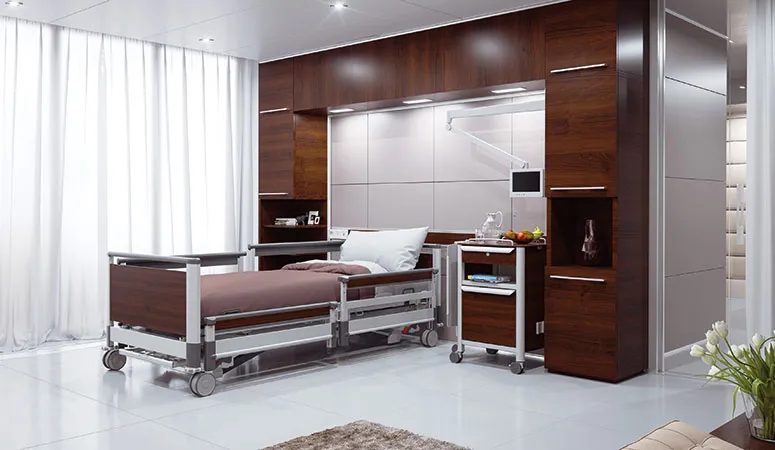
‘Good care cannot be delivered without good beds.’ It may seem obvious, but medical device manufacturer wissner-bosserhoff finds in practice that the capabilities of care and nursing beds are often underestimated. “‘A bed is a bed’, we hear, but medical beds have a huge impact on care. We see the bed as a medical device that has a positive effect on the care process, for both patients and staff. That is why we invest in training for users through our ‘Academy’,” says Erkan Sahin, Managing Director Benelux.
“And we do not invest only for our customers,” Sahin continues. “We genuinely believe in this vision. As a developer of the highest-quality beds, such as laterally tilting nursing beds and beds incorporating data technology, we see the positive impact on patients and staff in everyday practice. It is no coincidence that our products are developed in collaboration with the customer. And now that the role of data technology in care is growing all the time, it is essential that users are properly prepared, so that the functionality of medical beds is used to the full. That is why we have set up an ‘Academy’, as an added value offered by our company. We are keen to share our know-how with the market and show that investing in quality pays off.”
‘Data insights must deliver value’
The bed, perhaps the place where clients in institutional care spend most of their time, is a medical device for wissner-bosserhoff that improves the healing process and can take over care tasks from staff. Sahin is therefore 100% convinced that high-tech nursing beds have a bright future. “Deriving data from medical devices is a major trend. Remote monitoring is an important issue in this regard. ‘Is the patient still in bed? Has the client got out of bed independently or fallen out? What are their heart rate and breathing?’ Our in-house digital systems answer these questions and can even be installed in competitors’ beds. Our tilting beds can be operated by one person and are also programmable, which can bring significant benefits to the nursing process, for example for comatose patients.”
The market is asking for systems like these, Sahin says. But their technical capabilities must be used to the full. “The care and nursing beds we produce can yield so much data that customers should not have to put in extra working hours to process it all. And if they use the data, it must deliver functional value. We are keen to work with customers to optimise that value. This is another reason why we are going to provide product training. Quite simply, because we believe in the impact of the bed on care. These days, clients who spend a long time in hospital or a nursing home often cannot do much for themselves. It is therefore essential to make the most of the bed, to ease the burden on both clients and staff.”
‘Functional and beautiful’
Originally German, wissner-bosserhoff has R&D in its DNA, says Sahin. “We are the only supplier to manage the entire development process in-house, from start to finish. We focus on care and nursing beds, supporting products such as mattresses, and improving overall quality. That is what we do well.” The quality of the products may be universal, but sales vary considerably between European countries, according to Sahin. “In the Netherlands, investment decisions are approached thoroughly; the acquisition process looks 15 years ahead. In the countries around us, you sometimes see several parties involved in supplying medical beds, which does not benefit the overall quality of care. In that respect, the Netherlands is also a model country for wissner-bosserhoff.”
One aspect of the quality development wissner-bosserhoff is pursuing is the appearance of the care environment. The rise of care hotels is an important factor, says Sahin. “In those cases, the care environment is increasingly given the look and feel of a hotel. People sometimes think that care and nursing beds have to look ‘medical’ by definition, otherwise they will not be good enough. But we can dispel that misconception,” says Sahin. “Our beds are not only functional, they are also beautiful. We think that is only logical, because the bed is often the first thing you see in a care environment.” However, wissner-bosserhoff sees the bed first and foremost as a medical device. “We always approach things from a care perspective, and that is how we will shape our future product training too. It is no coincidence that we have hired an occupational therapist to lead these training sessions. This professional has previously helped develop a car seat for Volvo. I cannot say it often enough: we want to share our know-how with as many users as possible, so that the impact of the bed on the care process is never underestimated again.”
Question about this story? Ask your question
Keep following this
Get an email when a new story is published. No account needed.
- ThemeInteriors for housing and care
- SubjectGeneral







