











Vastgoedcongres review, Nieuwegein | ‘Silver tsunami calls for more nursing capacity, new housing models and prevention’
A smart care organisation plans for the future, ideally with several decades in mind. But what exactly will the combination of an ageing population, people living at home for longer and technological advances mean for housing and care needs around 2040? The challenges are many and varied. ‘Living at home for longer does not necessarily mean ageing healthily’ was one of the messages at Zorgvisie’s latest property conference in Nieuwegein.
Interaction with conference participants, a mixed group of healthcare managers, advisers and even GPs, is highly valued by Zorgvisie. At Green Village Nieuwegein, the audience was regularly polled on 24 October using provocative statements. For example, three-quarters of respondents to one such real-time poll felt that the old-style residential care home should be revived. But that will not happen, says speaker Cees van Boven, CEO of the Netherlands’ largest operator of senior housing (Woonzorg Nederland). “A silver tsunami is coming. That calls for a three-pronged approach: more nursing capacity, new intermediate housing models and preventive measures.” Under Drees, housing became a right rather than a privilege, meaning that even widowers who could not yet fry an egg could secure a place in a residential care home. That category has now disappeared altogether, “but the number of falls among older people living at home is rising, with 265 a day at A&E.”
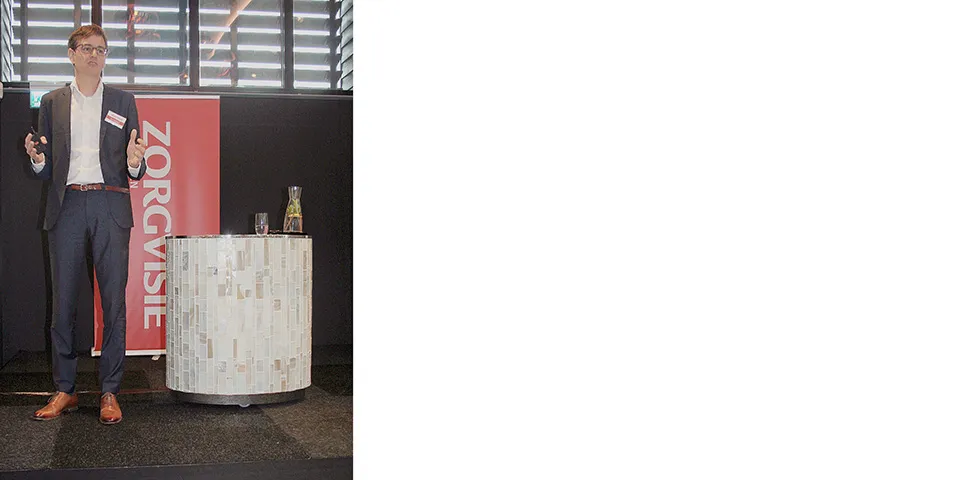
Financial adviser Pim Diepstraten.
Standardisation
Van Boven notes that none of the conference participants represents the traditional housing association sector. Is that surprising? He believes housing associations are not interested in healthcare property. “Healthcare property is a specialist field, with higher investment costs.” So what is the answer to the investment challenge? “Standardisation. Foreign investors are interested, but find the Dutch market too fragmented. We should not want a ‘bespoke solution’ everywhere.” At the same time, the days of Drees are over. Older people are old for longer and more self-assured. According to Van Boven, that calls for new intermediate housing models, such as Stadsveteraan in Amsterdam, a kind of student house for older people. Or Woonzorg Nederland’s own Zelfstandig Plus concept, offering 24-hour care for around € 100 in service charges. “We are also seeing the emergence of co-housing groups based on lifestyle. At regional level, we are coming together to discuss care for the neighbourhood, because there is a need for a new understanding of care and society. We envisage a caring neighbourhood, with multifunctional buildings, local entrepreneurs, opportunities to exercise and meet others, and development partnerships between housing associations and private-sector parties. To make that happen, we need ‘coalitions of the willing’.”
Who is the investor?
Investment in healthcare property grew over the past year to just under € 1 billion. “That is still only a fraction of the € 25 billion invested by housing associations,” says Pim Diepstraten, director of healthcare and senior adviser at Finance Ideas. Who are these investors? “Investors see healthcare property as a safe investment, unaffected by economic cycles. ESG investing is on the rise. Investment funds are often backed by social organisations. It is no coincidence that the pension fund for GPs has invested in healthcare property.” However, the audience’s reasons for engaging with an investor are mainly negative. ‘Strategic property is not our core business’ and ‘the banks won’t lend’ were the most popular arguments in a follow-up poll. “Banks are willing, but interest rates are too low,” says Diepstraten. “Returns are too low. And, of course, an organisation must be able to demonstrate sound financial ratios.” The practical problem is that 20- and 25-year leases offer too little flexibility. “Property standardisation, often something investors want, is held back by organisations that insist on their own programmes of requirements.”
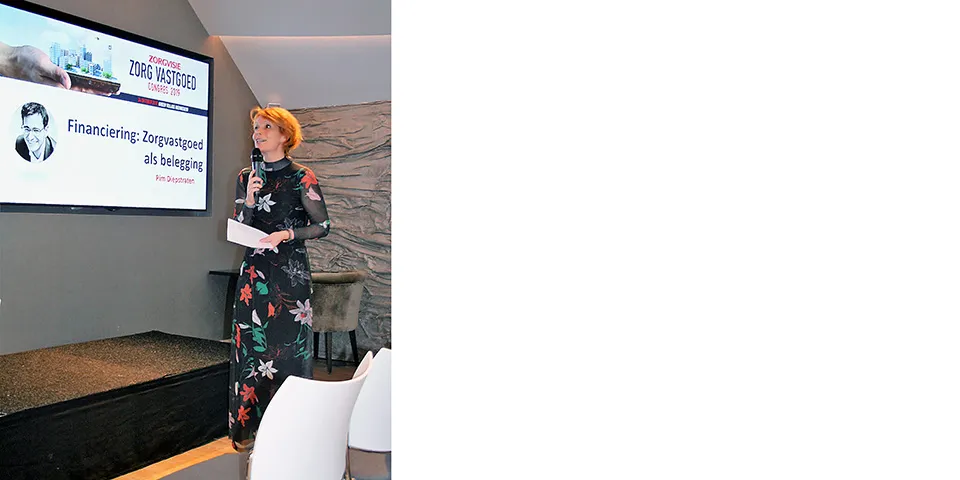
Conference chair Elisabeth van den Hoogen.
Healthcare architecture
We are becoming ‘greyer, greener and smarter’, says Masi Mohammadi, professor of Architecture in Health at HAN University of Applied Sciences, who believes in ‘responsive and empathetic healthcare property’. “A living environment tailored to older people who use technology. Around them, not enclosing them. Designers are society’s doctors.” The digital society is driving paradigm shifts. Technology is already in our heads and will eventually be in our bodies too, with smart pacemakers that regulate blood circulation and augmented reality glasses for people with impaired vision. “Technology has a major impact on property development, especially as software increasingly ‘eats’ hardware. ‘Technology is like oxygen’ is a Philips slogan. If we use technology incorrectly, that is our fault, not technology’s. But this is not about technology, bricks or money: it is about living,” says Mohammadi. But what does an empathetic living environment look like? “Perhaps we will live in a robot one day. Honestly, we will make it happen,” says the optimistic scientist. “Housing is becoming less static, with more diversity. Building only tiny houses is not enough.” Menno Hinkema, who researches lifetime homes at TNO, expressed a similar view at the end of the day.
Round-table discussions
The round-table discussions returned to many of the same themes: there is a divide between home care and nursing care, and it is growing. “But living at home does not always mean you are better off. Living at home for longer does not necessarily mean ageing healthily,” said the GP at the table. “On the other hand, admission to a nursing home cannot solve loneliness either,” said a healthcare manager. “In fact, healthcare property does not exist when it comes to housing. 93 per cent of older people live and die at home.” The adviser, who facilitates development processes, agreed with the healthcare manager. “Individual initiatives are fragmenting provision, so in the long term there will no longer be any real healthcare property.” Another table discussed solutions. “A cross-sector national Delta Plan for housing older people needs to be drawn up, with politicians kept out of it.” But who will take the lead? “Care providers are intrinsically motivated to take on that role. The client cannot, and neither can building owners.” Bob Janse of senior housing association Laurens Wonen concluded by talking about ‘Samen & Anders’. Residents of a former Rotterdam care home, redeveloped as an apartment complex, pay low rent on the condition that they contribute at least 10 hours a month to one another, the building or the nursing home’s residents. With a local, integrated approach based on new intermediate housing models, we are back where Cees van Boven began.
Question about this story? Ask your question
Companies in this story
Keep following this
Get an email when a new story is published. No account needed.
- SubjectGeneral
- CompanyWoonzorg Nederland







