‘Making intensive care units smarter and quieter’
Text and images Dräger
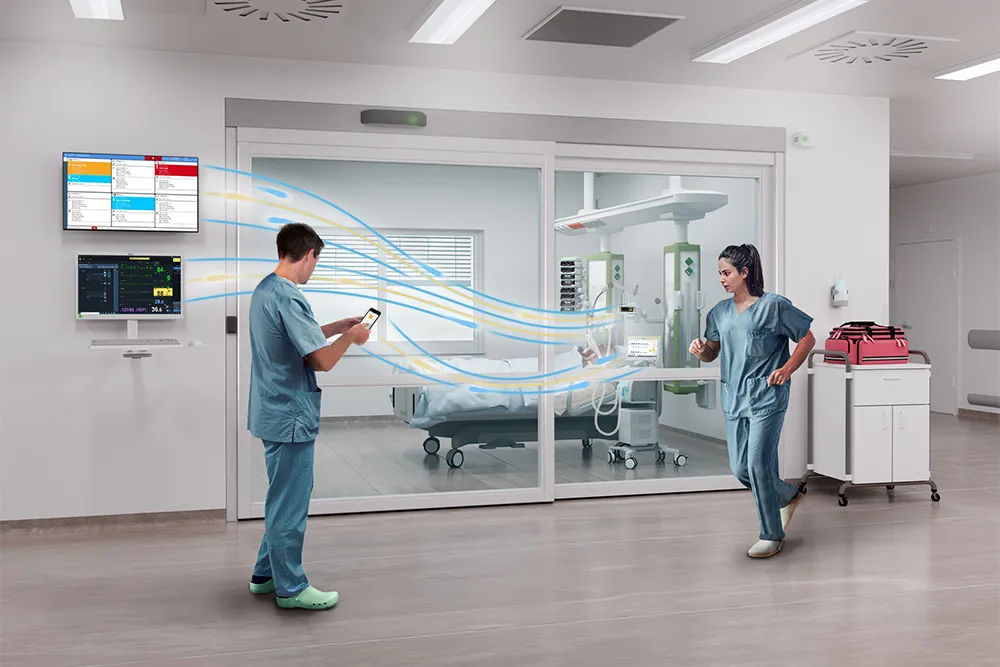
With the ‘Smart and Silent ICU’ research project, international medical and safety technology supplier Dräger aims to reduce the burden on staff and patients in intensive care by making alarms quieter and reducing unnecessary alarms.
Dräger and its technology partners have received funding from the Innovative Health Initiative (IHI). Half of the required €18 million is being funded by the EU’s Horizon Europe research and innovation programme. The research is being conducted at participating university hospitals in the Netherlands, Austria and Spain.
Preventing stress and alarm fatigue
The many alarms in intensive care units cause stress and alarm fatigue among both staff and patients. This can negatively affect the health of intensive care patients, resulting in longer hospital stays. ‘Smart and Silent ICU’ aims to reduce this burden for patients and staff alike. Another focus is to improve the prediction of changes in the condition of intensive care patients. To this end, AI applications that can recognise patterns will be used. The research will establish the extent to which clinical staff can identify relevant changes earlier, and how AI can support them in making therapeutic decisions.
Confirmation
The research project will run for three years and comprises four studies. Participants include Ascom, a supplier of mobile workflow solutions, BetterCare, a manufacturer of clinical data management solutions, five medical research institutions in Europe and Dräger itself. “We are delighted to have received funding from the IHI and see it as confirmation of the need for data-driven therapy support in acute care. This will make groundbreaking applications for clinical practice possible, such as AI-based clinical decision support,” says Michael Wilkening, Strategy and Business Development for Medical Technology at Dräger. Two application studies in the Netherlands are focused on reducing unnecessary alarms in intensive care units. A study at Erasmus Medisch Centrum in Rotterdam is investigating the impact on the healing process of muting alarm sounds around the bed and distributing them safely. This gives patients a calmer environment.
At Universitair Medisch Centrum Utrecht, nurses and intensive care doctors are studying the use of algorithms to assess clinical alarms based on clinical patient data. This is being carried out as a simulated study. The new rules will make it easier to identify unnecessary alarms and, where necessary, suppress them in the future.
Potential of AI applications
Two other research projects in Austria and Spain are exploring the potential of AI applications. A research group at the Medical University of Vienna is developing and validating functional algorithms that can analyse the condition of intensive care patients in real time, to detect changes in PICS indicators (Post Intensive Care Syndrome) at an early stage. This prediction tool gives doctors information in good time to guide treatment. At Hospital Clínic Barcelona and Universitat Politècnica de Catalunya in Barcelona, the focus is on analysing heart-lung interaction. This collaborative project is developing and clinically validating algorithms to detect and display negative changes in health and certain syndromes at an early stage.
A business enquiry for Dräger? Get in touch
Companies in this story
Keep following this
Get an email when a new story is published. No account needed.
- SubjectInteriors
- CompanyDräger