Smart Homes, Intelligent Buildings, Bits, Bricks & Behaviour: technology = sustainability
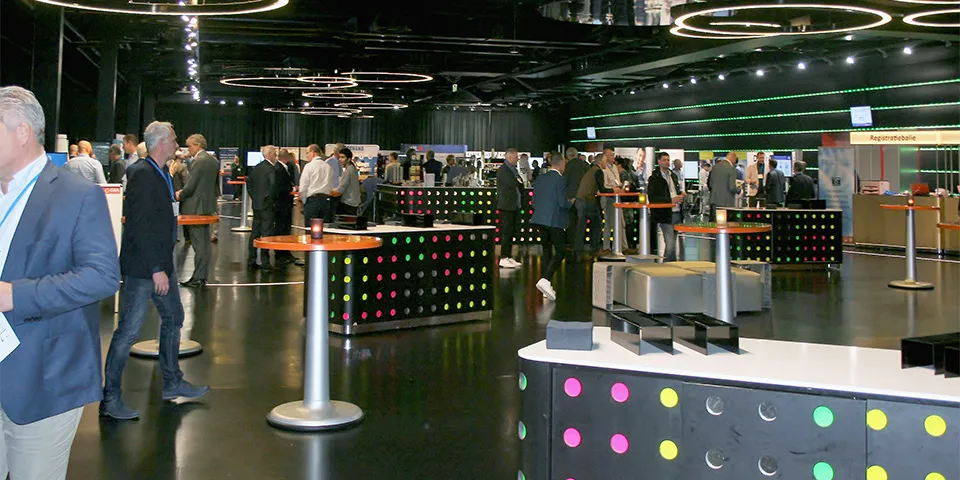
The digital society and the concept of connectivity are changing how buildings are used. Innovations such as the Internet of Things (IoT) should lead to real estate that serves people, rather than the other way around. That was the message at the Smart Homes & Intelligent Buildings/Bits, Bricks & Behaviour conference at Jaarbeurs Utrecht. And optimising building use is sustainable. “There is enormous potential for progress, particularly in non-residential construction and especially in public-sector real estate. Think schools, hospitals and care institutions,” said speaker Diederik Samsom.
In a passionate presentation in Utrecht on 5 November, former MP Samsom, a nuclear physicist by training and chair of the Climate Agreement’s Built Environment sector platform, displayed his characteristic optimism and faith in progress. But there are also caveats. What do all those open systems in smart buildings mean for our security and privacy? KNX is a communications protocol for building automation that can be used to link installations and devices. These include lighting and heating, security and ventilation, as well as audio and video, smart energy meters and even washing machines. Cybersecurity must always come first in building design, says Joost Demarest of KNX Association. “Hacking can start with cables left lying around or an easily accessible connection point in a suspended ceiling.”
Consultant Gerard Jansen of engineering firm RoyalHaskoningDHV spoke about the technological integration of sustainability objectives and advocates an integrated, conceptual approach, using the legal framework as its basis. “Start with energy saving, for example through LED lighting, control systems or heat recovery. Step 2 is choosing the form of energy generation. Take an integrated approach based on natural replacement cycles, with the aim of reducing demand. Do so cost-effectively, while maintaining comfort.” RoyalHaskoningDHV calls this step-by-step plan the Fastlane method. “A fast-track process that can, for example, be included as an update to the multi-year maintenance plan.”
Optimising floor space
Mark Mobach is Professor of Facility Management at Hanze University of Applied Sciences and conducts research into evidence-based design and the healing environment, together with institutions including the universities of technology, Radboud MC and the University of Groningen. “Always with a client from the field.” What has emerged? There is still enormous scope to optimise building use. “The concept of a healing environment could also provide valuable input for the future of open-plan offices,” and “end users have little knowledge of the condition of their building’s various components, including the building envelope, installations and internal walls.”
Jan-Willem de Beaufort on VodafoneZiggo’s Smart Office.
Gilles Ghyssaert of Spacewell, which provides software for design, development and maintenance, compares the construction sector with the automotive industry and notes that productivity growth is too low. “Buildings often underperform in terms of space efficiency, comfort and energy consumption. Building management accounts for 80% of total construction-related costs, and many of these costs are determined during the design phase.” The greatest gains can be made in the use of floor space, says Ghyssaert. “We analyse building use by the hour for clients, using sensor technology among other things.” This can quickly lead to a 25% improvement in workspace utilisation. “We approach technical design based on these kinds of usage specifications.”
Smart Office
At the end of 2018, VodafoneZiggo moved into a new head office in Hoog Catharijne, on the station square at Utrecht Central Station. This 15,000 m² office, which accommodates around 1,600 employees, was designed as a Smart Office from the outset, says Jan-Willem de Beaufort of VodafoneZiggo. “Watching Max Verstappen race is fun, but our core aim is to shape the digital society together with business customers and consumers.” Connecting people and spaces, along with VodafoneZiggo’s clear vision for the Internet of Things (IoT), supports users of the new head office. During the extensive refurbishment, the building was equipped with an integrated ‘IoT ecosystem’. The aim is to support efficient building management and ‘smarter working’ for Vodafone employees. “Using 1 universal app.” Around 1,000 sensors have been installed in the building for presence detection, lighting, sound and occupancy management. “All components need to communicate and work together seamlessly to achieve the set objectives,” says De Beaufort. “We have full ownership of all the data generated. Everyone now books a workspace via the app.
Adoption has been immediate, an important prerequisite for introducing a concept like this.”
‘A computer with a roof’
Derk Bots is CEO of Signify (formerly Philips Lighting). Together with end user Deloitte and developer OVG, his company is responsible for the concept behind Deloitte’s head office on the Zuidas, The Edge, which opened in 2015. One feature is a reduction in lighting power from 11 to 5 watts per square metre, made possible by LED lighting. “Sensors log usage to help achieve further savings.”
The Edge is ‘a computer with a roof on it’, according to the child of one of the employees in a promotional video. Optimising building use is still in its infancy, and Signify has the data. Bots: “Ask end users what they value in a building and comfort and privacy score lowest. Employees spend an average of 15 minutes looking for a workspace, and energy savings of 80% are possible on the climate control of rooms.”
Bots presented a newly developed sensor that monitors the operation of LED lighting for maintenance purposes, controls daylight, detects humidity and occupancy levels, and records temperature and noise levels. This multi-sensor will be integrated with Interact, “our IoT platform with energy and control dashboards for facility managers.” What’s next?
Li-Fi: LEDs that can transmit data in the same way as Wi-Fi does now, but at a much higher frequency. Watch this space.
Question about this story? Ask your question
Keep following this
Get an email when a new story is published. No account needed.
- SubjectInteriors