











Flemish Minister for Welfare Wouter Beke
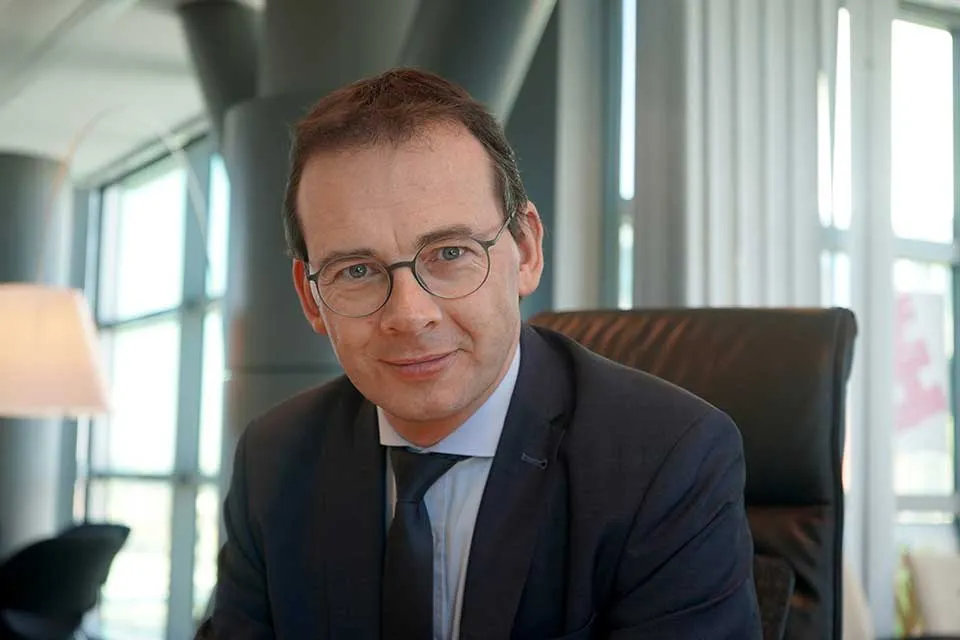
‘We are aiming for a robust core service in Flemish hospitals’.
Wouter Beke (46)
Master’s degree in political and social sciences, PhD in social sciences, KU Leuven Senator (2004-2014),
Mayor of Leopoldsburg (2013-present), Member of Parliament (2014-2019),
Federal Minister for Employment and the Economy (2019), Flemish Minister for Welfare, Public Health and Family (2019-present)
“To be selected, project applications had to meet clear criteria. They must be essential not only from the point of view of patient or fire safety, but also future-proof and contribute to better planning of healthcare provision. Flanders wants to reshape its healthcare landscape so that straightforward care close to people is also accessible close to home. Other conditions require specialist care, which depends on economies of scale and bringing expertise together.”
The total allocation of 30 million euros is divided into 3 sub-allocations: psychiatric hospitals, rehabilitation hospitals, and general and university hospitals. “All the selected hospitals will still need to demonstrate that they qualify for a specific amount.”
Over the next 30 years, the Flemish Government will invest an additional average of 30 million euros a year in infrastructure at various general hospitals, psychiatric hospitals and rehabilitation hospitals. “To do this, we selected applications submitted to the Flemish Infrastructure Fund for Personal Matters (Vipa) in recent years,” says Flemish Minister for Welfare Wouter Beke (CD&V). “The operators of the hospitals concerned will receive a strategic lump sum for their project, provided it is an urgent case. The projects must also fit within the regional healthcare strategic planning framework currently being rolled out by the Flemish Government.”
Psychiatric hospitals
Flanders is allocating 7 million euros each time to psychiatric hospitals. “The coronavirus crisis has once again highlighted the importance of mental wellbeing. Where infrastructure is outdated, catch-up investment is needed.” Beke is determined to make that happen. “Applications for a strategic lump sum will be assessed against a range of criteria. How outdated is the infrastructure? To what extent is the safety of patients and staff at risk? And is it possible to develop high-intensity care?”
Rehabilitation hospitals
A total of 5.5 million euros has been earmarked for rehabilitation hospitals. “During the coronavirus crisis, rehabilitation hospitals were used as a buffer. This brought the problem of sometimes severely outdated infrastructure, unsuitable for cohorting, for example, back to the surface. To qualify for subsidies, hospitals will have to demonstrate that their infrastructure is genuinely in a precarious condition.” Based on Vipa’s assessment, a budget of 5.5 million euros should make it possible to support the most critical projects at rehabilitation hospitals. Specifically, these are MSNC Melsbroek, BZIO Oostende, RMSC Pelt and Inkendael Vlezenbeek.
General hospitals
Flanders is also setting aside 17.5 million euros for general hospitals. “Vipa will screen the selected applications.
Only applications that meet the requirements will ultimately qualify for a strategic lump sum,” says Beke. “Projects must be urgent and must never conflict with the objectives of network formation and healthcare strategic planning. For Flemish hospitals, I am aiming for a robust core service, a concentration of expertise for complex pathologies and rationalisation of high-tech healthcare provision.”
The Flemish Government has selected the following hospitals to complete their applications: AZ Vilvoorde (Vilvoorde), ZNA-campus Jan Palfijn (Antwerpen), GZA-campus Sint-Augustinus (Antwerpen), AZ Diest (Diest), AZ Sint-Rembert (Torhout), Sint-Franciscus (Heusden-Zolder), AZ Sint-Jan Brugge-Oostende (Brugge), AZ Lokeren (Lokeren), Maria Ziekenhuis (Pelt), ASZ Aalst (Aalst), AZ Sint-Lucas Gent (Gent), Sint-Dimpna (Geel), AZ Glorieux (Ronse) and AZ Groeninge (Kortrijk). “In Flanders, demand for care has changed dramatically as a result of an ageing population and an increase in the number of people with chronic conditions and comorbidities. Hospitals need to adapt, and the Flemish Government will support them in doing so. This will enable us to continue developing Flanders’ healthcare landscape in the right way.”
OverKop houses
An OverKop house is a place where young people and young adults can spend time in a relaxed atmosphere, making it easier to talk about problems and, where needed, access low-threshold support. “Young people are growing up in an increasingly complex society and feel that they are often under pressure. The impact of the coronavirus measures on young people has brought this into even sharper focus,” Beke stresses. Over the coming months, 25 new OverKop houses will open in Flanders and Brussels, in addition to the 5 already in operation. “OverKop sits at the crossroads of education, youth work, mental health services, youth care, welfare services and local authorities. This means moving away from silo thinking and firmly opting for a cross-sectoral approach. Partners can decide for themselves how they contribute to each OverKop house. Thanks in part to a strong commitment from local authorities, we are managing to open more than one OverKop house in over half of the 16 operating areas. That brings the total to 30 OverKop houses opening in 2021. A further 3 will be added in 2022 and 2023.”
The OverKop houses are set up under the auspices of the Flemish Agency for Growing Up. “We are establishing 16 regional OverKop initiatives in Flanders and Brussels. Each will receive a subsidy of 100,000 euros per year for the next 3 years. If their evaluation is positive, the initiatives can count on sustainable funding from 2024.”
Question about this story? Ask your question
Keep following this
Get an email when a new story is published. No account needed.
- SubjectGeneral







