











Radboudumc ready for the future of healthcare with new building
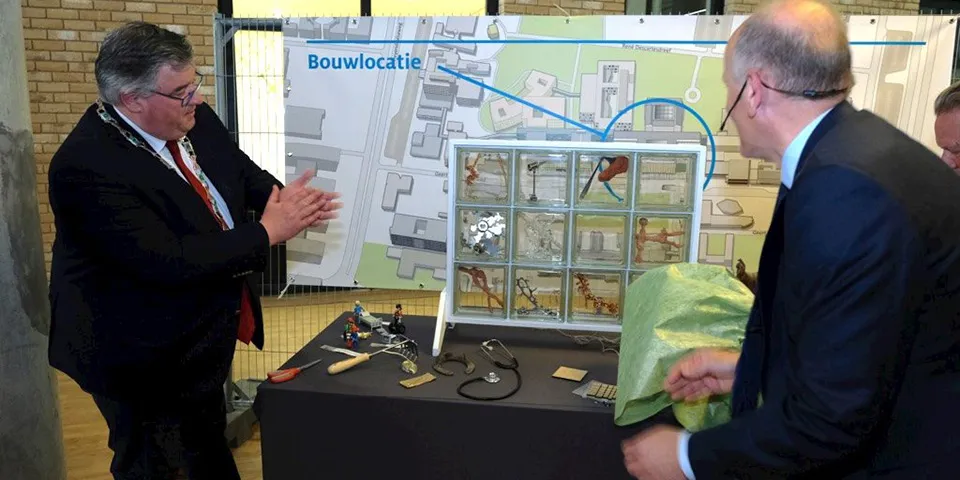
Construction of the new Radboudumc building officially got under way on 23 April. Within three years, a brand-new building will rise to the left of the current main entrance. It gives tangible form to Radboudumc’s long-term vision for its accommodation.
Radboudumc aims to lead the way in developing innovative, sustainable and affordable healthcare. Healthcare that will still be there for our children’s children. We do this by putting people first and embracing innovation, and by working together in networks. These principles have been translated into a Masterplan built around three Bs: Bricks, Bytes (smart technology) and Behavior. The latter stands for a different way of working, together. Because the university medical centre is investing heavily in smart technology and new ways of working, it has found that the number of Bricks can be cut dramatically. This smart approach makes it possible to build more compactly.
100,000 square metres less
In light of the latest developments in healthcare, research and education, the university medical centre sees major benefits in making more intensive and compact use of both existing and new accommodation. The more compact build will comprise 100,000 m2 less than the current accommodation. The designers call it ‘renewbuilding’: creating a strong relationship with and between the surrounding buildings while constructing new ones. Radboudumc previously received the international BREEAM excellent certificate for the design of the new building by architect Daniël van den Berg.
“Our higher goal will soon be within reach”, says Cees Buren, member of the Executive Board. “We will be able to deliver the best possible care more efficiently. This efficiency will not come at the expense of patients or healthcare professionals, the people at the bedside.”
Ready for the future
The healthcare landscape in the Netherlands is undergoing far-reaching change. The population is ageing and demand for care continues to rise. The significant increase in available technology and new treatment methods is also driving change in healthcare, research, education and the accommodation of university hospitals. With this new building, where spaces are more user-focused than ever and the latest technological and logistical innovations support care for both patients and healthcare professionals, Radboudumc is moving towards becoming the most person-centred and innovative university medical centre in the Netherlands.
150 super-smart patient rooms
A new feature of the building will be its 150 cleverly designed single-patient rooms. Each has its own bathroom and sleeping space for a family carer. All cabling is concealed in the walls, cabinets and floor to create a calm appearance. Video projections on the walls allow the room’s atmosphere to be tailored to the patient’s wishes. The layout can also be changed in an instant. For example, the bed can be moved if a patient would prefer to face the window, or not.
“We don’t believe in ‘one size fits all’. We create a personal profile for each patient and incorporate it into their care plan,” says professor of surgical education Harry van Goor.“What kind of environment can we create to promote their recovery? What helps them feel calm? What time do they normally go to bed? Because after that, we won’t disturb them…”
There is also a constant focus on working more efficiently. A simple example in the new university medical centre building is that patient rooms will be equipped with a tablet, allowing patients to communicate quickly and easily with their nurse and family at home. Targeted communication avoids unnecessary work: unlike with a call bell, patients can now specify what they need, so the nurse or catering assistant can respond appropriately straight away.
Design manager Iris Hobo: “I love the balance between technology and emotion. You’re in hospital to get better. For a seriously ill patient, every unnecessary stimulus is one too many. In our search for a human scale, we are constantly balancing minimalist and maximalist design.”
‘Healing environment’
Radboudumc has chosen the ‘healing environment’ principle. Personalised rooms that offer an individual experience are considered important factors in supporting the chances of recovery. With the help of real patients, the best possible room layout was tested in two trial rooms. Staff areas are also tailored as closely as possible to their users.
Construction director René Bleeker: “We have mapped out how each professional group works, right down to the individual level, and what they need to do their job. With those findings in hand, we will provide them with their new, optimal working environment in the new building.”
Light, air, space, views and a green setting, in the form of gardens and roof terraces, will therefore play an important role in the new building. This applies both to spaces used by patients and to staff working areas.
Artwork unveiling marks start of construction
Instead of laying the first stone, Mayor Bruls marked the official start of construction of the new Radboudumc building by unveiling the first (building) stones of an artwork.
Question about this story? Ask your question
Who worked on Radboudumc
- architectDaniël van den BergIn this story
- clientRadboudumcMentioned in Radboudumc and consortium proud of new main building on Nijmegen healthcare campus
- architectsEGM architectenMentioned in Radboudumc and consortium proud of new main building on Nijmegen healthcare campus
Keep following this
Get an email when a new story is published. No account needed.
- ProjectRadboudumc
- ThemeHospital construction and refurbishment
- SubjectGeneral
- CompanyDaniël van den Berg







