Light in the operating theatre: greater comfort and efficiency
Although operating theatres are characterised by a fixed light level, the latest technological developments in lighting control and manipulation are being applied here too. Bouwen aan de Zorg spoke to Jacques Brouhier, communications manager for the Benelux at luminaire manufacturer and lighting specialist Zumtobel.
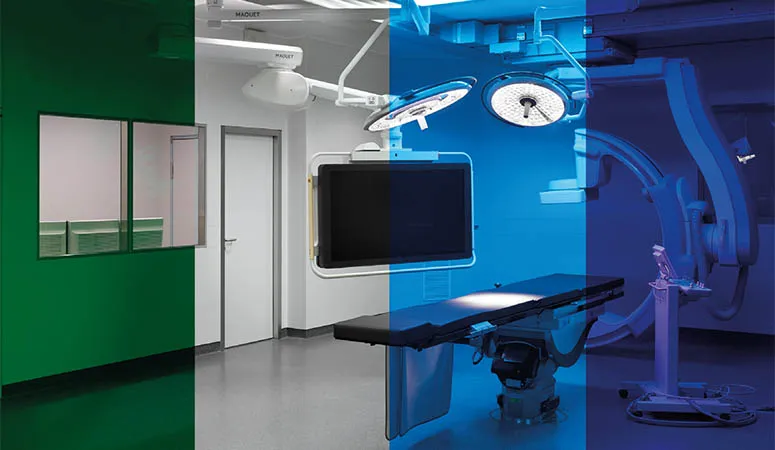
“Operating theatres do not need all the options offered by today’s lighting management systems, but advances in LED technology have opened up new possibilities that greatly increase surgeons’ comfort”, says Brouhier. “Alongside the general white light with a high colour rendering index, we add red, green and blue LEDs. By boosting one of these colours, we can alter the contrasts in the illuminated environment. Blood has a very distinctive hue, although this is not noticeable in normal daylight. But by making the lighting in the operating theatre more blue and/or green, the colour difference between the blood and the reddish organs is accentuated, allowing the surgeon to spot even minor bleeding immediately. We had known for some time that this was possible, as it was already established for image display on screens. But directly enhancing colour contrast on the patient’s body is a new application. ASZ in Aalst is one of the first to use it.”
The new applications have been developed in response to international demand. “Medical professionals have an idea of what is possible based on existing applications. In pharmaceutical research, for example, red light has long been used with test animals to avoid disrupting their sleep cycles. As a result, we are receiving more and more enquiries that did not exist before. A large proportion concern the flexible adjustment of light levels. Lighting controls need to offer much more than on and off buttons”, says the lighting specialist.
Dimming may not seem an obvious choice in an operating theatre. Or is it? “Surgeons may ask for the light to be focused on the ‘operating theatre’ and for the light level elsewhere in the room to be reduced, so that the background does not distract them.” LED technology has only recently made significant progress in this area. “An illuminance of 1,000 lux is often required, but surgeons sometimes ask for 10,000 to 100,000 lux to illuminate the operating field. Until recently, 1,000 lux was already quite high for LEDs; more light could only be achieved by installing more luminaires. We can now reach the same level with LEDs as with fluorescent lamps. The use of microprisms and special lenses has also reduced the risk of glare at this level.” One advantage of LEDs over fluorescent lamps is that refractors and safety glass are no longer needed.
Brouhier expects further efficiency gains in the near future. “All the major manufacturers are working on this.”
Words: Koen Mortelmans
Question about this story? Ask your question
Keep following this
Get an email when a new story is published. No account needed.
- ThemeSafe and reliable healthcare buildings
- SubjectInteriors