Operating theatre simulator: adaptable space for designing and fitting out operating theatres
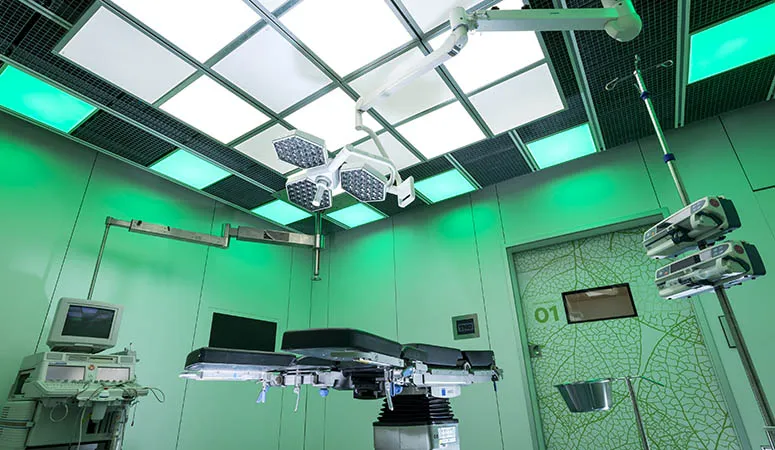
On 22 January 2015, the operating theatre simulator was officially opened at TNO in Soesterberg. According to the researchers in Soesterberg, this flexible space, with movable walls, pendants, equipment and monitors, is unique in Europe. The concept was developed together with suppliers and healthcare professionals.
Around 120 interested visitors, mainly from the healthcare sector, saw the flexible operating theatre simulator. The afternoon began with presentations which showed that surgical care is set to undergo significant change. Minimally invasive procedures are expected to become more common. To provide an affordable response to an ageing population, it seems necessary to combine techniques that have been proven to work. One example is bringing critical surgical information together on a single screen.
Jos Keurentjes, chief scientific officer at TNO, explained that the operating theatre simulator was created through collaboration and functions as a learning system. User feedback will help shape the concept further, for example by incorporating robot simulation.
The operating theatre of the future
Years ago, Roberto Traversari, senior scientist at TNO, was surprised by operating theatre complexes when he began researching the sector as an outsider. Many hospitals, it turned out, wanted to reinvent the wheel each time they designed and fitted out operating theatres. In 2011, Traversari was one of the experts at a masterclass on the operating theatre of the future organised by, among others, UMCG and TNO. Together with industry and healthcare institutions, he developed the idea for an operating theatre simulator, which took shape at the end of 2014.
Traversari’s video presentation showed how easily two people can move the operating theatre simulator’s walls using a stepladder. Pendants are easy to move and secure to the steel grid ceiling. Remote monitoring with smart cameras makes it possible to identify the ‘hotspots’ in the operating theatre. Hospitals, consultants, suppliers and researchers can use the simulator for a fee based on the time booked. According to Traversari, TNO’s flexible operating theatre simulator provides a platform for knowledge-sharing, research and product development.
High-end surgery
‘Trends and developments in the operating theatre’ was the subject of Ivo Broeders’ presentation. The professor at the Faculty of Technical Medicine and surgeon at Meander Medisch Centrum offered his vision of the period up to 2025 and predicted that surgery would change dramatically. Molecular medicine, for example, will play a more important role, and there will be fewer open operations, with more procedures performed through blood vessels or small incisions. The professor also predicted greater focus on geriatric issues. According to Broeders, operating theatre complexes will become highly efficient at routine processes and operations (95%). Hospitals can distinguish themselves through high-end operations in a particular specialism (5%). Performing ultrasound or X-ray examinations in the operating theatre during surgery will become commonplace. Finally, the professor pointed out that many parties have a stake in the development of operating theatre complexes, and some have significant financial interests. He also said that there is no longer any room for complacency. The professor advocated using proven techniques, either individually or in combination. In his view, the operating theatre simulator is a ‘fantastic’ idea for sharing knowledge and stimulating product development.
Saving hundreds of thousands
Ina Roubos, construction adviser at UMC Utrecht, presented the centre’s experience of using its own operating theatre mock-up for its refurbishment, part of which is due for completion on 23 February. The academic medical centre worked step by step towards an optimal design, using drawings, 120 different scale models and a full-size simulation. u
According to the construction adviser, it is useful to visualise aspects of the design early in the process in a way that is clear to healthcare professionals.
Operations can be rehearsed in an operating theatre simulator, together with the associated movement of goods. Roubos calculated that mock-up sessions can save hospitals hundreds of thousands of euros. Simulations can, for example, be used to check and fine-tune the size of the operating theatre, the size of the plenum and the reach of a pendant. The presentation also showed that other spaces, such as the recovery room and holding area, would benefit from simulation. UMC Utrecht’s construction adviser advocated involving the most critical people in the design process, from the board of directors to front-line staff. She also recommended bringing all surgical information together on a single screen, a ‘wall of knowledge’.
Benchmarking
Finally, Lizette Berkx, representing Erasmus Medisch Centrum in Rotterdam, presented the forthcoming Benchmarking OK 2015. This conference takes place on 26 June and focuses on sharing experiences in the operating theatre. There will be a strong focus on Evidence Based Healthcare Design and making the most of operating theatre time. The presentations were followed by a tour of the operating theatre simulator and drinks. This brought an inspiring afternoon packed with innovations and smart ideas for sustainable, high-quality healthcare in the Netherlands to a close.
Text: Martijn van den Bouwhuijsen | Photos: Martijn van den Bouwhuijsen/TNO
Lycalux, the innovative partner in LED lighting for hospitals
Lycalux is an innovative partner in LED lighting for hospitals. The company is proud to now offer hospitals a complete lighting range.
For operating theatres, Lycalux offers not only perimeter lighting, but also LED plenum lighting and surgical lights from Admeco. Lycalux recently introduced its plenum lighting at several hospitals. Lycalux holds the exclusive rights to Admeco’s surgical lights. These lights have been tested by TNO and meet the requirements of the new VCCN guideline 7, which determines the effect of surgical lights on the performance of the air-handling system.
Lycalux also offers a complete LED lighting range for other areas of the hospital.
For more information: www.lycalux.nl
Question about this story? Ask your question
Keep following this
Get an email when a new story is published. No account needed.
- ThemeSafe and reliable healthcare buildings
- SubjectInteriors