The value of continuous particle monitoring in operating theatres
To identify the factors affecting air quality in class 1 operating theatres, a study was conducted during five different procedures at two hospitals. Air quality was measured using airborne particle monitoring alongside visual observations. This information provides insight into the factors that cause disruption and can help improve air quality during surgical procedures.
The technical conditions in the operating theatres met the requirements applied in the Netherlands until the end of 2014: VCCN Guideline 7, dated November 2014; WIP Guideline on Air Treatment in the Operating Theatre and Set-up Room in Class 1 Operating Departments, November 2014; ISO 14644-3 (2005); and the 2005 Air Management Plan.
The target air quality was ISO class 6 in the protected area and ISO class 7 in the peripheral area during operations.
Equipment, locations and measurement method
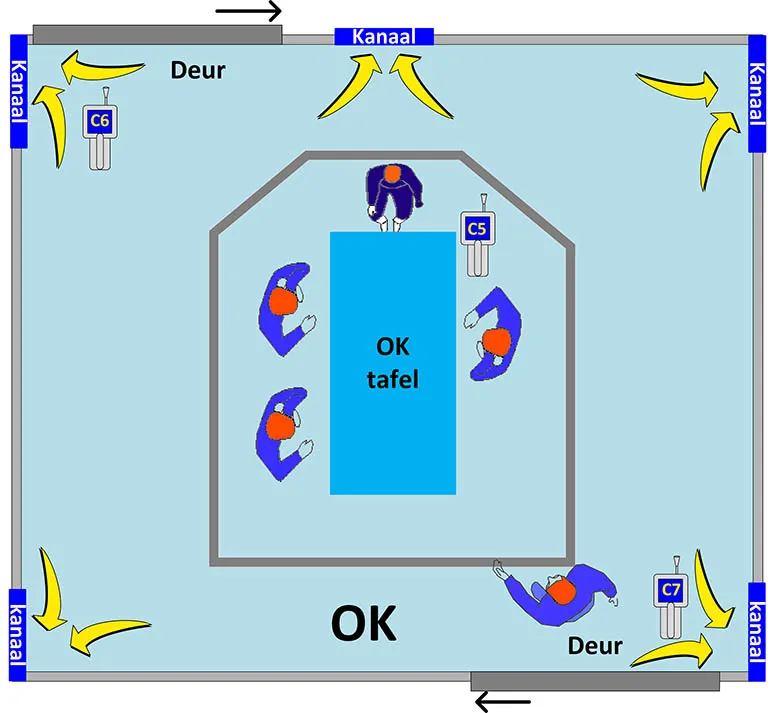
Three particle counters (2.83 litres/min) were used for real-time monitoring. All data from these counters was continuously collected using LMS Express RT© software. This made it possible to collect and analyse all data during the operations. Actions and movements were also observed and recorded during the procedures. Particle counters 6 and 7 were positioned next to the entrance doors, by the return air duct. Particle counter 5 was positioned at the head end of the operating table, just below operating level, within the protected area. Particle monitoring was carried out during five different types of procedure: a knee operation (OR 6), a heart operation (OR 1) and three consecutive laparoscopic procedures (OR 10).
The sampling time for all particle counters was set to one minute, with all particles ≥0.3 µm, ≥0.5 µm and ≥5.0 µm recorded. Monitoring was carried out before and throughout all procedures, including preparation and cleaning. All measurements began during the unoccupied period, allowing a sound comparison of particle concentrations in unoccupied and operational conditions.
Study findings
During the operations, particle concentrations were often below the ISO class limits, and sometimes the results even matched the requirements for unoccupied conditions. However, there were also several occasions when the ISO class 6 and 7 limits were exceeded:
While the patient was being transported to the operating theatre.
While the patient was being prepared on the operating table.
When the operating table was raised or lowered.
While the operating theatre was being cleaned between procedures.
When a stool was moved from the peripheral area into the protected area.
When someone entered the protected area during a conversation between operating theatre staff.
When the operating theatre doors were opened and closed (in the peripheral area).
As a result of sudden movements by operating theatre staff.
While the CO2 gas supply was being connected beneath the operating table.
When diathermy scalpels were used with a smoke evacuator.
When diathermy scalpels were used without a smoke evacuator (extremely high particle counts)
These instances can be analysed further to minimise particle generation as far as possible. Air quality was restored very quickly each time, within a minute, demonstrating a high air change rate and good recovery time.

Substantial exceedances of ISO class 6 during diathermy
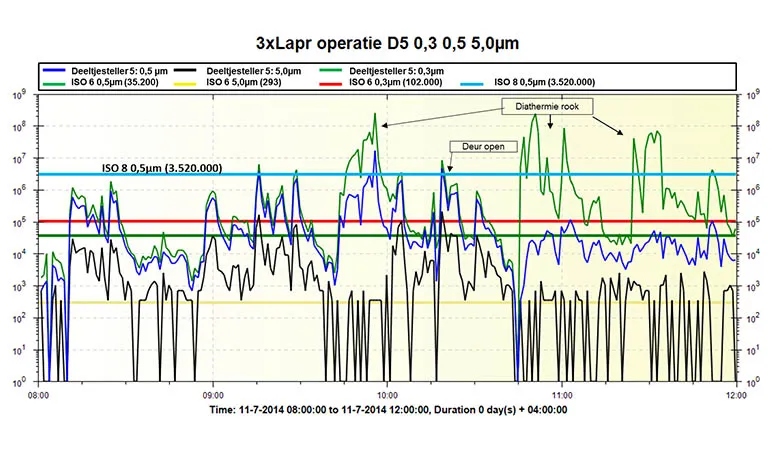
No smoke evacuator was used with the diathermy equipment during the laparoscopic procedures. The use of diathermy equipment during these operations led to substantial exceedances for all particle sizes (0.3, 0.5 and 5 µm). At 0.5 µm, peak readings even reached ISO class 8 (3.5 million particles ≥ 0.5 microns per m³). Particle counters 6 and 7 in the peripheral area recorded the same counts, and sometimes even higher counts shortly afterwards. The graph shows the same pattern at all measurement locations.
A smoke evacuator was used with the diathermy equipment during the heart operation. This resulted in particle counts 10 times lower, but they were still well above ISO class 6 and sometimes even reached ISO class 8. Here, too, the results from all particle counters were comparable.
Further investigation into the large number of particles generated by diathermy is recommended.
Measurement results in the protected area versus the peripheral area
All particle counters gave the same results. Particle counter 5 in the protected area often recorded the first readings when particles were generated there, followed shortly afterwards by almost identical readings from particle counters 6 and 7 in the peripheral area. The reverse was also observed: movements in the peripheral area, at the edge of the protected area, did not cause contamination in the protected area.
In 95% of cases where particle counter 5 recorded an exceedance of the ISO class 6 limit, particle counters 6 and 7 also recorded the same results against ISO class 7. This means that, in such a situation, measurements in the peripheral area provide a good indication of a cause in the protected area. However, a higher particle concentration in the peripheral area may also be caused by activity there, which is usually the reason. When a high particle concentration is detected in the peripheral area, the cause and effect therefore need to be analysed carefully.
Ing. J. Laurensse
LLTA Laurensse Luchttechnisch advies
Question about this story? Ask your question
Keep following this
Get an email when a new story is published. No account needed.
- ThemeSafe and reliable healthcare buildings
- SubjectInteriors