First self-expanding pulmonary valve implanted via the groin
Text Koen Mortelmans Beeld UZ Gent, Tom Baas, Noah Noël Smulders en Koen Mortelmans

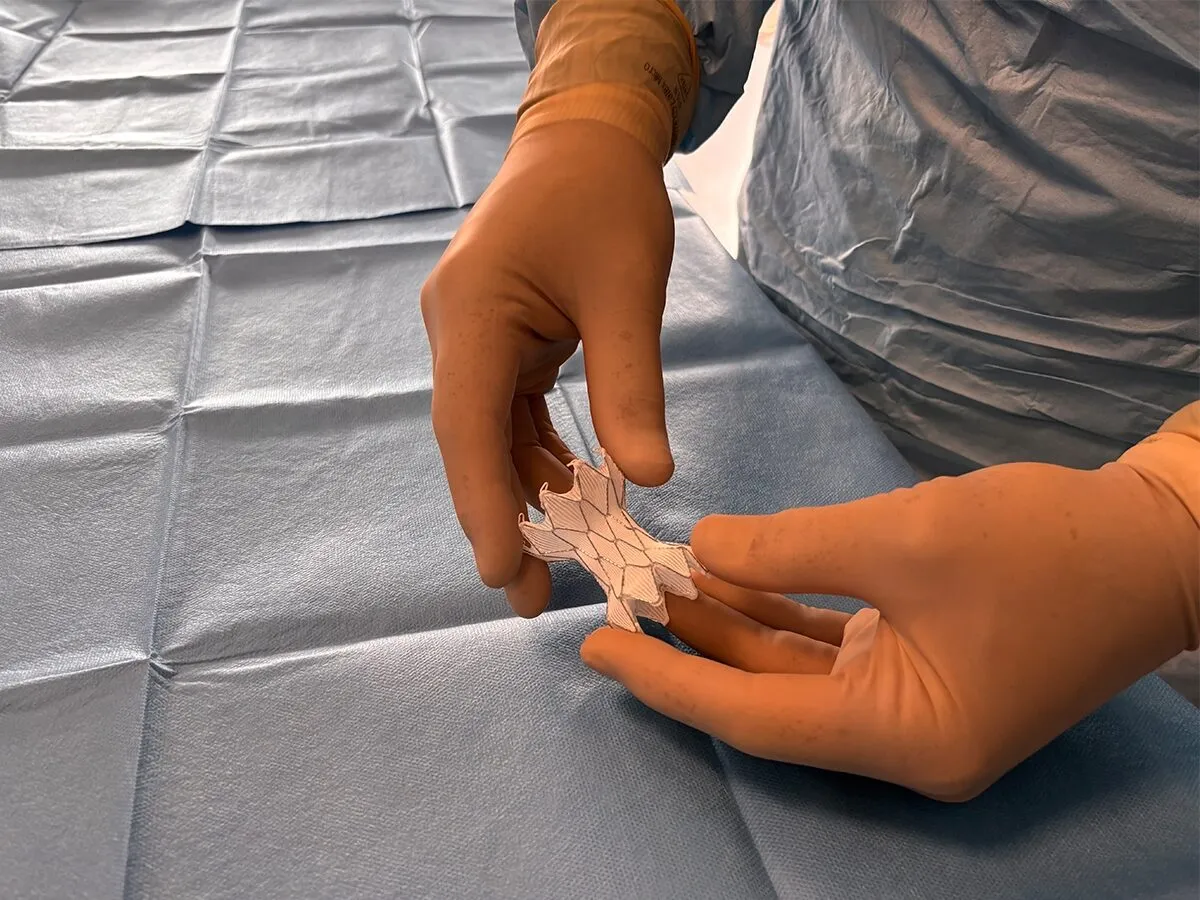
Cardiologists at UZ Gent have treated a patient with a complex congenital heart defect using a new type of pulmonary valve, for the first time in Belgium. The valve can be implanted via a catheter inserted in the groin, avoiding the need for open-heart surgery. The technique offers a new treatment option for patients with enlarged pulmonary arteries, for whom existing catheter valves are not suitable.
In some patients, the passage from the right ventricle to the pulmonary artery is severely enlarged, often as a result of previous operations. Conventional catheter valves do not fit well in these cases. The heart valve is delivered to the heart through a catheter inserted in the groin, where it expands and locks firmly into place. The chest does not need to be opened again. For patients who have already undergone one or more heart operations, this can be a significant advantage, or even the only option. More information: uzgent.be
New homes for vulnerable young people
In Gouda, Minister for Housing Elanor Boekholt-O’Sullivan opened 247 new homes developed under the 1828 youth housing concept. They provide affordable accommodation for young people aged 18 to 28, including those in vulnerable situations, with monthly rents of 713 to 1,096 euros for studios measuring 25 to 50 m². With more than 1,000 people interested, all the homes were let in no time.
Initiator Ernest van der Meijde aims to open twenty of these buildings by 2035 and is targeting the sixty largest cities in the Netherlands. The decision was made to build relatively compact developments of 150 to 250 homes, using a concept that can be applied in many cities. Further developments are planned in the coming years, including in Alkmaar, Haarlem, Leidschendam, Santpoort-Noord and Zoetermeer. More information: 1828.nl

Greater focus on occupational physicians’ preventive role
Just 57% of occupational physicians in the Netherlands expect to be able to carry out their preventive duties in practice. This is the finding of research by PhD candidate Suzanne Orhan Pees (Vrije Universiteit Amsterdam). Prevention is one of the statutory duties of occupational physicians. These duties include identifying risks, preventing work-related health problems and limiting their impact.
Occupational physicians currently focus mainly on supporting individual employees who are off sick. This comes at the expense of preventive activities such as workplace visits. Orhan Pees shows that occupational physicians are keen and willing to do more to promote prevention, but that this is not easy to achieve. They can mainly take small steps themselves. Many of the obstacles are linked to how the system in the Netherlands is organised. Employers and occupational health services can help improve delivery by taking supportive action.
More information: research.vu.nl/en/publications/prevention-by-occupational-physicians-a-study-from-policy-to-prac

One death every hour linked to a high BMI
In 2022, more than 9,500 deaths in Belgium were linked to a high body mass index (BMI). According to Sciensano, this represents 8.2% of all recorded deaths in the country, or more than one death per hour. Overweight and obesity are major determinants of chronic diseases and premature mortality. An ageing population further increases this considerable burden of disease.
“When healthy choices also become the easiest choices, we can prevent a significant proportion of diseases linked to overweight and obesity and sustainably reduce their burden”, says Sciensano scientist Kim Fernandez. The proportion of people who are overweight has risen considerably since 2001: 49% of the population aged 3 and over are overweight, including 18% who are obese. However, this upward trend appears to have levelled off since 2018. The high prevalence of overweight and obesity places a considerable burden on public health. In 2022, a high BMI was linked to 9,509 deaths and 157,178 years of life lost in Belgium. The main causes of death attributable to a high BMI are cardiovascular disease, dementia, chronic kidney disease and certain cancers of the digestive system. More information: sciensano.be
Question about this story? Ask your question
Keep following this
Get an email when a new story is published. No account needed.
- SubjectNews