Residential care & nursing homes
Ambitions under severe pressure
Text and images Capital Value

Investment in new-build care homes down 40% in 2024
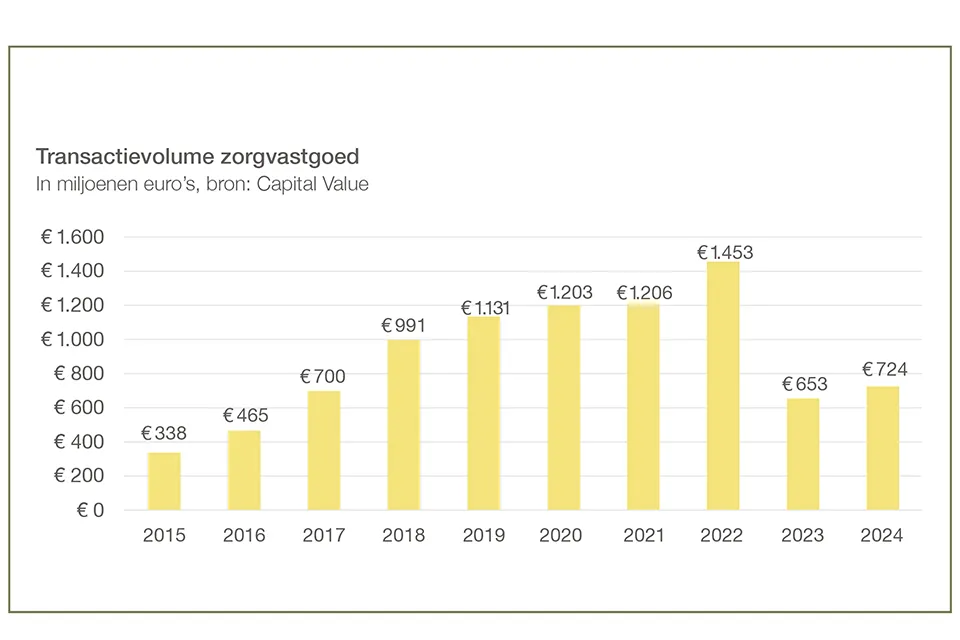
In 2024, €724 million was invested in healthcare property. This represents an increase of 11% compared with 2023. The recovery remains tentative compared with the years 2019 to 2022, when more than €1 billion was invested in this segment each year. This is according to Capital Value’s annual analysis. In 2024, €270 million was invested in new-build care homes. That is 40% less than in 2023 and amounts to just 3% of the annual new-build target for older people’s housing. Reducing the growing shortfall requires not only significantly more investor capital, but also a much larger supply of new-build care homes. Developers’ pipeline for 2025 in this segment falls 5% short of the expansion needed. Urgent action at national government level and incentive measures are essential to deliver more care homes in the coming years.
Private capital makes a significant contribution
With a volume of €331 million, private investors and property funds were the largest buyers of healthcare property in 2024. They invested €200 million more than in 2023. Institutional investors invested €190 million. Their share of the total volume therefore fell from 60% in 2023 to 26% in 2024. This investor group usually provides a significant boost to the share of new-build investment in the healthcare property market. Foreign investors were very cautious on the buying side. Notably, several international listed property funds were mainly visible as sellers of healthcare property, accounting for 36% of total transaction volume. These transactions included sales by Aedifica, Cofinimmo, Korian and Emeis.
Share of private residential care and primary care continues to grow
For the second consecutive year, investment in 2024 was concentrated mainly in the private residential care segment. A significant part of this segment was the portfolio transaction in which Bouwinvest acquired 11 complexes from Wonen bij September (Emeis). Bouwinvest’s purchase of the Thagaste new-build development (66 units) demonstrated the market potential for larger asset-level transactions in private residential care. This development by healthcare property developer Gaudium Real Estate is leased on a long-term basis to care provider Kloek. The number of investments in primary care complexes doubled in 2024 compared with 2023. A total of €106 million was invested in this segment. More and more private and public sector parties are working together. The sale of five substantial Pro Senectute sites to Schroders Capital is a leading example. The portfolio comprised 430 existing senior homes.
Investment in new-build falls
In 2024, €270 million was invested in new-build housing for older people. The share of new-build in transaction volume fell from 69% in 2023 to 37% in 2024. Investment in 2024 equates to approximately 1,000 new units. Compared with the 1,700 units invested in during 2023, this represents a fall of around 40%. Investment is nowhere near sufficient to meet the annual national target of 35,000 additional homes for older people, set by the national government in 2022. This is putting even greater pressure on the shortfall in this segment. The outlook for 2025 is not much more promising. Capital Value research shows that just 5% of developers’ new-build plans for 2025 involve senior or care homes.
Simplifying the development of homes for older people
One possible explanation for the lack of new supply is that developers are reluctant to build senior and healthcare property. They have less experience in developing this specific type of housing. However, under current building regulations, a home built to be suitable for care requires only a few modifications compared with a conventional home. With a small number of adaptations, these homes can meet potential future care needs. This is crucial, as demand will change in the future as the population ages. By 2030, there will be more than 2 million people aged 75 and over. The current housing stock does not meet this group’s need for suitable accommodation. Government incentives are also needed to expand the stock, for example, subsidies such as a start-up construction grant for new homes for older people, and support for developing greater expertise in this area.
Upgrading and making use of existing stock offers opportunities
Investment in expanding the stock is currently inadequate, and urgent investment is also needed to modernise and improve the sustainability of the existing healthcare property stock. An earlier Capital Value analysis of the Dutch healthcare property stock found that 58% of it dates from before 1995. More than six million square metres have an energy rating of E or lower. Investment to improve quality, as well as to make functional adaptations, is urgently needed. Such investment could give a significant boost to the supply of suitable homes for older people, particularly now that new-build output is insufficient to meet rising demand. Manon Kuipers, Director of Healthcare Property at Capital Value, says: “Significantly more capital needs to be made available for this asset class in the coming years to meet enormous demand. We therefore urge investors to explore how they can include homes for older people and healthcare property in their (impact) strategies. This is particularly important given the urgency in this segment and the positive social impact. Efficiency gains can also be made by focusing more on making use of the existing stock and future-proofing older care homes.”
Question about this story? Ask your question
Keep following this
Get an email when a new story is published. No account needed.
- ThemeHousing with care close by
- SubjectResidential care & nursing homes