Residential care & nursing homes
High-quality dementia care within Brielle’s historic walls
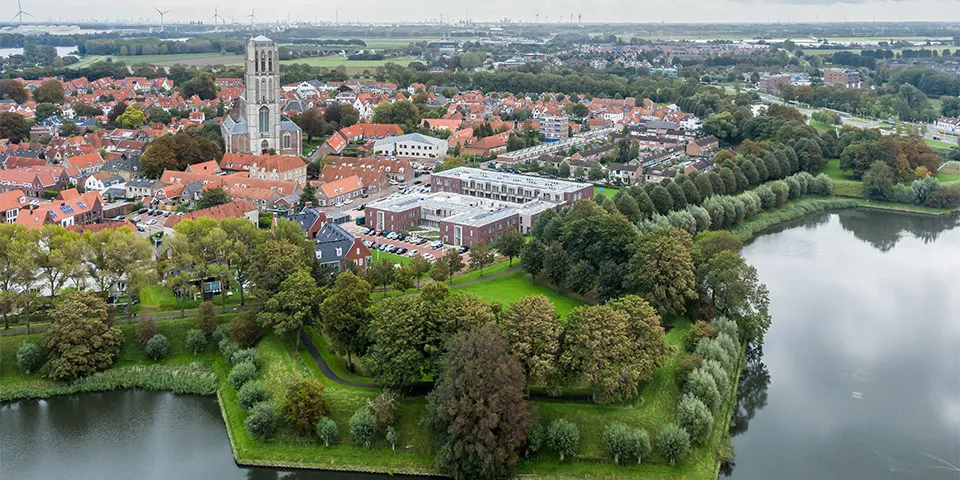
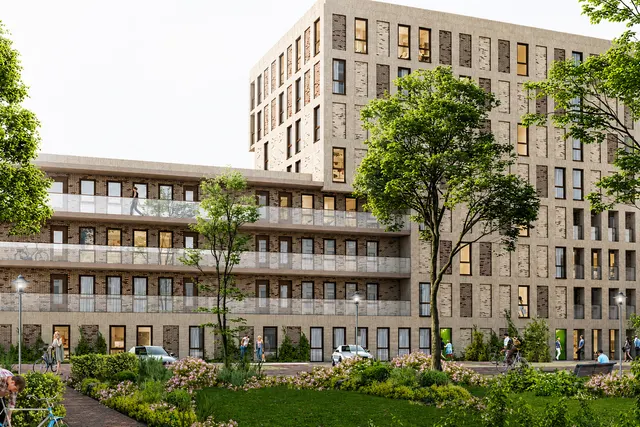
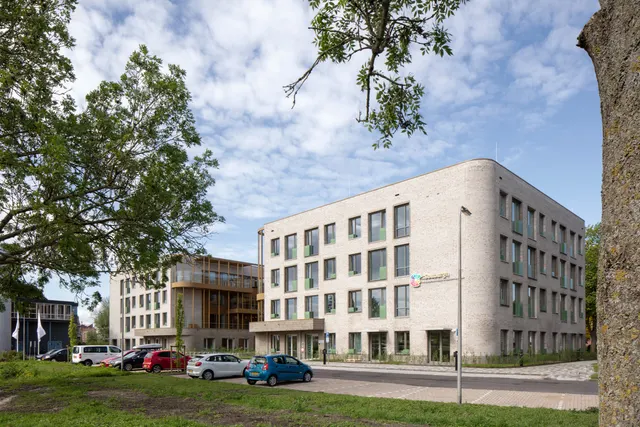
A short walk to the baker’s? This will soon be an option for the psychogeriatric residents of Het Prinsenkwartier in Brielle. The brand-new care home, beautifully located within the historic ramparts, provides dementia care to the latest standards. Alongside 44 high-quality senior apartments and the integration of Welzijn Ouderen, the complex is a valuable addition to senior housing in Brielle.
A garden gate marks the boundary between the safe residential environment of Het Prinsenkwartier and the outside world. A walk of a few hundred metres takes you into the heart of the historic fortified town. Hans Biezemans, director of Catharina, thuis op Voorne, expects most of the 28 psychogeriatric residents to be able to come and go independently. “By using GPS/beacon technology with wristbands, combined with a social app, a kind of Amber Alert used by a large number of volunteers in Brielle, we can always find out where our residents are. This gives them a great deal of freedom, which I believe contributes to greater wellbeing. Ultimately, it is about adding life to days, rather than days to life.”
Building and renewal
Catharina, thuis op Voorne is a care and welfare organisation operating in Westvoorne and Brielle. It currently has four care home sites with a total of 150 beds. The organisation is undergoing significant change. “There is enormous demand for nursing home care in this region. Several sites are very outdated, so we are currently building and renovating in a number of locations. Catharina Gasthuis in Brielle is being renovated, and we want to develop two more new sites in Hellevoetsluis and Oostvoorne. We aim to grow to 220 places within five years,” says Biezemans.
Het Prinsenkwartier significantly expands the foundation’s capacity in Brielle. Its location within the fortified town’s walls is unique and also has a historic background. Biezemans: “Archive research has shown that care has always been provided here, including in a hospital for wounded soldiers and a monastery. This really is a site with a history of care. The fact that the complex is within the ramparts appeals to many people. The long waiting list we already have is proof of that.”
Courtyard concept
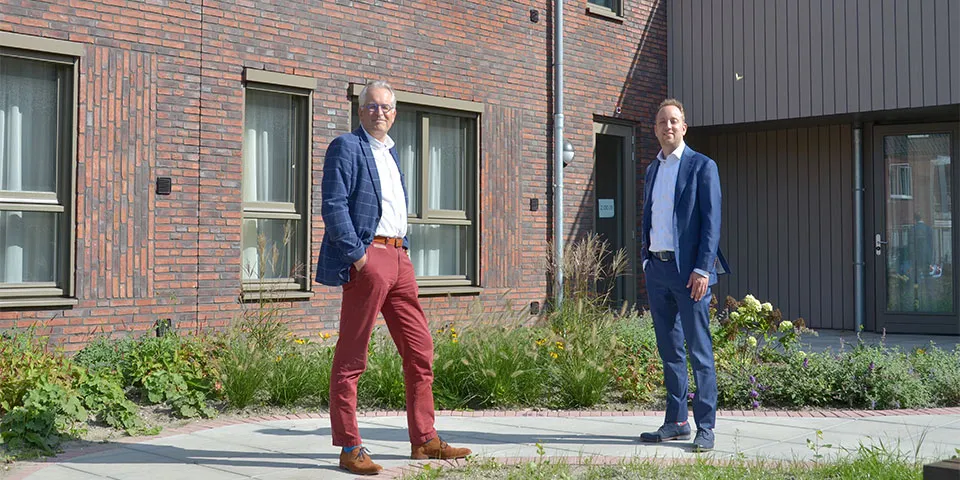
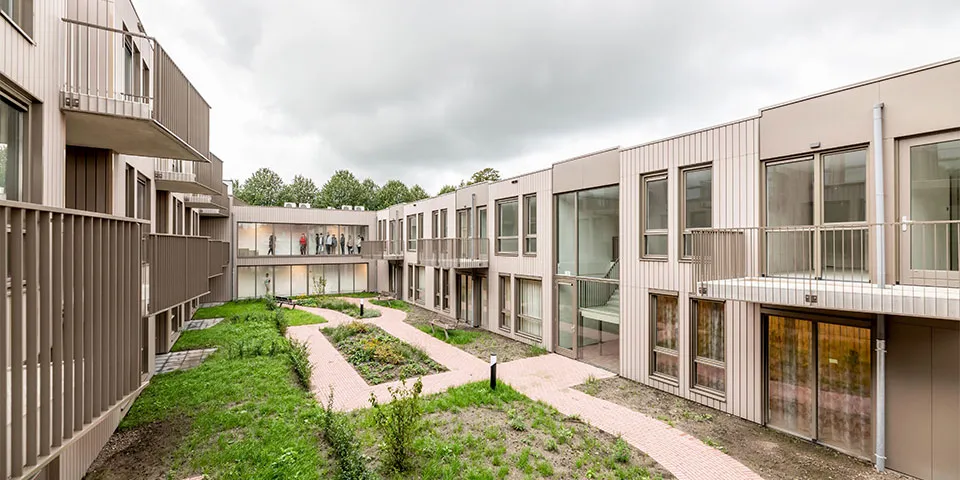
Three years ago, Catharina issued a tender for the project, together with Deloitte and 4Building. The initial plan was to concentrate psychogeriatric care on a single floor. However, investor Altera did not find this an attractive option. In the tender, Catharina had explicitly given market parties scope to propose optimisations. Gebroeders Blokland revisited the initial parameters and came up with a suitable alternative. “We submitted a plan in which care was spread over two floors. This allowed us to configure the building services more efficiently, which in turn meant we could make the outdoor spaces larger, giving residents of the senior apartments more privacy. That is how the courtyard concept came about, as ultimately realised,” says project manager Wim de Jong. Care is a relatively new field for Gebroeders Blokland. The developer-builder is primarily active in housing, but in recent years has increasingly focused on care projects. De Jong has learned that openness and transparency are crucial. “It is very important to understand each other’s worlds. Only then can you create a building that meets the needs of its residents.”
High quality and sustainability
Social interaction is one of the needs that was carefully considered in the design of Het Prinsenkwartier. Residents can meet in a variety of ways.
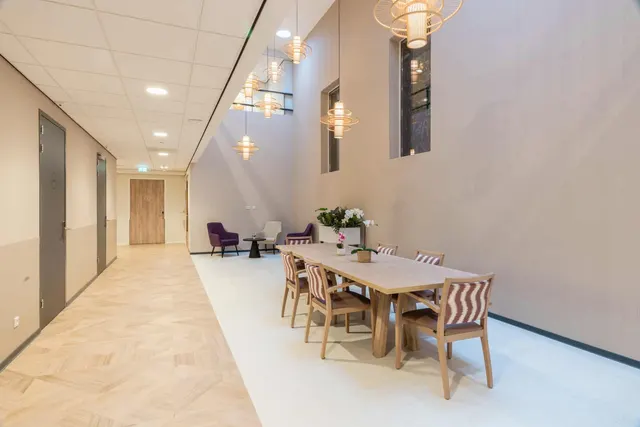
In the garden, where benches have been installed for a chat, or in the Grand Café, where residents can have a drink or play klaverjas. There is also a ‘social living room’ where people can have dinner together in the evening.
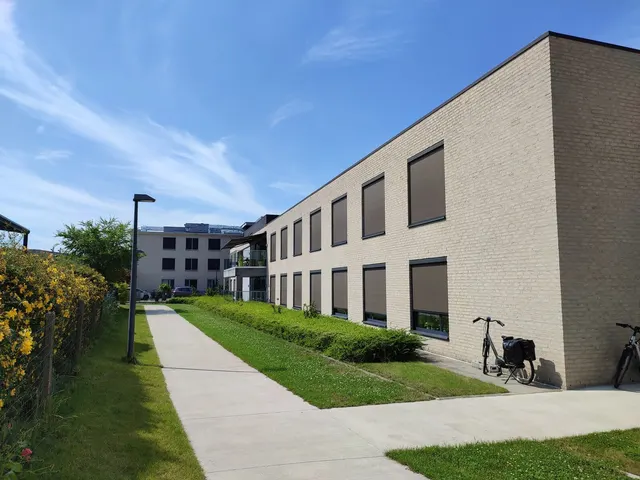
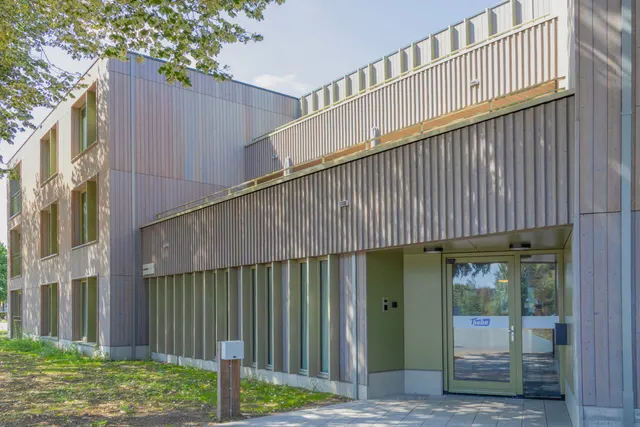
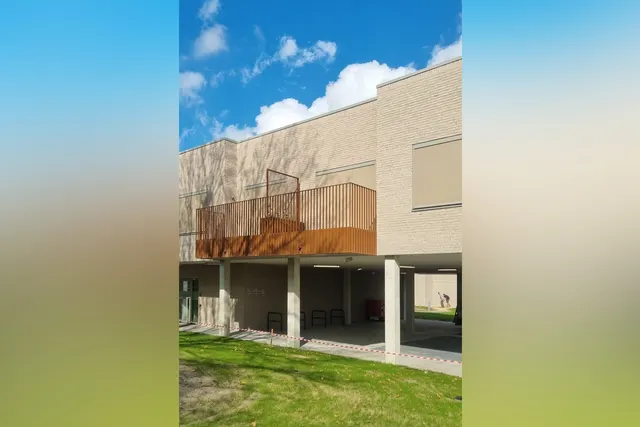
Considerable attention has been paid to materials and detailing. The brickwork is an eye-catching feature, with its attractive brick and vertical brickwork. The Neolife timber façade panels will retain their appearance, according to De Jong. “They barely discolour, require little maintenance and are made from around 90% high-quality wood.” With an EPC of 0.0, the building is also highly sustainable and future-proof. Nearly 1,000 solar panels, air-source heat pumps, a sedum roof and CO2-controlled ventilation units are the main green measures.
No locked doors
Psychogeriatric care accounts for around half of the building. The 28 residents are divided into four living groups of seven, two on the ground floor and two on the first floor. The communal living rooms are adjacent to one another and open onto either a secluded courtyard garden or a spacious roof terrace. Each resident has a combined sitting and bedroom of around 28 m² and their own bathroom. The layout and interiors are dementia-friendly. Design agency Livin’, a specialist in this area, was brought in for this purpose. For example, long corridors are broken up with sensory corners, such as ‘Havenzicht’, featuring a sea salt dispenser, a video of the harbour and images from the past. The use of colour helps residents recognise their own unit and room and creates a sense of being at home.
Being able to move around freely is very important for this group, says Biezemans. “If someone wants to visit another resident on the first floor, they can. That is why we have no locked units. Residents are welcome everywhere.”
Care technology
A wide range of care technology has been installed to make it possible for residents to move around freely, even in the centre of Brielle. Each resident receives a wristband (tag) that gives them a defined level of freedom (a safe zone), extending as far as the public highway. Beacon technology enables care staff to see where someone is in the complex when they press their alarm button. Every room has a Smart Optical Sensor (SOS) that analyses the space and records movements using anonymised image fragments. If a resident’s usual routine changes, care staff receive an alert on their smartphone.
Biezemans believes the benefits of these applications far outweigh the drawbacks. “While some see them as measures that restrict freedom, I believe they actually increase it. And I am convinced that greater freedom leads to less agitation and reduced medication use.”
Het Prinsenkwartier was handed over in August, after a construction period of 14 months. All 28 psychogeriatric residents have now moved into their new home. The 44 senior apartments will not be let as such until a year from now. Biezemans: “Until then, we are using them as temporary accommodation for residents of Catharina Gasthuis while it is being renovated. It is a practical and efficient solution that we are very pleased with.”
Electronic access control for Het Prinsenkwartier
To ensure that residents of the Het Prinsenkwartier care home retain control over their lives for as long as possible and enjoy optimal freedom, Avics has installed an extensive wandering detection system. The electronic BUVA blueSmart access control system was selected for all other doors that residents are not allowed to access. Commissioned by contractor Gebroeders Blokland, BUVA helped develop the most suitable electronic locking plan for Het Prinsenkwartier. The Barendrecht-based homecare systems supplier also supplied all the other ironmongery.
“Initially, the locking plan for Het Prinsenkwartier was largely mechanical,” says Ugo Harmsen, project supervisor at BUVA. “But it was soon expanded to include some additional access control. On our advice, BUVA blueSmart was chosen, as it is ideally suited to care projects. We worked out the electronic locking plan in detail with the contractor, client Altera N.V. and door supplier Berkvens Deursystemen. We were subsequently also awarded the contract to supply the ironmongery. In addition to BUVA blueSmart cylinders and card readers, we supplied standard locks and BUVA FD20 swing door operators for the internal and external doors, among other items. This ensured that electronic access control and ironmongery worked together optimally.”
Gebroeders Blokland is one of BUVA’s regular customers and is very familiar with blueSmart, Harmsen explains. “The electronic access control system was also recently installed in the contractor’s new headquarters in Hardinxveld-Giessendam.”
A business enquiry for Avics? Get in touch
Who worked on it
Het Prinsenkwartier in Voorne aan Zee
- dwaaldetectiesysteem
 Avics
- clientAltera N.V.
- contractorGebroeders Blokland
- design agencyLivin’
- IronmongeryBUVA
- deurenleverancierBerkvens Deursystemen
Keep following this
Get an email when a new story is published. No account needed.
- ProjectHet Prinsenkwartier
- SubjectResidential care & nursing homes
- CompanyAvics
- CompanyAltera N.V.
- CompanyGebroeders Blokland
- CompanyLivin’
- CompanyBUVA