











National Cleanroom Day focuses on contamination control
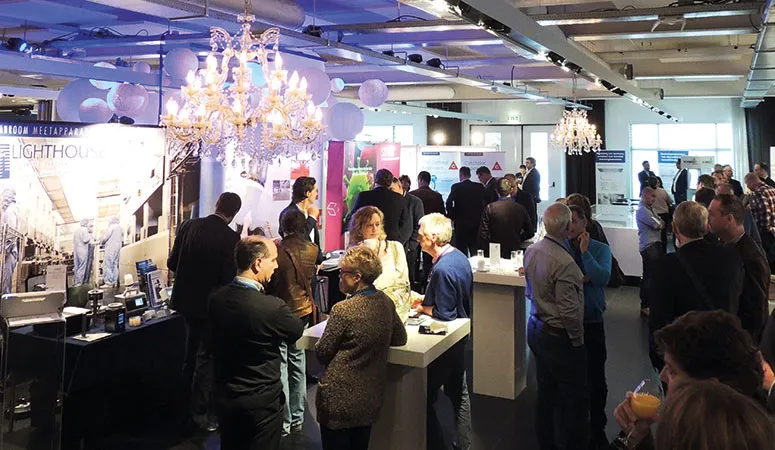
A special event on contamination control took place in Bussum on 7 October: the 13th VCCN National Cleanroom Day. The presentations showed that creating a cleanroom is an extremely complex task. It brings together a wide range of technical disciplines and involves various stakeholders. The V-model provides a practical framework from planning through to commissioning.
Conference chair Wouter Burggraaf of VCCN lectures and conferences spoke about the importance of the event. “The 13th VCCN National Cleanroom Day is about raising awareness of contamination control. Gaining and sharing knowledge. Both the air and surfaces in a cleanroom can become contaminated and require disinfection. Contamination is transferred through particle deposition and direct contact. People are the biggest source of contamination in a cleanroom.” Frans Saurwalt of Kropman Contamination Control discussed the purpose of contamination control. “For an increasing number of companies, the use of low-dust and low-microbial environments is an essential part of the primary process. We use the V-model as a framework for creating a cleanroom, from initial concept through to use. The model shows the level of abstraction over time. At the outset, the client’s wishes are abstract. Standards and guidelines provide a framework for specification and design. Wishes and requirements are translated into a drawing with dimensions and material choices. Construction follows, giving the cleanroom a tangible form. Validation then tests it against measurable criteria. The criteria selected are specific to the sector and depend on the user. The final stage, use, concerns personal behaviour and adaptations in the way the cleanroom is used.”
Standards, specifications and design
André van Tongeren of Aero-Dynamiek gave a presentation on standards. “There are many standards and guidelines relating to cleanrooms. They form the basis for agreements between stakeholders. Although they can be difficult to understand, it is worth the effort. VCCN provides support through training courses. ISO standards apply worldwide, CEN standards in Europe and NEN standards in the Netherlands. Contamination control is covered, for example, by NEN-EN-ISO 14644 (airborne particles) and NEN-EN-ISO 14698 (micro-organisms). VCCN RL 09 covers particle deposition and VCCN RL 10 covers air permeability.” Peter van Casteren of Philips Innovation Services spoke about design and specification. “If you don’t ask for something, you won’t get it. Drawing up a good set of requirements is complex. The production process is central. The design is based on the specifications requested, but even more so on the intended use. That is the guiding principle for construction and validation. It is important to understand the total cost of ownership, including the costs of energy, cleaning, maintenance and consumables.”
Construction and validation
Michiel van Kooten of Cleanroom Combination Group explained the process of constructing a cleanroom. “Various factors need to be considered when constructing a cleanroom, including ergonomics, air quality, fire resistance and cleanability. Decisions need to be made about the layout and materials. These affect the construction method and sequence. I advise clients to do their research, look at reference projects and use mock-ups. It is important to record milestones during the construction process and communicate changes to all parties involved. Moving a LAF cabinet, for example, can already affect air circulation.” Edwin den Hartog of Kalibra International BV provided further details on cleanroom validation. “Validation involves checking critical factors in the production process. It consists of installation qualification, operational qualification and performance qualification. These assess whether what was delivered matches the drawings, whether the systems are functioning and whether the User Requirements Specs have been met. Each sector has specific criteria for HVAC, cleaning, gowning procedures and monitoring.”
Operations
Barbara Wessels of Ecolab Contamination Control gave a presentation on operations. “Before entering a cleanroom, people must be fully gowned to prevent skin flakes or hair from entering the air. These particles can carry micro-organisms. People working in a cleanroom must be properly trained. Moving quickly disrupts the laminar flow in a cleanroom. Turbulence causes particles to become airborne. Infection can also be caused by contaminated materials brought into a cleanroom. Cleaning and disinfecting the room remain essential.” Wouter Burggraaf concluded the lecture programme for new professionals: “Nothing is absolute when creating a cleanroom. Keep thinking for yourself. Remain constantly aware of the process for which it will ultimately be used. Today we talked about contamination control, about keeping out micro-organisms and dust particles. We are dust, and to dust we shall return. Today, we gave you food for thought.”
Text and photo: Martijn van den Bouwhuijsen
 |
Project information |
|
|
|
Tailored cleanroom monitoring
“Air quality is business-critical in hospitals,” says sales engineer Lars Smidt on behalf of Lighthouse Worldwide Solutions. “To ensure patient safety and quality assurance, monitoring systems must be used to independently record the conditions of rooms and equipment, as well as working practices.” Lighthouse Worldwide Solutions supplies measurement equipment and delivers monitoring systems. In an operating theatre, for example, temperature, humidity, particle concentration and the number of door movements are measured, and checks are made to see whether critical values have been exceeded. “Thanks to our partnerships with end users, our many years of experience and our knowledge of regulations, we offer the tailored solutions you would expect from the market leader in Environmental Monitoring Systems.”
Every monitoring solution is 100% tailored to the applicable standards and regulations. Lighthouse’s comprehensive monitoring solutions enable a single system to be used throughout the hospital, covering all departments while allowing access rights to be set separately for different users. “This makes monitoring safer and more efficient.”
For more information: www.golighthouse.nl
|
Project information |
|
|
|
Cleanroom construction specialist
Cleanroom Combination Group (CCG) specialises in the construction of low-dust and low-microbial environments. The company, based in Bergeijk, takes an integrated approach from final design through to handover. It provides ‘Room for perfection’ for clients in the pharmaceutical industry, biotechnology, biopharmaceuticals, healthcare, nanotechnology, microelectronics and other high-tech industries.
“By listening carefully and working with our clients, we can build cleanrooms in which performance is optimised,” says CCG technical director Michiel van Kooten. “We have extensive experience in constructing and refurbishing operating theatres, and we have the knowledge, ideas and materials.”
CCG provides, among other things, fixed fittings, loose furniture, doors, pass-through cabinets, wall systems and ceiling systems. It also develops products such as the flexible CCG-10 wall system. The wall in the CCG-10 system consists of a freestanding HPL frame, which incorporates services such as pipes and ducts. This frame is clad with a 10 mm-thick HPL panel, mounted so that it can be dismantled at the floor and ceiling junctions. “This makes it quick to modify the services in or behind the wall, with minimal disruption to operational processes.”
For more information: www.ccgholding.nl
Have a business enquiry for CCG Holding? Get in touch
Companies in this story
Keep following this
Get an email when a new story is published. No account needed.
- ThemeSafe and reliable healthcare buildings
- SubjectGeneral
- CompanyCCG Holding







