











New pilot project to reduce hospitals’ waste mountain
Select4Care is pursuing a circular strategy for medical plastics
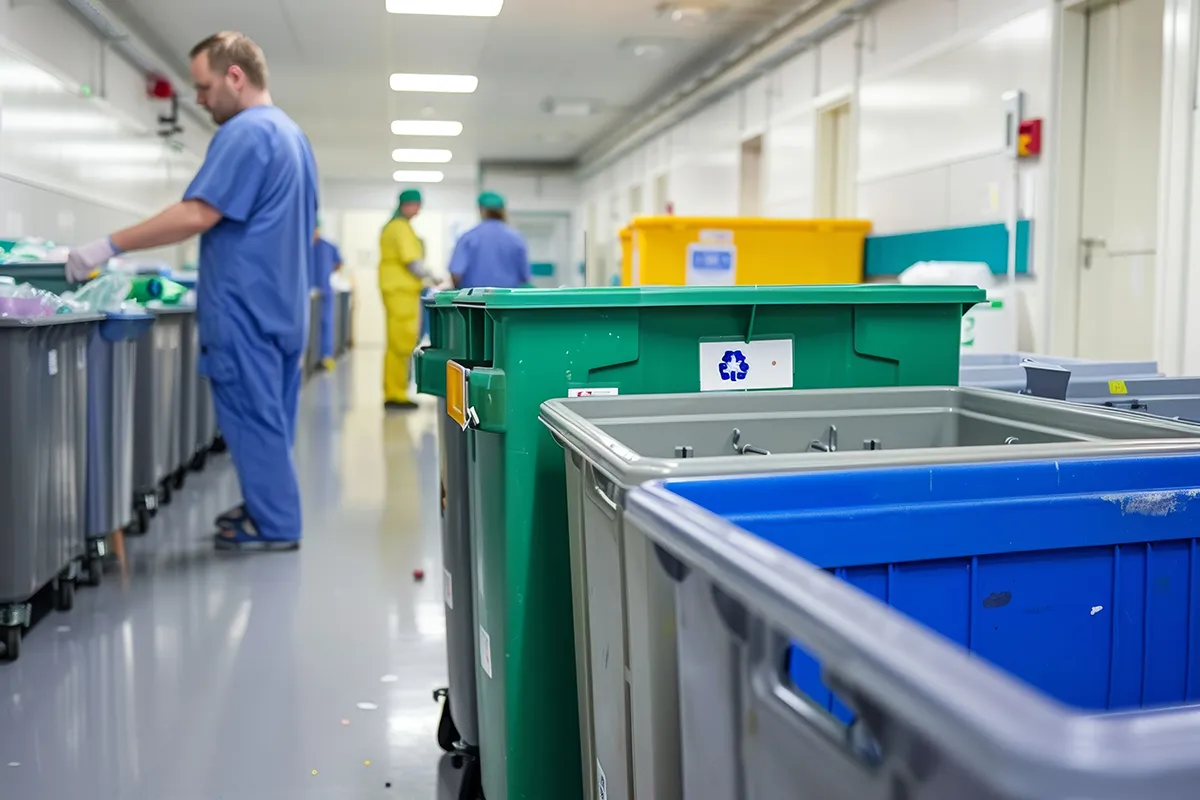
Hospitals generate a large volume of plastic waste. Today, most of it is incinerated, partly because of regulations and partly because there are no other solutions. To change this, a groundbreaking pilot project starts this week at Ziekenhuis aan de Stroom Cadix in Antwerp. The aim is to collect disposable medical materials and instruments from operating theatres separately, disinfect them and then sort them for recycling.
Select4Care, a project by VIL and Denuo
This pilot project is part of Select4Care. This is a collaboration between VIL and Denuo, with financial support from Vlaanderen Circulair and VinylPlus®. VIL is the innovation platform for the logistics sector. Denuo is the Belgian federation of the waste and recycling sector.
No fewer than twenty-four parties are joining forces for this pilot project, including hospitals, recycling companies, medical materials manufacturers, waste companies and social enterprises. The broad interest in the project demonstrates the need for change. Hospital staff are also calling for greater emphasis on sorting and recycling materials.
Strict rules and no alternative
The impetus for this new project is the growing volume of waste from medical materials and instruments. Many of these plastic products are incinerated after a single use. This is partly due to strict regulations, but also to the lack of circular alternatives. With this new pilot project, VIL and Denuo, together with various partners, are taking an important step towards a more sustainable solution.
Pilot project in Cadix operating theatre
The pilot project is taking place in the operating theatre at Ziekenhuis aan de Stroom (Cadix campus, Antwerp). This is no coincidence, as the operating theatre generates the largest waste stream. For two weeks, staff will collect all plastics in special sealed collection bins.
“We use enormous quantities of plastic materials every day in an operating theatre. After a single use, they go straight into the waste. Too much of this is still incinerated today, even though we all know that this is not sustainable. Sustainable care does not stop with the patient. What we do with our waste also determines the health of society tomorrow.” Jean-Luc Jadoul, anaesthetist, ZAS
The material will then be decontaminated in a washing unit made by the Dutch company Greencycl. The company already has experience decontaminating metal medical instruments. The plastics will then be dismantled and sorted by hand.
Interest is also growing in the Netherlands. Maasstad Ziekenhuis Rotterdam has started a similar trial in parallel, providing additional data for evaluating the test.
From proof of concept to a viable business model
This pilot project will establish whether the method is practical. We will investigate which plastics are generated, and in what volumes, and how they can be safely reused.
The aim of this test is to achieve an initial ‘proof of concept’. This will be followed by an economic analysis, with the goal of turning the pilot project into a scalable and profitable model. The results of the pilot project will be presented to the public at a closing event in late 2025.
Question about this story? Ask your question
Keep following this
Get an email when a new story is published. No account needed.
- ThemeSustainable healthcare buildings
- SubjectGeneral







