











Portfolio roadmaps and tools
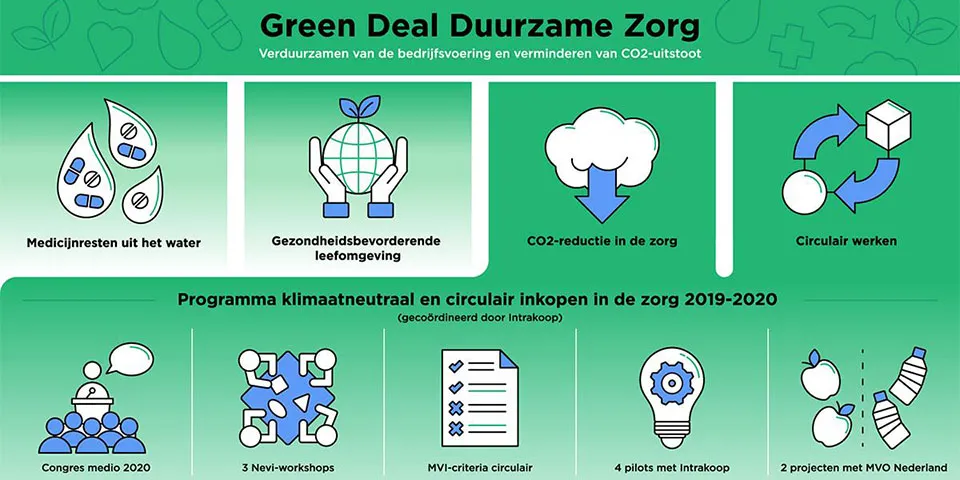
The Green Deal on Sustainable Healthcare 2.0 commits the sector organisations NFU, NVZ, ActiZ, GGZ Nederland and VGN to encouraging their members to draw up individual portfolio roadmaps by the end of 2020. These roadmaps will set out how each organisation will contribute to the CO2 emissions reduction target in the Climate Agreement. The portfolio roadmaps will periodically be translated into an updated sectoral roadmap. If the sector achieves sufficient CO2 emissions reductions itself, this will prevent government intervention and additional requirements being imposed to ensure the sector meets its targets.
Distinguishing between direct and indirect CO2 emissions
Under the so-called ‘chimney approach’, which is the basis of the Climate Agreement, only reductions in direct emissions from the building stock count towards the reduction target for the built environment. For buildings, this primarily means reducing natural gas consumption. Reductions in indirect emissions are also taken into account, but contribute to the targets of other sectors, such as energy production. As a result, a specific additional target has been set for existing non-residential buildings by 2030: an additional 1 Mtonne reduction in CO2, to be achieved by reducing natural gas consumption (approx. 18 PJ or approx. 512 million m3). For 2050, no specific target has been set for reducing natural gas consumption, in addition to the 95% reduction in CO2 emissions. Nor has a specific target been agreed for the built environment’s contribution to reducing indirect emissions. However, certain energy policy instruments aimed at the built environment do contribute to this, including: (1) the energy-saving obligation under the Activities Decree; (2) the new BENG requirements for new-builds; (3) requirements under the revised EPBD and (4) various subsidy schemes.
Given this monitoring approach, portfolio roadmaps should explicitly distinguish between an organisation’s contribution to reducing direct CO2 emissions (reducing natural gas consumption) and its impact on indirect CO2 emissions (expected savings and/or increases in electricity consumption, generation of renewable electricity on site, use of centrally generated heat, …).
Guidance
Several initiatives have been launched to support the healthcare sector in preparing portfolio roadmaps. These include guidance to help care and cure organisations draw up a portfolio roadmap in a structured way. The guidance was validated in pilot projects for the care and cure sectors with a limited number of organisations, and amended where necessary. Various tools have also been developed to support the preparation of portfolio roadmaps. The guidance is available on the website of the Expertisecentrum Verduurzaming Zorg
(EVZ, www.dezorgduurzaam.nl).
Tools
A tool has been developed for care organisations to calculate CO2 reductions for their property: the CO2 Reductietool. It allows users to schedule energy-saving measures for existing healthcare properties. The tool provides insight into energy savings, payback periods, CO2 reductions and the costs and benefits of each measure. Users can see the CO2 reductions at each site and, via a clear dashboard, across the organisation’s entire property portfolio. Both legally recognised measures and major renovation measures can be scheduled at building level, with standard figures provided for investment and energy savings. Where desired, users can overwrite this information with more specific details, for example based on quotations. New-build projects can also be easily scheduled and included in the calculations. This enables healthcare organisations to make practical progress towards meeting the climate targets for 2030 and 2050.
A further tool is available, which was also used to carry out the calculations for the sectoral roadmaps. By entering the volume and quality of their own property, organisations can project the scenarios used in the sectoral roadmap onto their own buildings. This provides an initial indication of the options available to a healthcare organisation and the investment required. Parameters for these scenarios can also be adjusted to assess their impact and sensitivity. A further tool has been developed to calculate direct and indirect CO2 emissions based on energy consumption (kWh electricity, m3 natural gas and GJ external heat) in a given year. The tools can be downloaded from the EVZ website (www.dezorgduurzaam.nl).
11 JUNE: CONFERENCE ON SUSTAINABLE PROCUREMENT IN HEALTHCARE
On 11 June 2020, Intrakoop, Nevi, Milieuplatform Zorg, MVO Nederland and the Ministry of Health, Welfare and Sport are organising a national conference on sustainable procurement in healthcare. The day promises to feature inspiring speakers, practical breakout sessions and plenty of networking opportunities. Find out more at:
Question about this story? Ask your question
Keep following this
Get an email when a new story is published. No account needed.
- ThemeSustainable healthcare buildings
- SubjectGeneral







