











Survey of hospitals reveals major energy-saving potential in operating theatres!
Auteurs: Dr. Ing. Roberto Traversari MBA, drs. Ing. Jos Lans, Ir. Wim Maassen EngD en Drs. Sandra LakoImage Pexels
Landelijk Netwerk de Groene OK is investigating energy use by air-handling systems in operating theatres. This article presents the initial findings. The study is funded by the Ministry of Health, Welfare and Sport (VWS) under measure 51 of the Urgenda agenda.
Landelijk Netwerk de Groene OK is a partnership of fifteen scientific and professional associations working to make care in operating theatres more sustainable. It is also a signatory to the Green Deal 3.0 ‘Working together for Sustainable Healthcare’. The network encourages and supports individual medical specialists and healthcare professionals working in operating theatres to contribute to climate targets in a sustainable way. The Energy working group focuses on CO2 reduction and energy saving in operating theatre departments. The energy consumption of an operating theatre department differs fundamentally from that of a whole hospital. This is because more than 90% of the energy consumed by an operating theatre department is used by its ventilation system.
INITIAL FINDINGS
The study was announced in the January 2023 edition of Bouwen aan de Zorg. This article presents the main findings from the first phase of the study. Between mid-2023 and the end of 2023, all hospitals were invited to complete a survey about the air-handling systems serving their operating theatres and how those theatres are used. Of the 93 hospitals contacted, including the 7 University Medical Centres, 51 completed surveys were returned (55%). The findings show that 55% of operating theatre departments are more than 10 years old, while 12% were built before 1995 and are therefore more than 30 years old. This is notable, as the technical service life of an air-handling system for an operating theatre or department is generally no more than 15-20 years.
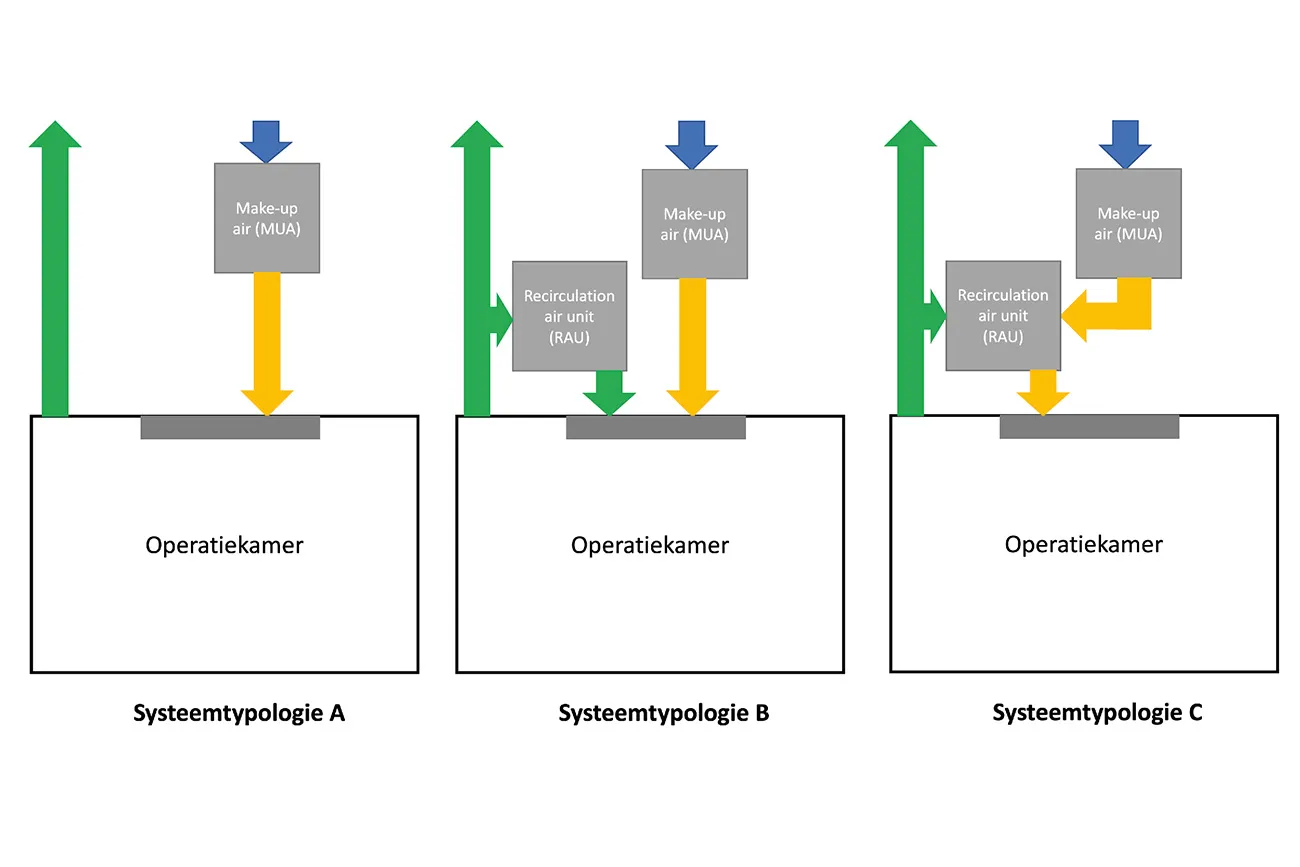
Three basic systems can be distinguished, as shown in Figure 1. The analysis shows that 16% of respondents use air-handling system typology A, 41% typology B and 43% typology C. Operating theatres built before 1995 are predominantly typology A. The airflow rates used are shown in Figure 2.
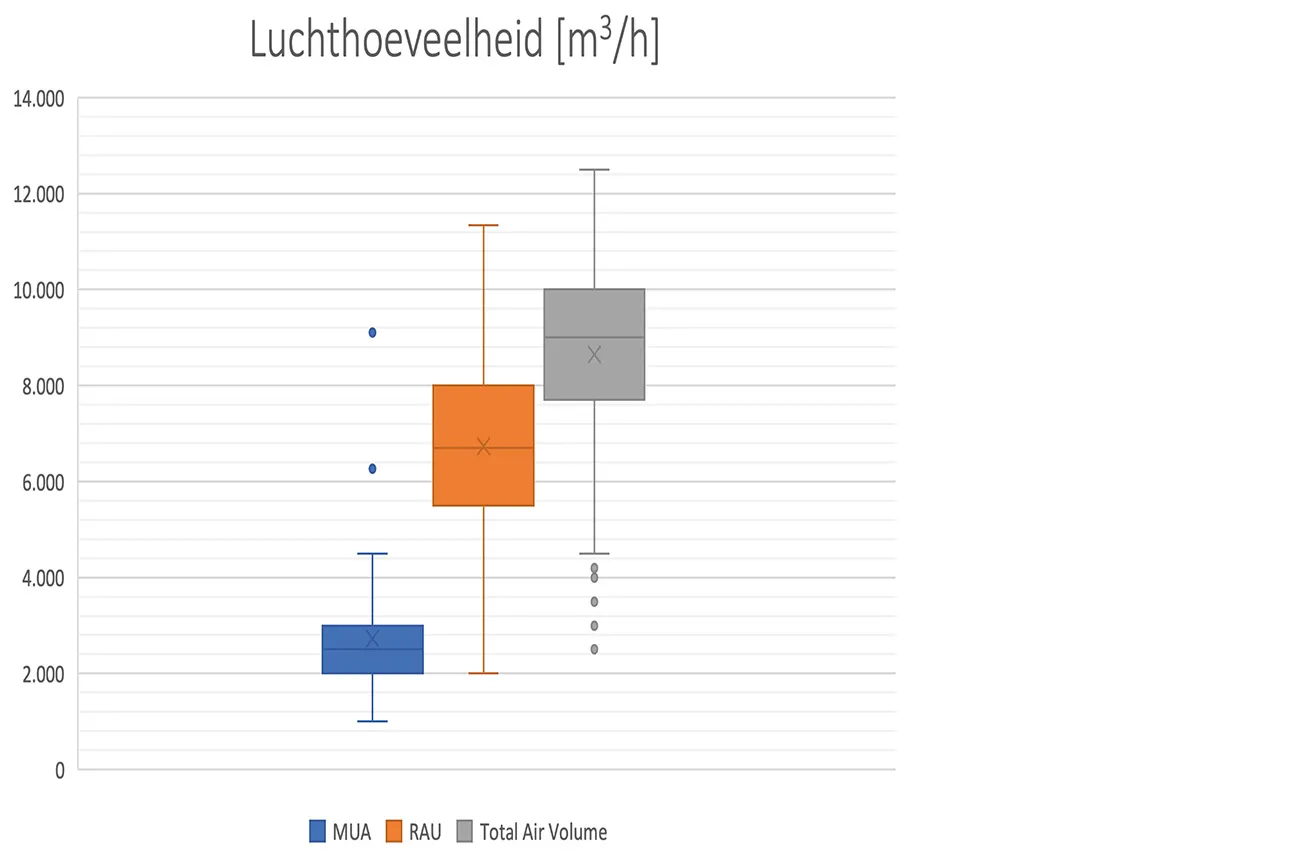
The volume of fresh outdoor air (MUA) ranges from 1,000 to 4,500 m3/h, with outliers of up to 9,000 m3/h. For the use of inhalation anaesthetics, the UMC Occupational Health and Safety Catalogue (ventilation in operating theatres and recovery rooms) states that, depending on the anaesthesia system used, the fresh air volume should be between 1,000 and 2,000 m3/h. Some hospitals therefore use considerably more fresh outdoor air than the minimum required. This fresh air is energy-intensive because it is heated, cooled, humidified and dehumidified in the MUA. The ‘recirculation air’ in the RAU is conditioned only to a limited extent. The total air volume supplied to the operating theatres ranges from 2,200 to 12,500 m3/h.
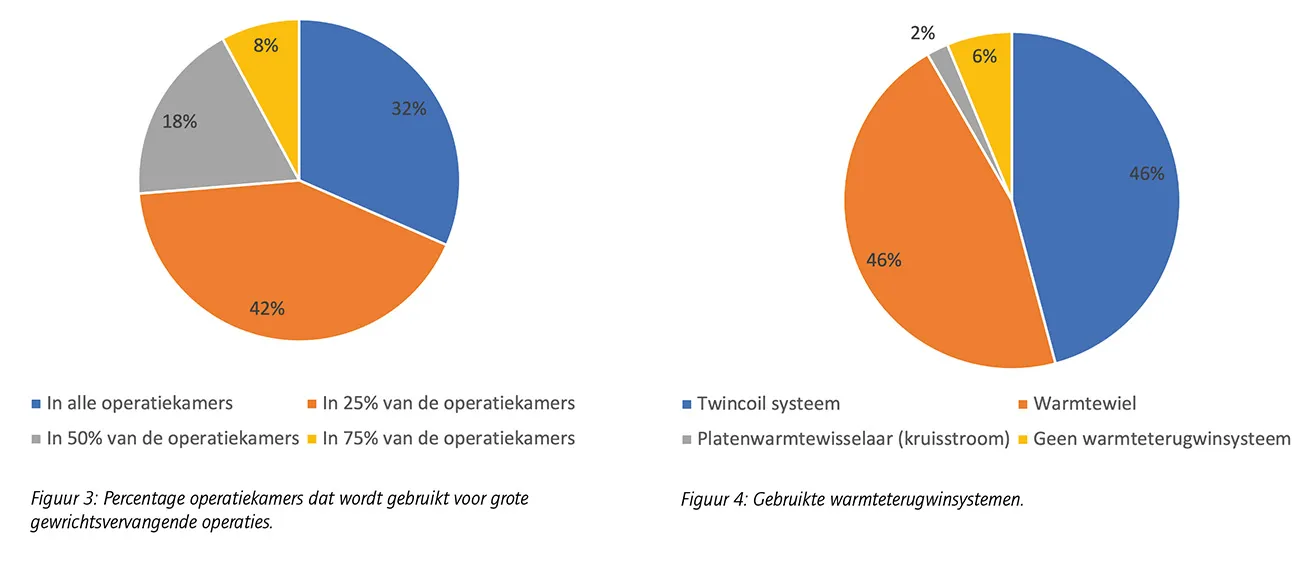
The number of air changes in a room is known as the air change rate. The study found that operating theatres have an average air change rate of 60 h-1. This is considerably higher than the requirement for a Class 1 and Class 1+ operating theatre, which is an air change rate of 20 h-1, under the FMS guideline on air-handling in operating theatres and treatment rooms. This higher air change rate is necessary to meet the Dutch Orthopaedic Association (NOV) position statement on requirements for a Class 1+ operating theatre. The study shows that in 32% of hospitals, all operating theatres are used for major joint replacement procedures, as shown in Figure 3. In 42% of hospitals, these procedures are performed in only 25% of operating theatres.
Energy-saving measures
The findings show that almost all operating theatres are Class 1+, making them suitable for major joint replacement surgery. In practice, however, they are often not used for this purpose. Many operating theatres therefore use more (recirculated) air than required for much of the time, resulting in unnecessary energy consumption.
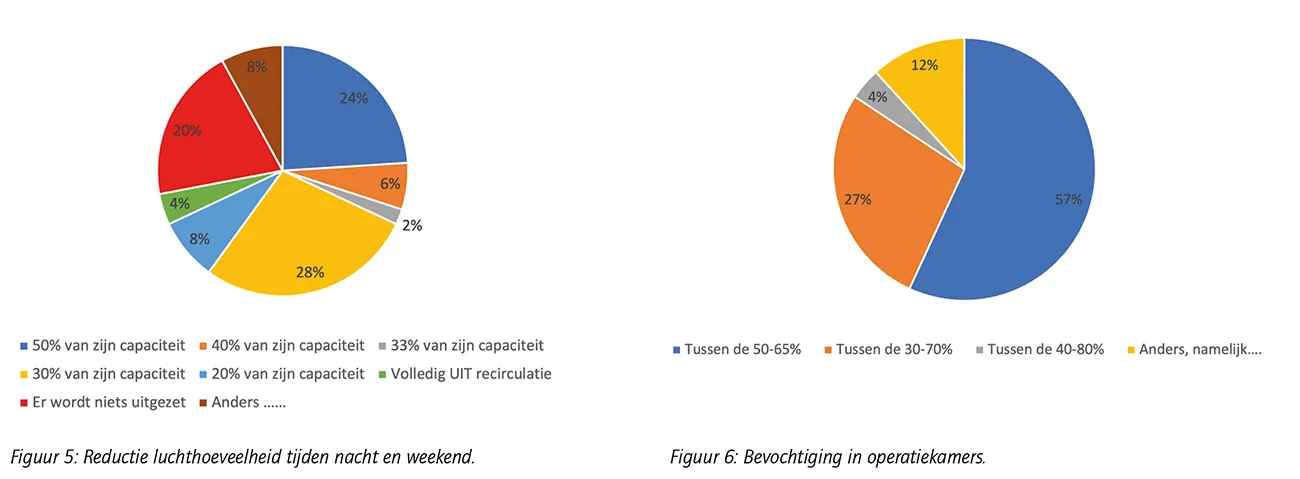
Most operating theatres, 94%, recover energy (heat) from exhaust air. Figure 4 shows that rotary heat exchangers and twin-coil systems, in which heat exchangers are installed in the supply and extract air streams and connected hydraulically via a pump, are the most widely used. In 72% of hospitals, airflow is reduced by at least 50% at night and at weekends. Some hospitals (4%) even switch off recirculation completely, as shown in Figure 1, and supply only fresh outdoor air, as shown in Figure 5.
Humidification consumes a great deal of energy. For this purpose, 76% of hospitals still use steam generated centrally using natural gas, 20% use electric humidifiers installed locally at the air-handling unit, and 4% use adiabatic humidification. Despite the study by the Centre of Expertise for Sustainable Healthcare, the position statement of the UMCs and the advice of De Groene OK, operating theatres are still humidified extensively, as shown in Figure 6. In 57% of operating theatres, humidity is still maintained at between 50 and 65%. The survey also shows that only 4% of hospitals (n=51) measure and analyse the energy consumption of their operating theatre air-handling systems and use the results to guide their operation.
CONCLUSION
Hospitals are already taking various measures to reduce the energy consumption of air-handling systems in operating theatres. Almost all hospitals use heat recovery systems to recover energy from the exhaust air stream. Airflow is also often reduced at night and at weekends. However, airflow is only rarely adjusted to reflect whether a Class 1 or Class 1+ operating theatre is needed. In practice, a Class 1+ operating theatre has far more air changes on average (60 per hour) than the minimum of 20 air changes per hour required by the FMS guideline, in order to meet the requirements set out in the NOV position statement.
There appears to be considerable potential for energy savings through measures such as reducing humidity, and, where the type of procedure allows, switching airflow in a Class 1+ operating theatre to the Class 1 level. Reducing the volume and proportion of fresh outdoor air could also make a significant difference, as it consumes much more energy than recirculated air. Further reductions in airflow at night and at weekends could also deliver substantial savings. The next phase of the study will involve measurements in a number of operating theatres and a national-level calculation of the energy-saving potential of these measures.
Question about this story? Ask your question
Keep following this
Get an email when a new story is published. No account needed.
- ThemeSustainable healthcare buildings
- SubjectGeneral







