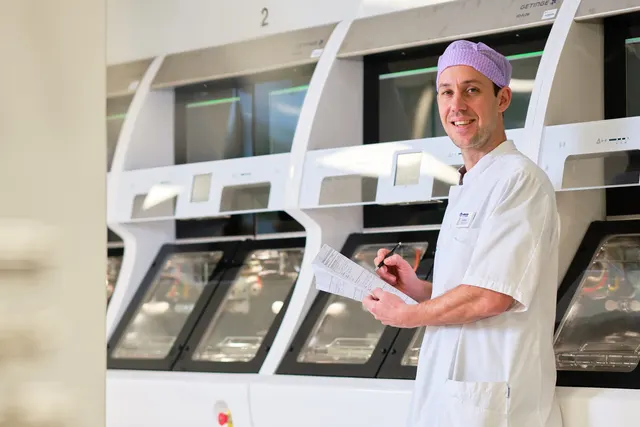
Bernard Ceriez: ‘Healthcare needs fundamental reform’
Text Koen MortelmansImage Marc Wallican

Belgian healthcare is at a crossroads. The system, long praised for its accessibility and quality, can no longer meet the growing challenges. The Belgian Association of Hospital Directors (BVZD) is sounding the alarm.
“We felt that the negotiations to form a new federal government presented a good opportunity to do this,” says BVZD chair Bernard Ceriez. “Growing demand for care, severe staff shortages and the financial difficulties facing many hospitals are bringing the system ever closer to an existential crisis. Without structural reforms, the affordability, efficiency and accessibility of care will all be at risk. That is why BVZD is calling for fundamental transformation, based on the concept of value-based healthcare (VBHC). This makes it possible to deliver healthcare solutions at manageable cost.”
A coherent vision is needed
“Traditionally, our healthcare system has focused on treating and combating acute conditions, with remuneration based mainly on activity. We need a new approach to reforming the organisation and financing of healthcare, one that puts patients and the highest possible quality of care at its centre. This requires transparency, accelerated digitalisation, robust data infrastructure and close collaboration between all the stakeholders involved. These include not only hospitals, but also medical associations, many hospital doctors in Belgium are self-employed, health insurance funds and the various government bodies responsible for hospitals.”
VBHC
“In 2006, Michael Porter and Elizabeth Teisberg introduced VBHC as a solution to rising healthcare costs and increasing pressure on the quality and accessibility of healthcare worldwide. The aim of VBHC is to sustainably improve outcomes by organising care around individuals with a specific condition. This is achieved by standardising the measurement of outcomes and costs, and using these data to monitor and compare performance within and between organisations. VBHC defines value as the measured improvement in a person’s health outcomes relative to the cost of achieving that improvement.”
“VBHC offers a clear approach and mindset for decisively tackling the shortcomings of the current model,” says Ceriez. “It organises integrated care holistically around patients’ needs, with a focus on prevention. This does not mean that hospitals have to specialise, but that care providers must offer patients a clear care pathway. This, together with more efficient use of available resources, will keep care accessible and affordable for everyone.”
Government must take the lead
“A successful transition to VBHC calls for a nationally coordinated approach. This is a major challenge given the complex structure of Belgian healthcare. The division of responsibilities within the state model leads, in part, to overlapping responsibilities and delays systemic reform. Despite significant spending, the system’s results fall short of expectations. As the system’s largest funder, the government provides the resources and also has an important responsibility to facilitate change and innovation with all stakeholders.”
Belgium is lagging behind internationally
“While many other countries are making progress in modernising their healthcare systems by beginning to implement VBHC, Belgium is falling behind,” Ceriez believes. “The government does too little to encourage innovation and digitalisation that would enable data-driven healthcare. This not only hampers the integration of new technologies, but also slows the introduction of sustainable care models such as VBHC. Without a clear strategy, Belgium will remain stuck in a reactive system.” BVZD, which represents 95% of general and academic hospitals, is therefore calling for a federal coordinating body to lead the transformation. “It should have political backing and involve all stakeholders in developing a shared strategy and clear roadmap for systematically implementing VBHC. Alongside political support and financial resources, a change in mindset is essential to make this shift towards future-proof healthcare possible. It requires leadership and the courage to make structural choices. With the right approach, however, Belgium has the opportunity to become a European example.”
Question about this story? Ask your question
Keep following this
Get an email when a new story is published. No account needed.
- SubjectInterviews & columns