











Amersfoort: conference on the next generation of healthcare property
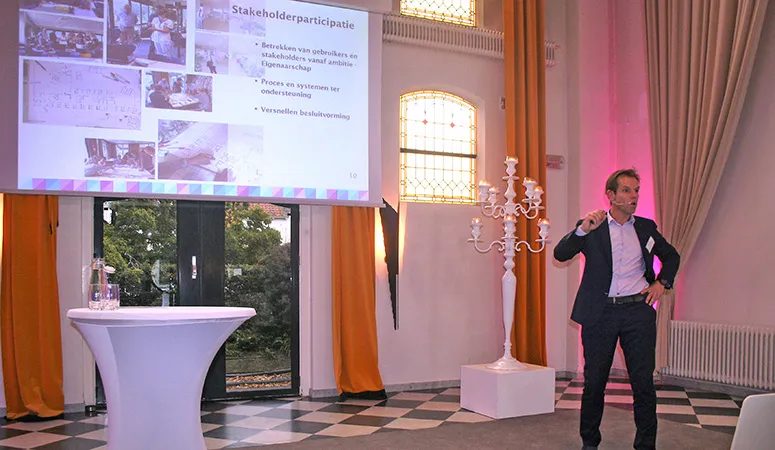
‘Opportunities for new and existing healthcare property’: the future lies with stakeholder alliances
In the exclusive setting of Mariënhof, a wedding venue in Amersfoort, healthcare property specialists came together on 11 October for a series of varied presentations. A lease arrangement with an investor? Keeping new-build projects in-house and standardising them? Or creating ‘uniqueness and connection’ through stakeholder alliances? These are very different approaches. Keynote speaker and Government Architect Floris Alkemade sees opportunities in transformation and the repurposing of buildings.
Easier said than done, because healthcare property is not a category in its own right. Acute and community care sometimes operate in tandem, but usually they do not. And there are significant differences within healthcare organisations’ own property portfolios. Belgian investor Cofinimmo, which owns hospital sites and health centres in the Netherlands, among other assets, does not invest in healthcare property indiscriminately. “The Netherlands is an interesting growth market for international investors because of the need for diversification. But investors are not indiscriminate in their investments,” says CEO Sébastien Berden. “For example, we advise hospitals to retain ownership of their main sites, as these are strategic assets. However, there are often opportunities to dispose of peripheral property, such as offices, or to sell us satellite sites and lease them back. For instance, we can own buildings for a period of forty years, after which ownership reverts to the user. We are also seeing US-style trusts emerge: groups of small investors investing in healthcare property.” These arrangements give healthcare organisations undertaking construction projects additional investment capacity, Berden argues. Changes in government policy are a risk for investors. “That is why it is important to build flexibility into the property when an investor becomes involved in a new-build or renovation project.”
Rijnstate’s alliances
Hospital Rijnstate, which has four sites in and around Arnhem, has placed an outpatient clinic with Cofinimmo. The building serves as “a gateway to healthcare in Arnhem-Zuid”, says Willem-Jan Hanegraaf. The construction programme director at the Gelderland hospital group was in Amersfoort to explain the project approach it had developed in-house, a hybrid of the traditional construction team and integrated contracting. The principles are collaboration on an equal footing, greater investment upfront and making use of the market’s expertise. “This enables us to select the best consortium for each specific sub-project, for example, the current renovation of our hot floors. The result is a team led by a single project director, which also reduces overheads.”
This project model includes a contingency fund for unforeseen circumstances. “So far, the amount required has been in line with expectations,” says Hanegraaf. Forming these changing alliances is a learning process, and there is still room for fine-tuning. “A future goal is to involve design firms on a risk-sharing basis as well. One major advantage of this approach is that it creates commitment while avoiding rigidity.”
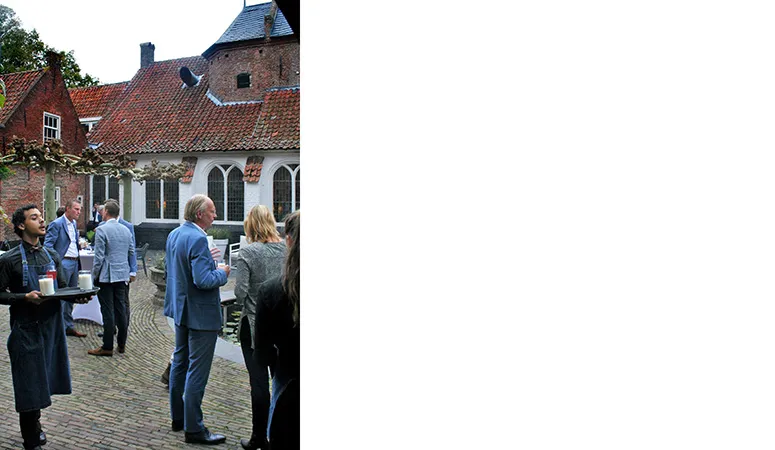
The former Mariënhof monastery in Amersfoort provided an elegant setting for the conference.
’s Heeren Loo’s accommodation concept
With around 1,000 buildings, mental healthcare organisation ’s Heeren Loo is a major landowner, in the words of moderator Elisabeth van der Hoogen. New-build and renovation projects for care homes follow a fixed accommodation concept that incorporates many generic features, even after individual housing preferences are taken into account. The starting point is a 21 m² studio with a 5.5 m² bathroom. Variation is mainly found in the form and appearance of the apartment building. “The findings of the research that led to this concept initially surprised us,” says property director Roeland Brouns. “Our client group is diverse, but housing preferences are generally similar: a private room with a shower and toilet. The great thing is that the concept can be standardised in both design and delivery, and further developed. We work with preferred partners to do this. We are also committed to the sustainability transition, using the Green Deal for Healthcare, BENG and the Climate Agreement as our guiding principles. Our priorities are meeting statutory requirements, a fast construction process, low capital costs and flexibility in occupancy.
For now, a standard concept is working well. In principle, it could also be applied successfully in elderly care,” Brouns says in response to a question from the audience.
Park Vossenberg
Stichting Maasduinen, a care provider operating in the municipalities of Waalwijk, Loon op Zand and Gilze en Rijen, is taking the opposite approach. Together with Loon op Zand council, a housing association and Rabobank, it is creating a ‘unique’ residential area on the grounds of an existing site in Kaatsheuvel: Park Vossenberg. “Stichting Maasduinen creates communities, combining residential care with independent living. This fits with Rabobank’s philosophy,” says healthcare sector manager Suzanne van Hoeve. “We are investing around 400 million in sustainability. The quality of use is part of our sustainability vision, and Park Vossenberg is a good example of this.” Designed by BiermanHenket, Park Vossenberg will comprise one hundred apartments arranged around the former Sint Antonius mission house, with its existing chapel serving as a community centre and extensive green space. Stichting Maasduinen owns and is developing the six-hectare site; the existing care home will be demolished. As the government is encouraging people to live at home for longer, working with the council on this project is no easy task, says Vicky van Kuijk of Stichting Maasduinen. “Sometimes there could be a little more trust in what we are doing here for the community: creating a unique and inclusive way of living together, a ‘village within a village’.”
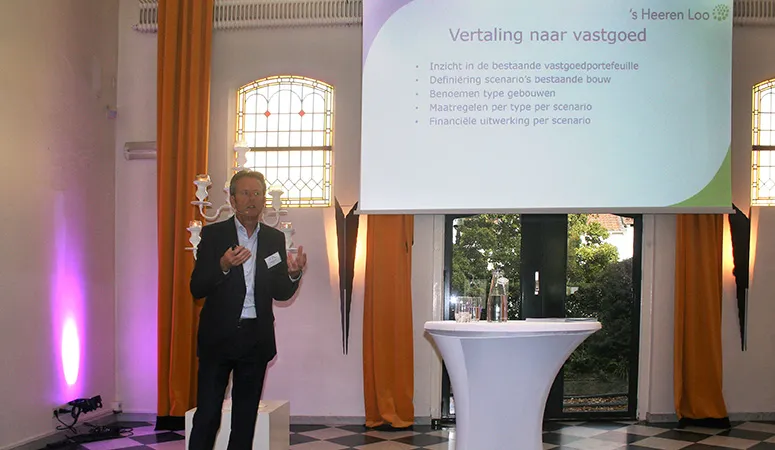
Roeland Brouns discusses ’s Heeren Loo’s accommodation concept.
Alkemade’s vision
A Government Architect who has taken a particular interest in healthcare property? Floris Alkemade has done so, through the Who Cares initiative, which brought together various alliances to develop new healthcare concepts. Courtyard living was one of the winning concepts. Alkemade sees an ageing population not as a problem, but as an “extremely welcome” opportunity to transform ageing neighbourhoods, for example by converting vacant office buildings for residential use. In a presentation summarising the history of supported living, Alkemade drew on statistical data to conclude that transformation and repurposing are key components of the necessary process of change, driven by an ageing population, a declining number of young people, individualisation and deinstitutionalisation. This calls for a focus on smaller households, with a higher average age than in the past, living in independent homes. The separation of functions must be avoided; shrinking regions and disadvantaged neighbourhoods present the greatest challenges and the greatest opportunities. “We need to think in terms of social benefits, with people in need of care as an integral part of society.” New forms of supported living may be the most urgent niche in the housing market.
Words & images | Jan-Kees Verschuure
Featured image: Willem-Jan Hanegraaf of Rijnstate highlights the strength of alliances.
Question about this story? Ask your question
Keep following this
Get an email when a new story is published. No account needed.
- ThemeFuture-proofing healthcare estates
- SubjectGeneral







