











Future-proof property calls for innovation from care providers and better collaboration with investors
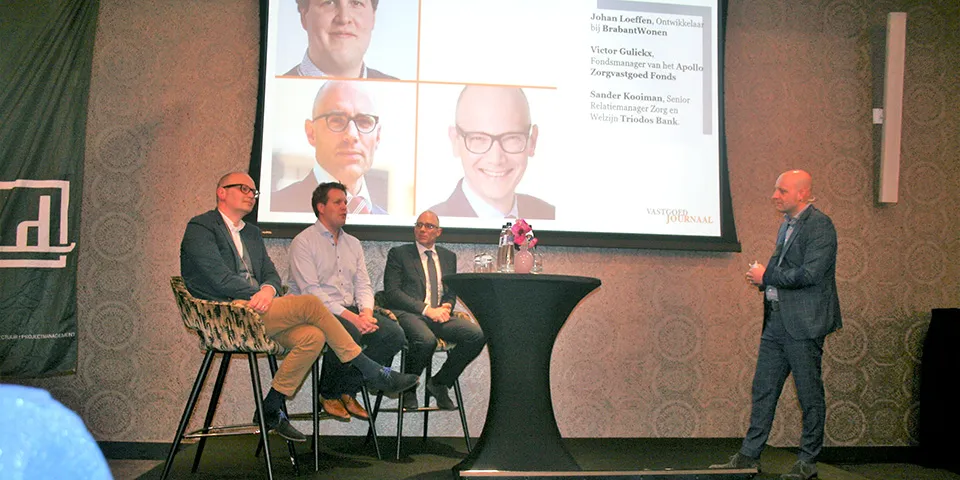
The ambitious premise of the healthcare property conference, entitled ‘What healthcare property will be needed in five years’ time?’, was difficult to cover. The time frame simply falls short, the speakers agreed. A sense of urgency is nonetheless very welcome, was the conclusion at Van der Valk hotel Utrecht on 11 April. In recent years, the sector has faced a ‘tsunami’ of housing preferences and property requirements, while demand for care continues to outstrip supply. Not in five years’ time, but already.
Does our healthcare property still meet today’s needs and requirements? “We are not sufficiently concerned about the growing number of people aged over 80 and those living alone, there is not enough diversity in the housing supply, the proportion of working people in society is falling, and the growth in care provision will always be lower than demand,” warns Rick Hoogenboom, also managing director of De Posten in Enschede, on behalf of ActiZ. Intermediate forms of care housing, clustered with facilities, are needed, but ‘silos and pots of money’ make this complicated. “Building for Wlz care is not that difficult; at the same time, older people occupy many hospital beds.” The various speakers from care institutions all face this challenge, while investors such as banks, investment funds and housing associations are at least interested. They still need to find one another when it comes to redevelopment and new-build projects. That is the simple starting point; the challenges are varied and complementary. In addition to the necessary investment over the life of a building, healthcare property needs to adapt to the separation of housing and care, statutory sustainability requirements, and growing and changing demand. “The care gap, the difference between supply and demand, certainly cannot be solved with bricks and mortar alone. Enabling people to live at home for longer requires inclusive neighbourhoods,” says Hogenboom. “Rehabilitation, for example, needs to be integrated into everyday life. This requires major efforts from the three parties involved: the municipality, housing association and care provider.”
In-house management or outsourcing?
Underlying everything is the fundamental question: is it right for me as a care provider to own property, or would it be better to outsource the ‘bricks and mortar’ to a specialist? And if so, can I find a partner whose interests align with mine? The principles for adapting property portfolios are the same for care and disability care institutions, the conference’s main target audience, depending on the condition and age of their buildings. Solutions for operation and changes of use can, however, vary considerably according to policy and local factors. A large organisation such as Zorgpartners Midden-Holland (Groene Hart) prefers to retain ownership of its 15 care locations and 11 residential complexes; Zorgspectrum (Nieuwegein and surrounding area; 1,100 clients) focuses on specialist care provision without owning property. “It is good to see more competition and collaboration in our area,” says managing director Vivian Broex. “Competition between care providers thanks to new entrants, and genuine collaboration with property companies. There is still a lot to be gained, particularly in speeding up processes.” Bronia Vermaas, Director of Property at Zorgpartners: “We have found it difficult to find a good match with development partners. We are seeking a balance, carrying out transformations and sustainability upgrades in-house at the right moments.” Johan Loeffen is a Developer at BrabantWonen. This housing association in Oss and Den Bosch took ownership of BrabantZorg’s healthcare property, on a virtually one-to-one basis. “I looked up the term healthcare property in the Groene Boekje, and it turned out not to exist,” says Loeffen. “As I see it, this is about good housing and good care; we stand for the former when it comes to lower-income households in our region, while BrabantZorg stands for the latter. That is where we come together.”
Sustainability upgrades
Archipel Zorggroep in Eindhoven and the surrounding area (2,500 clients/12 locations) focuses on the basics, says Property Manager Bart Smits. “What matters most to clients is having a place available, preferably in their own area.” Etso Pier, Director of the Service Centre at Zorggroep Alliade, also takes a region-specific approach, but with the organisation retaining ownership. The 400 locations and 1,000 buildings in Friesland are adapted to local demand within set concepts, meaning that even studios for people with learning disabilities in group homes can eventually be structurally linked to form family homes. The disability and older people’s care organisation also actively seeks to work with municipalities on site development. “That keeps our property flexible and allows us to take local circumstances into account. Poor North Friesland is a very different setting from Beetsterzwaag, where many doctors and notaries live.” Alliade commissions development concepts based on floor plans and UAV-GC contracts, under which the contractor can use its own construction concept and the appearance may vary. This ensures both diversity and competitive pricing, says Pier, who, as a member of the Dutch Green Building Council’s Werkgroep Zorg Paris Proof, advises opting for the highest achievable level of sustainability. “Invest on the basis of the building’s lifespan. It is better to be ready for the 2050 targets than for 2030. The NHC (normative housing component; ed.) is based on a 30-year period for new-build projects.”
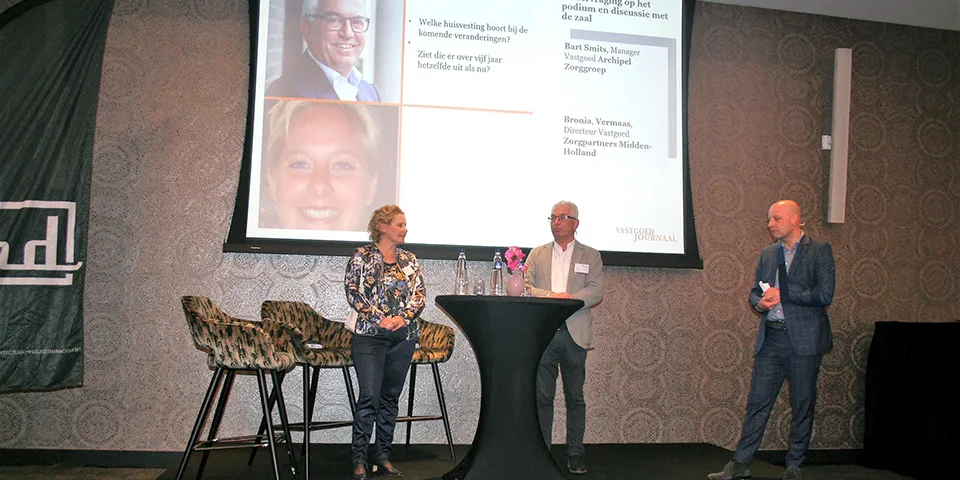
Bronia Vermaas, Bart Smits and conference chair Maarten Visser.
Land prices
For anyone who might see this parade of opinions as a grab bag of speaker quotes, the final session with investors highlighted another necessity: find the right match between care, property and finance. “For Triodos Bank, sustainability is about much more than energy performance. What does your organisation do about food, for example?” says Senior Relationship Manager for Care and Wellbeing Sander Kooiman. Care is a key focus for the bank, according to Kooiman. “As a socially responsible investment. ‘Mixed housing’ (for example, a combination of students and older people; ed.) is encouraging, as are private initiatives.” The idea that investors are only out to take money is a matter of ‘healthy mistrust’ anyway, says Victor Gulickx, Fund Manager at Apollo Zorgvastgoed Fonds. “We all have interests that align. Providing good care through high-quality organisations is essential for us too.” Investment companies are certainly needed where scale must be created and investment capacity is lacking. “Apollo develops care buildings and health centres tailored to tenants’ needs. A major problem is the rising cost of land in cities such as Amsterdam, which makes it increasingly difficult for partnerships of doctors, physiotherapists and dentists to build. Municipalities should take a closer look at that.”
Question about this story? Ask your question
Keep following this
Get an email when a new story is published. No account needed.
- ThemeFuture-proofing healthcare estates
- SubjectGeneral







