











‘Making the healing environment measurable’
Text Koen Mortelmans Beeld Klaas Huizenga
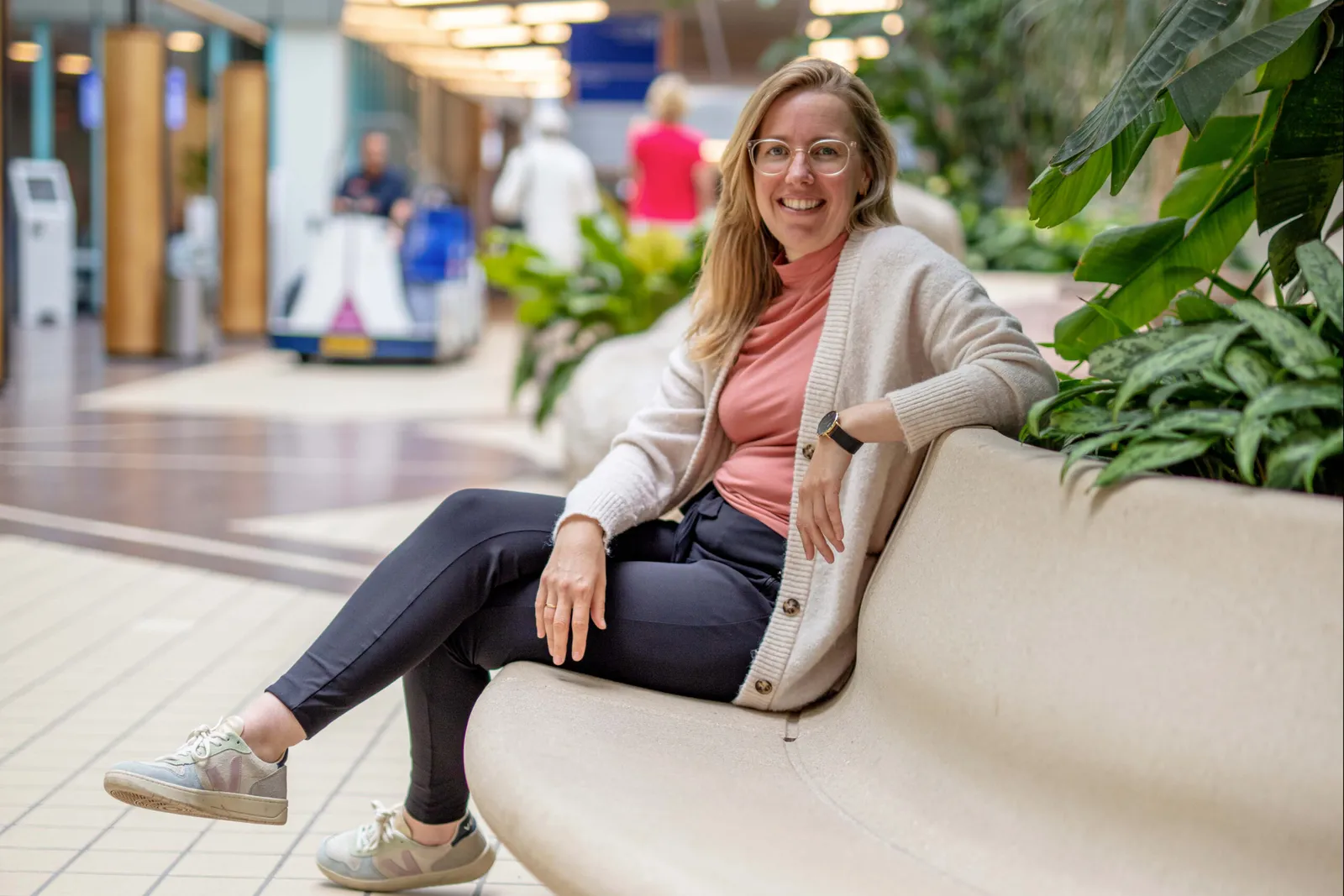
Alongside treatment and diagnosis, a well-designed care environment also affects the quality of medical care. Various studies have demonstrated the effects of factors such as daylight, larger windows, views of greenery and art. Emma Zijlstra is investigating how scientifically verifiable these effects are.
“One positive aspect of the growing use of the term healing environment is that the role of the environment in people’s wellbeing is receiving increasing attention. In many places, people are still unaware of this. That is a missed opportunity. But saying that an environment or building is a healing environment is, unfortunately, often an unsupported claim. It creates the illusion that we fully understand a comprehensive concept and apply all this knowledge. However, an environment can only genuinely be called a healing environment when evidence has been provided to support this. Evidence-based design is the theoretical concept behind a healing environment.”
Looking for links
“It is important to conduct larger studies using sound research methods to establish actual causal relationships,” says Zijlstra. “In different contexts, because what is effective for postoperative patients may work differently for oncology patients. Think of single rooms versus multi-bed rooms. And what works in the United States may have a different outcome in the Netherlands.” A patient experiences more than just one aspect, but the entire package: waiting times, parking, wayfinding, hospitality services, the waiting room, medical care, …. That is why we are developing a practical tool that enables hospitals to measure the entire patient experience easily and systematically, and then draw up an improvement plan and conduct follow-up measurements.”
There is growing evidence of positive associations between patients’ experiences and the safety, clinical effectiveness and technical quality of medical care. This is shown both in self-reported data and in objective measurements. “We looked at the entire outpatient journey from the patients’ perspective, taking into account facilities, the physical environment and care. We also conducted research among current and former inpatients. We looked at the overall concept, because when renovating or modernising, hospitals usually face the practical challenge of redesigning an entire room or department.”
Ancient traditions and new research
“We looked at the effects of the latest scientific insights and of centuries-old design principles,” says Zijlstra. “We were surprised that both the Feng Shui room and the evidence-based design room could reduce anxiety. There is quite a lot of scepticism about Feng Shui. However, the evidence-based design room produced the greatest reduction in anxiety. Relaxation is incredibly important for recovery. Studies have shown that wounds heal faster when people are relaxed.”
“Based on earlier literature, we expected nature to have a positive effect on people. We were curious to see whether images of nature would have the same effect. We compared two groups of patients, one group who saw no nature images in the CT scanning room and one group who did. Patients reported feeling less anxious when a landscape of hills and clouds was projected onto the wall and the ring of the CT scanner. They also had significantly lower heart rates and blood pressure. This is essential for cardiac scans, because a lower heart rate means they do not need beta blockers.”
Looking ahead
“We cannot say what a hospital should look like in fifteen years’ time. But hospitals can learn systematically from the current situation, because buildings, care and technology are not static, but constantly changing. We want to conduct more research into this. It has already been shown that a pleasant environment can reduce patients’ physiological and psychological stress. Giving them choices is essential: a one-size-fits-all solution is not always suitable for everyone. And of course, avoiding noise and light disturbance and providing sufficient privacy are just as important.”
Emma Zijlstra
Bachelor’s degree in Facility Management, Hanzehogeschool, Groningen
Master of Business Administration, Rijksuniversiteit Groningen
PhD in Medical Sciences, Rijksuniversiteit & UMC Groningen
PhD candidate, Hanzehogeschool, Rijksuniversiteit & UMC Groningen, 2013-2021
Evidence-based design researcher, Hanzehogeschool Groningen, 2021-
Question about this story? Ask your question
Keep following this
Get an email when a new story is published. No account needed.
- ThemeHealing environments
- SubjectGeneral







