











Sint-Niklaas, Zorgvastgoed België
Around 140 healthcare real estate professionals attended the annual Zorgvastgoed België event on 24 October. This initiative by Spryg Real Estate Academy was held this year at Hotel Serwir in Sint-Niklaas. Led by Stefaan Gielens (CEO of Aedifica), several leading market players discussed the future of healthcare real estate in Flanders. The Flemish Government was also represented, by Tom Vermeire, head of the residential care and primary care department at the Flemish Agency for Care.
Joels Schols.
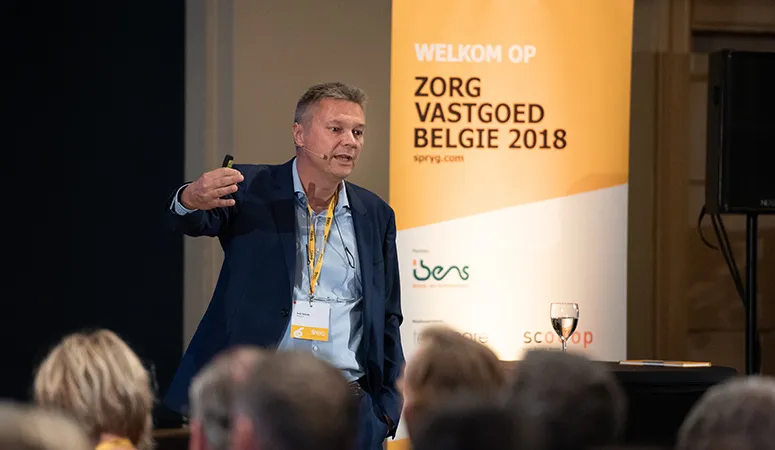
“Healthcare and policy on healthcare are undergoing major changes, including rapidly changing legislation. Many of these changes have an impact on the sector’s funding,” said Vermeire. More specifically, he explained which responsibilities will transfer from the federal to the Flemish level on 1 January 2019 as part of the sixth state reform, and how Flanders intends to take on these responsibilities. They relate not only to residential care for older people, but also to sheltered housing initiatives, home care and psychiatric nursing homes. Hospitals remain a federal responsibility for the time being.
Flanders brings together its healthcare responsibilities under the Flemish Social Protection (VSB), with a total budget of €3.94 billion. It could be described as a Flemish social layer on top of the federal social security system. “We set out our healthcare objectives from the perspective of the person in need of care,” he said. This was not intended as criticism of care providers. “When we took over responsibility for healthcare, we found that primary care was a mess.”
From a banking perspective
Wim Boon, business development manager and sector expert in social profit and local authorities at KBC, discussed healthcare real estate financing from the banks’ perspective. He reviewed the conditions and developments, and highlighted opportunities available now or in the near future. “People are not only living longer, they are also enjoying more and more healthy years. Residential care homes are no longer automatically full,” he warned. When it comes to assisted living, he considers a possible link with a residential care home important.
Scale matters
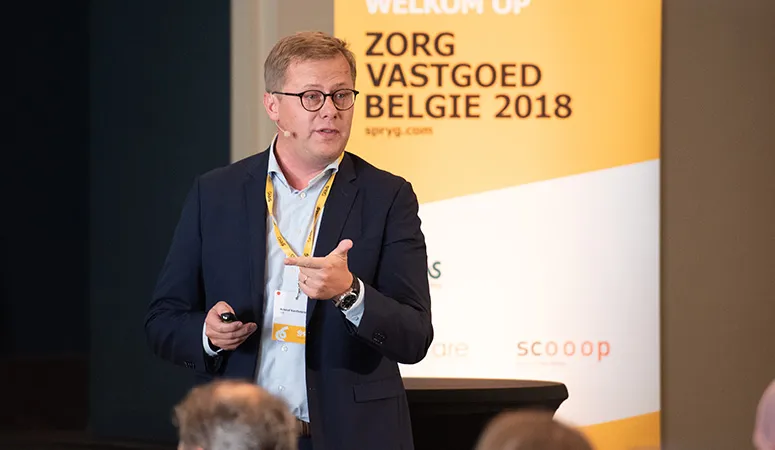
Kristof Vanfleteren, managing partner at property developer Ion, outlined his vision for the future of assisted living and lifetime homes. Ion is a relatively young company, but already has projects worth around €1 billion in its pipeline. Given the government’s current approach, he sees no further role for property developers in building new residential care homes, but does see one in assisted living. “Experience has taught us that successful assisted living schemes need to meet certain criteria. Scale is important: clusters of 40 to 60 units are ideal, but blocks with more than 100 dwellings are not attractive. They also need to be located in an area with urban amenities close at hand.”
Sébastien Berden, COO Healthcare at listed property company Cofinimmo, shared his views on the future and prospects for healthcare real estate and the healthcare sector in terms of building management, project development, and credit and market oversight. Cofinimmo has an international portfolio of 145 residential care homes, rehabilitation, psychiatric and acute care clinics, and more than 12,800 beds in four countries. This makes it one of the leading healthcare real estate investors in continental Europe. Cofinimmo’s portfolio long consisted of traditional property, but today it is undergoing an intensive shift towards healthcare real estate.
Investment opportunities for the general public
Cofinimmo and Aedifica are regulated real estate companies (gvv), or real estate investment trusts. “They give the general public the opportunity to invest in healthcare real estate,” said Berden. “There are only 15 of them in Belgium today. We are therefore far behind our neighbouring countries. What is more, Belgian gvv companies invest only in elderly care, whereas in other countries they also invest in, for example, hospitals.”
Tom Vermeire represented the Flemish Government.
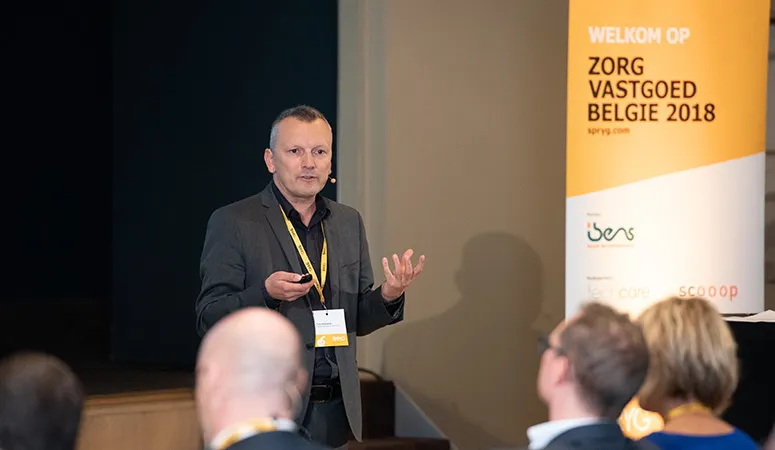
Joël Schols, director of healthcare and partner at ICT company Nextel, reviewed current opportunities and future developments in smart ICT and data networks, and the impact they have, or could have, on healthcare real estate. “Innovations such as assistive technology have a major impact on communication, comfort, safety and efficient working in both residential care homes and assisted living schemes,” said Schols. He championed smart simplicity. “A smart care building is created when systems for emergency calls, comfort, safety, lighting and HVAC are dynamically connected and ICT controls the subsystems.” Many existing applications, such as thermostats, are far too complicated, he said. “For some older people, turning a key in a lock takes too much strength. Digital locks, which can be opened with a badge, for example, are much easier to use.”
Kristof Vanfleteren.
Home care can be more expensive
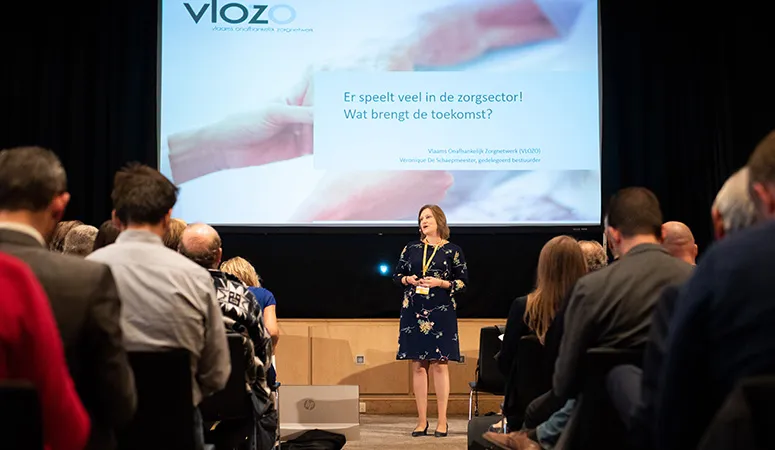
Véronique De Schaepmeester, managing director of the Flemish Independent Care Network (Vlozo, the umbrella organisation for independent operators of residential care homes), reviewed the most relevant topics currently affecting healthcare and healthcare real estate: dismantling divisions, scoring, personal budgets, the recognition calendar, subsidies, and more. “Technological developments are making it possible for people to remain at home for as long as possible. But home care is often more expensive than care provided in residential care homes, so we must not lose sight of the further expansion and support of residential care. Home care cannot always meet specific care needs either, which makes the development of high-quality residential elderly care a priority. Current resources are insufficient to provide 100% nursing and care home coverage for everyone with substantial care needs,” she stressed. “There is a major shortage of nurses. The revision of Royal Decree 78 means that more nursing tasks can be delegated to care assistants. This also makes a revision of the recognition and funding standards for nurses necessary.”
Debate
The event concluded, not counting the networking reception, with a debate between several leading operators of housing for older people. According to Geert Uytterschaut, COO at Armonea, a lot is happening in Flanders today, while elderly care is evolving more slowly in Wallonia and Brussels. “Perhaps we are moving a little too fast,” he suggested. Dominiek Beelen, CEO at Senior Living Group, noted that the German-speaking Community in eastern Belgium, which is also responsible for healthcare, is focusing on residential care homes specialising in specific conditions.
This year, Zorgvastgoed België attracted around 140 attendees.

The panellists went on to discuss the role of government. “The public sector is not legally obliged to organise residential care,” said Johan De Muynck, CEO of Zorgbedrijf Antwerpen. Responsibility for planning lies with the Flemish Government, which holds the financial levers and therefore determines what can be developed. However, it is the municipalities that decide what gets built. “In most municipalities where the local OCMW organises residential care, the municipality has to provide financial support,” Beelen responded. Luc Van Moerzeke, CEO of Vulpia, pointed to the example set by the city of Ghent. “It first mapped out the needs, then issued permits in the right locations based on that information.” The result is that housing provision there is well aligned with demand. Elsewhere, assisted living schemes sometimes struggle to find tenants.
Text | Koen Mortelmans Images | Petra Vermeer Fotografie
Featured image: Véronique De Schaepmeester speaking.
Question about this story? Ask your question
Keep following this
Get an email when a new story is published. No account needed.
- ThemeFuture-proofing healthcare estates
- SubjectGeneral







