











Strong call for differentiation at ZorgVastgoed België 2015
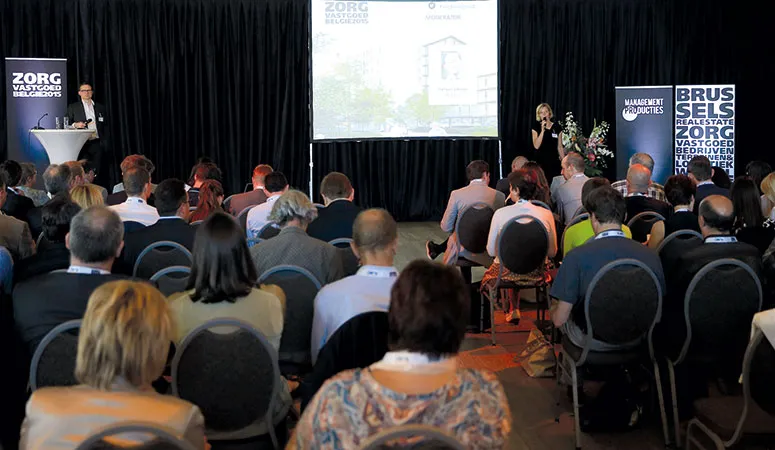
The healthcare property sector is developing rapidly. This was once again clear at the third edition of ZorgVastgoed België, although the many stakeholders still face numerous challenges. On 11 June, we found out what some of these challenges are behind the scenes at Grand Café Horta in Antwerp.
“Clearly, more of you have turned up than in previous years,” observed moderator Stefaan Gielens (CEO Aedifica) at the start of the third Belgian healthcare property conference. He was right: there were few empty seats left in the hall at Grand Café Horta.
Healthcare property has been on the rise for some time. “In the EU, we are talking about a much smaller scale than in the US, with a strong emphasis on senior housing, but things are moving nonetheless. In that respect, the healthcare property conference is an ideal annual gathering to review the latest trends and developments together,” Gielens said in his opening remarks.
Not ‘one size fits all’
The day’s first speaker was Anja Declercq (LUCAS, KU Leuven), who outlined innovations in care housing from her perspective. She called for older people and the care they want or need to be mapped, and for care provision to be tailored to this information. “A great many shifts and developments are taking place: from acute to chronic care, from a curative model to one focused on care and prevention, from task-oriented care to relationship-based care with a strong social component, and so on. There are trends we can identify, but this is certainly not a case of ‘one size fits all’,” Declercq concluded.
We heard similar views in the much-appreciated contribution from Jo Vandeurzen, Flemish Minister for Welfare, Public Health and Family. For him, the main priority is to understand needs and gain insight into developments in the (elderly) care sector. “We are moving towards adapted housing for all kinds of people, and are therefore calling on developers to be creative and develop innovative models for housing with care. The demand for chronic care, the rising demand for mental health services, support in the familiar home environment, the socialisation of care and the associated deinstitutionalisation: these are major challenges that we are tackling in earnest. We are moving from traditional institutional funding to demand-led systems. In short, a very interesting period lies ahead for anyone looking to innovate.”
Differentiated or not
The financial picture was also discussed at ZorgVastgoed België 2015. Renaat Van Der Stock, senior analyst at Belfius Bank, reviewed the finances of the non-profit care sector in Flanders. “The sector is solvent and sufficiently profitable to ensure continuity. There is scope for further investment. But of course there are some pitfalls. We need to be wary of the hype surrounding healthcare property, which could lead to vacancies. The challenge is to find a profitable, long-term partnership between care and property.”
After the break, Frederick Pouders of Aldea took us on a virtual tour of Parkresidentie Wivina in Dilbeek, a monastery being repurposed as a complex with 65 assisted living units, a residential care centre and a short-stay care hotel. In a complex that keeps alive the memory of its stately past, the building’s social function is preserved to the greatest possible extent.
Herwig Teugels, director of Kenniscentrum Woonzorg Brussel, then focused on future forms of housing. He warned those present in particular against focusing too heavily on the same target group. “Between now and 2035, we are moving towards a completely different reality. Too many large, interchangeable projects are currently being built, end users and potential neighbours have little say, and the range on offer is not varied enough. Differentiation and diversity are urgently needed! We must be careful not to create oversupply. Since a neighbourhood-based approach is the way forward, we need to continue pursuing an inclusive, small-scale approach. This can, incidentally, work perfectly well alongside a large-scale model. Healthcare property will either be differentiated or it will not exist!”
Panel discussion
The conference programme at ZorgVastgoed België concluded with an informative debate between Dominiek Beelen (CFO Senior Living Group), Ronald De Buck (managing director Woon- en Zorgcentra De Foyer), Charles-Antoine Van Aelst (investment manager Aedifica) and Herwig Teugels (director Kenniscentrum Woonzorg Brussel). Moderator Stefaan Gielen put a number of pertinent questions to them across three themes.
Asked whether the government should continue to invest in care and residential care buildings, Dominiek Beelen gave a nuanced answer. “The residential care centre market has become very mature, and various private-sector players have shown that you can provide high-quality care without government subsidies for bricks and mortar.
On the other hand, we may be facing an oversupply of large-scale projects, and subsidies for private-sector players could be an important incentive for them to invest in small-scale, privately run projects too.” Herwig Teugels added that VIPA subsidies should continue to be available for infrastructure that is not viable in its own right, such as a community services centre that is not part of a residential care complex.
The second theme was liberalising the assisted living market, a decision the panellists did not regard as particularly positive. “We have to acknowledge that many projects focus solely on property, rather than on crucial aspects such as care, services and integration into the local community. Deregulating the planning process has led to a proliferation of projects and therefore failed to achieve its purpose,” said Dominiek Beelen. “I expect there to be some disasters, particularly among those who barely focus on services and concentrate solely on the housing aspect,” added Ronald De Buck.
The final question discussed was whether regulation stifles creativity and, in turn, innovation in the sector. Herwig Teugels put it as follows: “The government will move more quickly to deregulate if the healthcare property sector opts for different, innovative typologies.” In other words, innovation and differentiation are the future: that was clearly the thread running through this engaging afternoon.
Text: Tim Janssens
Photos: Management Producties
Question about this story? Ask your question
Keep following this
Get an email when a new story is published. No account needed.
- ThemeFuture-proofing healthcare estates
- SubjectGeneral







