Technology essential to affordable healthcare
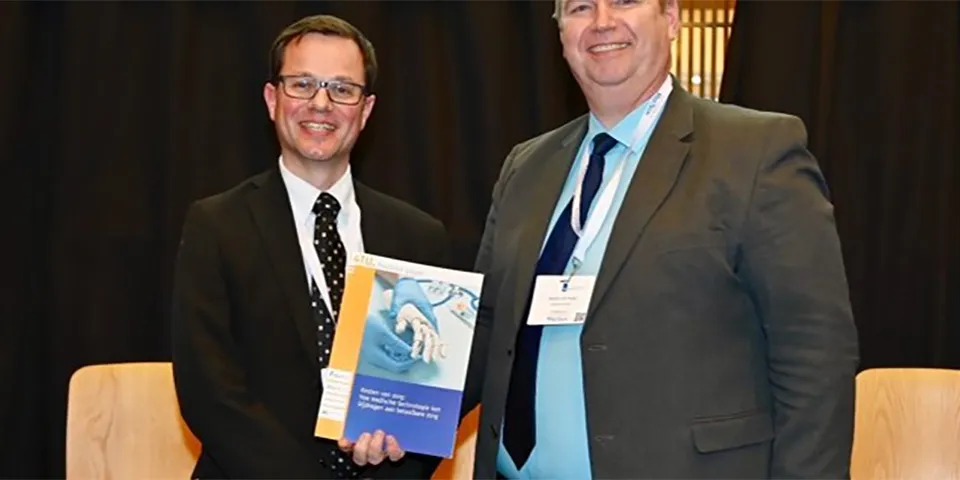
Today, the four technical universities, working together as 4TU, will present a position paper to Marcel van Raaij, Director of Medicines & Medical Technology at the Ministry of Health, Welfare and Sport. With the position paper, the universities aim to promote a balanced assessment of the costs of medical technology. Dr Ir Erik Koffijberg, associate professor at the University of Twente, says: ‘Technology has come to be seen as synonymous with higher costs. This is by no means always the case. With this paper, we want to emphasise that many technologies help reduce costs, and that technology is essential to delivering affordable, adequately staffed and efficient healthcare in the future.’
Technical universities present position paper to the Ministry of Health, Welfare and Sport
Technology as part of the solution, not the problem
Erik Koffijberg says: ‘Technology has greatly improved the quality of care, but this has often been accompanied by higher costs. However, many new medical technologies can reduce healthcare costs while improving or maintaining health outcomes. Where this does not happen, it is often because implementation programmes have too narrow a focus and lack evaluation points. As a result, potential cost savings go unrealised and technology is often wrongly seen as part of the problem, rather than as a possible solution for keeping healthcare affordable in the future. Technology can indeed deliver cost savings in healthcare. To achieve this, alongside well-designed and supported implementation processes, it is essential to build evaluation points into technology development from the outset and investigate how best to use the technology.’
Millions in savings through ‘Health Technology Assessment’
The position paper, entitled ‘Healthcare costs: how medical technology can contribute to affordable care’, calculates that research conducted before and during development and implementation could save millions to tens of millions of euros a year. A so-called ‘Health Technology Assessment’ (HTA), combined with implementation research, can help determine at an early stage whether a medical technology can reduce costs and remove barriers to successful implementation. These include high implementation costs, suboptimal use and limited adoption of new technology, and limited replacement of old technology. These various barriers relate to different areas of healthcare and require a multidisciplinary approach. The 4TU partners call for collaboration in education and research to sharpen the focus on future requirements for the development and use of technology in Dutch healthcare, with the aim of keeping the country’s healthcare affordable, adequately staffed and efficient.
About 4TU
The position paper, ‘Healthcare costs: how medical technology can contribute to affordable care’, can be downloaded via this link. It was commissioned by the Health@4TU steering group. Within 4TU, this steering group focuses on medical research and promotes collaboration with partners in the healthcare sector.
Question about this story? Ask your question
Keep following this
Get an email when a new story is published. No account needed.
- SubjectTechnology