Martini Ziekenhuis and RUG join forces to develop innovative application for scheduling outpatient ‘1.5-metre care’
When restarting routine care, ensuring patient safety is the top priority. Martini Ziekenhuis wants to help as many patients as possible, but the hospital and its waiting rooms must not become too busy. Martini and the University of Groningen (RUG) are therefore working together to develop an innovative application for scheduling outpatient ‘1.5-metre care’. Dr Justin Drupsteen, Manager of Integrated Capacity Management at Martini Ziekenhuis, says: “The 1.5-metre measures will sometimes require us to reduce the number of patients in a waiting room at the same time by as much as 75%. To serve patients as well as possible, we need to introduce a completely new way of scheduling our outpatient clinics and diagnostic services such as X-rays and ultrasound.”
Planning to ensure patient safety
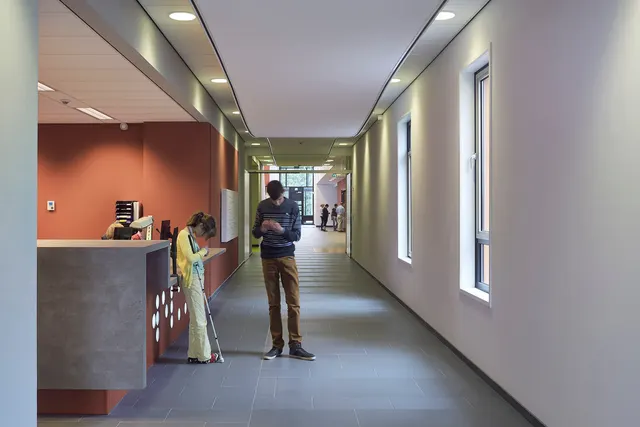
Since the end of April, Martini Ziekenhuis has increased the proportion of routine care it provides. Patient safety is the top priority, with measures including one-way systems, screening at the entrance and distance markers in corridors. Waiting rooms are also being arranged to maintain a distance of 1.5 metres. This means fewer patients can be in a waiting room at the same time, which in turn limits the number of treatment rooms that can be scheduled simultaneously. Before the COVID-19 outbreak, the constraints on care were the number of doctors, nurses or treatment rooms. Now, it is the waiting room.
Justin Drupsteen says: “Of course, we know that many people are waiting for treatment or tests. In this situation, we want to make the best possible use of the space available. Together with RUG, we are developing a tool that generates outpatient clinic schedules which take account of many of the challenges of life in a 1.5-metre society. For the tool to work as well as possible, it is important that patients are neither late nor much too early. The further people deviate from their appointment time, the fuller the waiting rooms become.”
Scheduling uncertainty, or the uncertainty of scheduling
The application was developed by RUG researchers Prof. Dr Iris Vis, Prof. Dr Kees Jan Roodbergen, Dr Michiel uit het Broek and Dr Ilke Bakir. Michiel uit het Broek, a researcher in the Operations department at the Faculty of Economics and Business, explains: “We have developed a mathematical model that generates appointment schedules designed to see as many patients as possible while keeping the number of patients waiting at the same time as low as possible, using various ways to stagger appointments. For example, not all appointments start at the same time, doctors’ breaks are shifted, vacant treatment rooms are used as waiting areas and gaps are left between appointments. This is naturally less efficient for doctors, but is sometimes necessary to ensure that too many patients do not arrive in the waiting room at the same time.”
Iris Vis, Professor of Industrial Engineering and Management, says: “The application also estimates the risk of the waiting room’s maximum capacity being exceeded. There is always a chance that things will turn out differently in practice than expected, for example because an appointment overruns. But the tool can never predict exactly how individual doctors, staff and patients will behave, or whether all the organisational measures have been implemented effectively. That is why it is important to build up gradually.”
The idea is to start with a low number of appointments, for example 40% of the usual number. If this works well in practice, the number of appointments can then be increased in stages, using the schedules generated by the tool.
Testing
The first version is now being tested at the Obstetrics and Gynaecology outpatient clinic. Many specialties distinguish between different appointment types, making scheduling even more complicated. Dr Marinus van der Ploeg, a gynaecologist at Martini Ziekenhuis, says: “We want to provide everyone with the care they need again as soon as possible. The guiding principle is to spread appointments across space and time. This is a huge logistical challenge, and we are very pleased that RUG is helping us with it.” The tool was not developed specifically for Obstetrics and Gynaecology: all specialties can use it to support their scheduling. Martini Ziekenhuis therefore wants to roll out the application at all its other outpatient clinics as soon as possible. Patients will, of course, be given extensive information about the changes to the hospital’s logistics.
Next steps
Further research will extend the application to take account of practical considerations such as doctors’ availability and preferences for what makes a good appointment schedule. The tool can also provide insights into the effects of the measures on the hospital’s available care capacity. The researchers are also exploring options for linking the application automatically to hospital information systems. They are currently working with the computing cluster at RUG’s Centre for Information Technology to develop a web interface and calculate complex schedules.
Other hospitals interested in this project can find more information at www.rug.nl/cope/1.5
Question about this story? Ask your question
Keep following this
Get an email when a new story is published. No account needed.
- SubjectHospitals