











20 questions and answers on the role of hospital design in infection prevention and patient safety
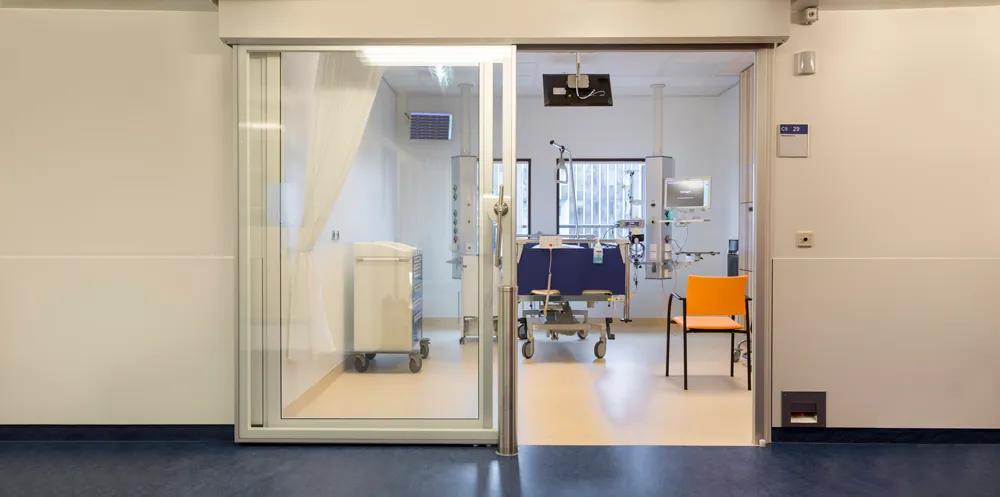
The design of hospitals and nursing homes has a huge impact on safety in healthcare and on preventing the spread of viruses. This has become all the more evident during the current COVID-19 crisis.
As developers of medical door systems and partners in the construction and fit-out of healthcare facilities, Metaflex takes a close interest in these topics. Here are 20 questions and answers that matter to every healthcare facility and healthcare architect.
On 26 January 2021, HKS Architects and engineering consultancy Arup published an article and a report on how hospitals and healthcare facilities can use design and fit-out to prepare for a pandemic and continue operating safely. Each space has specific requirements, with doors and other openings playing a key role.
Metaflex recognises the importance of safeguarding patient safety so that patients, visitors and healthcare staff are optimally protected against infectious diseases. That is why we are pleased to share our knowledge with you. The following questions and answers are based on the article and report by HKS Architects and on our own white paper on the role of doors in the spread of pathogens.
1. Will infectious diseases occur more frequently in the future?
‘We need to prepare for a future with more outbreaks of infectious diseases,’ says epidemiologist and virologist Marion Koopmans, head of the Department of Virology at Erasmus MC.
For decades, experts have warned that infections are increasingly jumping from animals to humans (known as zoonoses). This is due to various ways in which we have shaped the world, including the growth of global trade and travel, land use, our natural environment and climate change.
Source: Utrecht University
2. Is healthcare sufficiently prepared for the emergence of (new) infectious diseases?
‘Preparing for new infectious diseases should really be a regular part of healthcare,’ says epidemiologist and virologist Marion Koopmans. ‘During the Ebola outbreak in West Africa, all hospitals suddenly had to practise protective measures for approaching a patient with a fever. It is not good to start thinking about this only when an outbreak occurs. We need to make outbreak preparedness a much more firmly established part of our systems.’
Source: Utrecht University
3. How can healthcare better prepare for a future pandemic?
The healthcare environment should be seen as part of the solution to containing a pandemic. It is essential to create facilities that can continue operating during a pandemic. This must be taken into account when designing new healthcare spaces and buildings, and when adapting and renovating existing ones. Flexibility is ‘key’ in this respect.
Source: HKS report.
4. What are the main themes in healthcare design?
HKS identifies design for flexibility, safety and hygiene, and human wellbeing.
Flexibility
Multifunctional or flexible spaces will be essential in future healthcare. Examples include temporary (pop-up) walls or room dividers made of materials such as perspex.
Patient safety and hygiene
Particular attention should be paid to providing a short, direct route from the Emergency Department (ED). At a facilities level, ventilation, power supply and sanitation must also be considered as part of any solution to promote infection prevention.
For more information, see HKS’s 2020 ER Contagion Report.
Human wellbeing
Pandemic care places extraordinary demands on staff, patients and families. This should be taken into account in the design. Hospitals can designate units for rest, recovery and wellbeing.
Source: HKS report.
5. What principles underpin pandemic-resilient healthcare design?
- Versatile design
- Prepared for a rapid influx of patients
- Supporting wellbeing
- Clean air and surfaces
- Isolating patients and separating patient flows
- Safe and robust infrastructure
- Seamless transition between the digital and physical domains
Source: HKS report.
6. What are the key conclusions of the HKS report?
- Continuity of operations and care is crucial to our healthcare system and patients’ health. The design of healthcare facilities can help ensure that continuity;
- Designing for flexibility, including the use of multifunctional or flexible spaces, is essential to the healthcare design of the future;
- Facilities-level design must take ventilation, power supply and sanitation into account as part of the approach to infection control;
- Solutions will vary from one facility to another: there is no ‘one-size-fits-all’ approach.
Source: HKS report.
7. How do viruses spread in a healthcare facility?
In various ways. Examples include shared use of equipment, mixed visitor and patient flows, touching door handles (Wojgani, Kehsa, Cloutman-Green, Gray, Gant & Klein, 2011) and air movement caused by opening and closing doors that provide access to areas such as isolation rooms or operating theatres (Ham, 1999; Kalliomäki, Saarinen, Tang & Koksela, 2015; Mouvasi & Grosskopf, 2016).
Studies have shown, among other things, that door movement speed, the length of time a door remains open, use by healthcare staff and climate control all affect the amount of air movement between different spaces (Ham, 1999; Mouvasi & Grosskopf, 2016; Tang et al., 2013).
Questions 7 to 16 are answered on the basis of the Metaflex white paper on the role of doors in limiting the risk of infection in hospitals. For more information, see that report.
8. Why should air movement be restricted as much as possible?
At first, air movement may not seem dangerous. However, if the air contains droplets carrying pathogens, it poses a direct risk. This is particularly true when the door between an isolated room and the adjacent space is opened (Kiel & Wilson, 1989; Eames, Shoaib, Klettner & Taban, 2009). The patient’s respiratory droplets can enter the air and create a pathway between the infected person and a susceptible person (Mousavi & Grosskopf, 2016). This transmission can spread certain infectious diseases, such as COVID-19 (Mousavi & Grosskopf, 2016).
9. How can air movement be restricted?
Airflows can be controlled in various ways, including through temperature and pressure differences, but these controls are not sufficient on their own. In addition to climate control, doors play a major role in controlling air movement between different spaces.
10. What role does temperature play in air movement?
Even a small temperature difference can greatly increase air movement through an opening in a partition (Kalliomäki et al., 2015). A temperature difference that is too large can also change the direction of airflow, which is problematic when negative pressure is used to limit airflow from areas such as an isolation room. In this situation, warmer, contaminated air can leave the isolation room at head height and reach a healthcare worker’s face (Tang et al., 2005).
11. How do hinged and sliding doors differ in their effect on air movement?
Tang and colleagues (2013) show that sliding doors cause less air movement when opened than hinged doors (Tang et al., 2013). Other research also shows that hinged doors cause greater air movement (Kalliomäki et al., 2015). Kalliomäki and colleagues (2015) also demonstrated that double hinged doors cause the most air movement, while single sliding doors cause the least. However, single sliding doors take up relatively more space, which is not always available. Climate control can be used as a supplementary measure.
12. What role does the speed at which doors open and close play in air movement?
Higher opening and closing speeds have an adverse effect on the number of particles displaced (Ham, 1999). Research by Tang and colleagues (2013) shows that hinged doors open and close faster. They can therefore displace more contaminated airborne particles than sliding doors. Research shows that, in the absence of ventilation, opening a sliding door causes only a modest airflow. By contrast, hinged doors create a strong flow through the doorway that reaches far into the room (Kalliomäki et al, 2015). The longer a door remains open, the greater the air exchange between the two spaces, increasing the risk of infection.
13. What role does negative pressure play in climate control in healthcare?
With negative pressure, a ventilation system creates lower pressure in an isolation room by extracting more air from it than from the surrounding rooms. The aim is to ensure that, when a door opens, air is drawn into the isolation room rather than blown out, helping to prevent the spread of airborne infectious diseases (Adams, Johnson & Lynch, 2011).
14. Is negative pressure sufficient to prevent the spread of viruses?
No, because air still moves when the door is used, even under negative pressure. Moreover, if the negative pressure is insufficient, it can even have the opposite effect (Mousavi & Grosskopf, 2016; Tang, Eames, Li, Taha, Wilson, Bellingan, Ward & Breuer, 2005). Opening a door too quickly, as can happen with hinged doors, can also counteract the negative pressure and result in greater air movement (Mousavi & Grosskopf, 2016; Tang et al., 2005). The direction in which a hinged door opens also appears to affect negative pressure (Tang et al., 2013). For sliding doors, research shows that, with sufficient negative pressure, air movement between two spaces is lower when sliding doors are used (Tang et al., 2013).
15. What role does healthcare staff’s use of doors play in air movement?
Several studies show that when a healthcare worker leaves an isolation room, the concentration of airborne particles increases in the space they enter (Kalliomäki et al., 2015; Rydock & Eiand, 2004; Tang et al., 2013). Some of the air from the isolation room is carried into the other space in the healthcare worker’s wake (Tang et al., 2013). The relative effect of passing through the doorway is greater with sliding doors than with hinged doors (Tang et al, 2013; Kolliomaki et al, 2015). Nevertheless, the average airflow during passage in either direction (from outside to inside and vice versa) is lower with sliding doors than with hinged doors (Kalliomaki et al, 2015; Hayden, Johnston, Hughes & Jensen, 1998). This also means a lower risk of infection (Ham, 1999).
16. What role do door knobs and handles play in infection prevention?
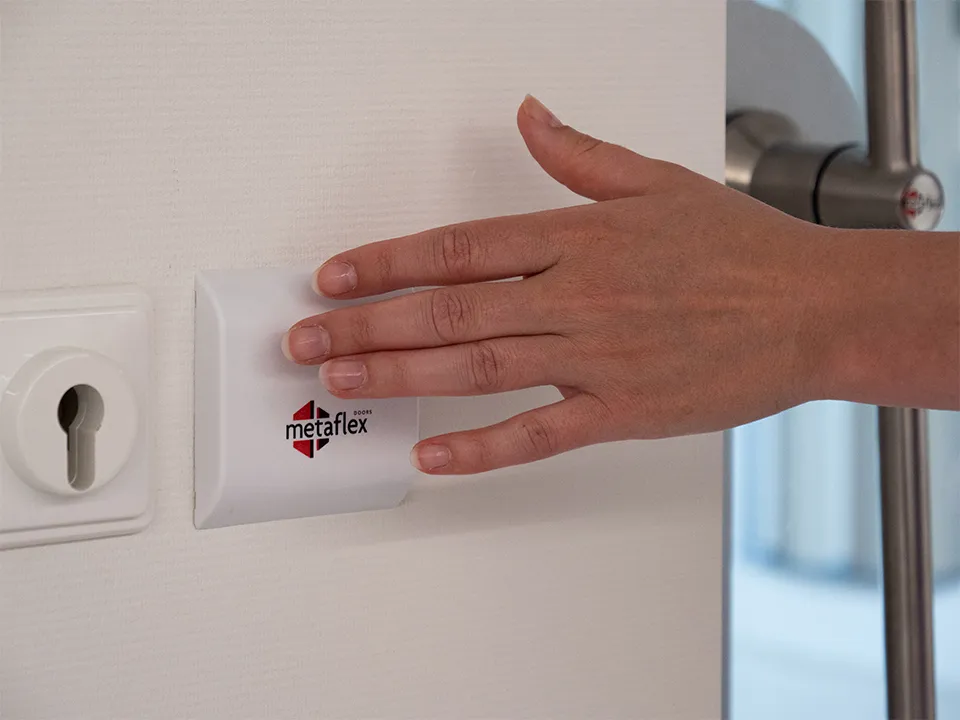
Research (Wojgani et al., 2012) shows that door handles pose the greatest risk of contamination, followed by pull handles and, lastly, push plates. According to the researchers, this is related to the size of the surface touched and/or grasped by the user. Given that many infectious diseases, including COVID-19, can also be spread through hand transmission, using an automatic door-opening system is a logical choice (Wojgani et al., 2012). This greatly reduces the surface touched and, consequently, the risk of infection. Tang and colleagues (2013) recommend sliding doors with an automatic opening system. Metaflex therefore offers various opening sensors that allow doors to be opened without contact.
17. What are the right doors for an operating theatre complex?
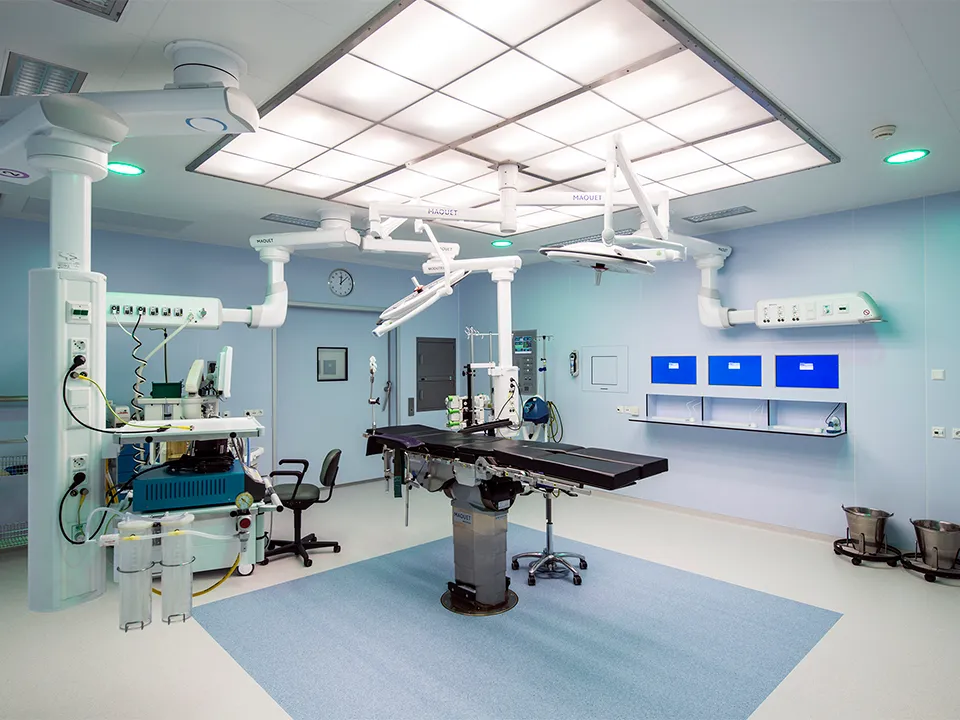
To minimise the risk of infection and maintain the necessary positive pressure in the operating theatre, an airtight seal is essential. Door solutions can make a significant contribution, particularly when they seal a room perfectly airtight, preventing any loss of pressure. Since no air can escape around the door, and therefore no ‘dirty’ air can leak into other rooms, the air-handling system can optimally control the supply of clean air and the removal of dirty air. To improve this control further, the doors can be configured to operate as an airlock. They can also be connected to a door logging system or operating theatre access system. This makes it possible, among other things, to keep an accurate record of how often and for how long the door opens and closes during an operation.
18. What are the right doors for an intensive care unit?
To ensure a hygienic and protected environment in an intensive care unit, it is important to seal off the different ICU rooms appropriately. This helps protect patients from external influences and ensures that all safety requirements are met. Clean air greatly reduces the risk of contamination and, as a result, infection risks. It is therefore essential to maintain this hygienic environment as effectively as possible, including by using airtight doors and appropriate ventilation.
19. Which doors are suitable for an isolation ward?
The risk of infection is particularly high in isolation rooms and quarantine areas. It is recommended that particular attention be paid to air handling in these areas, using an airlock, hermetic doors and contactless operation.
20. Which doors are recommended for patient rooms?
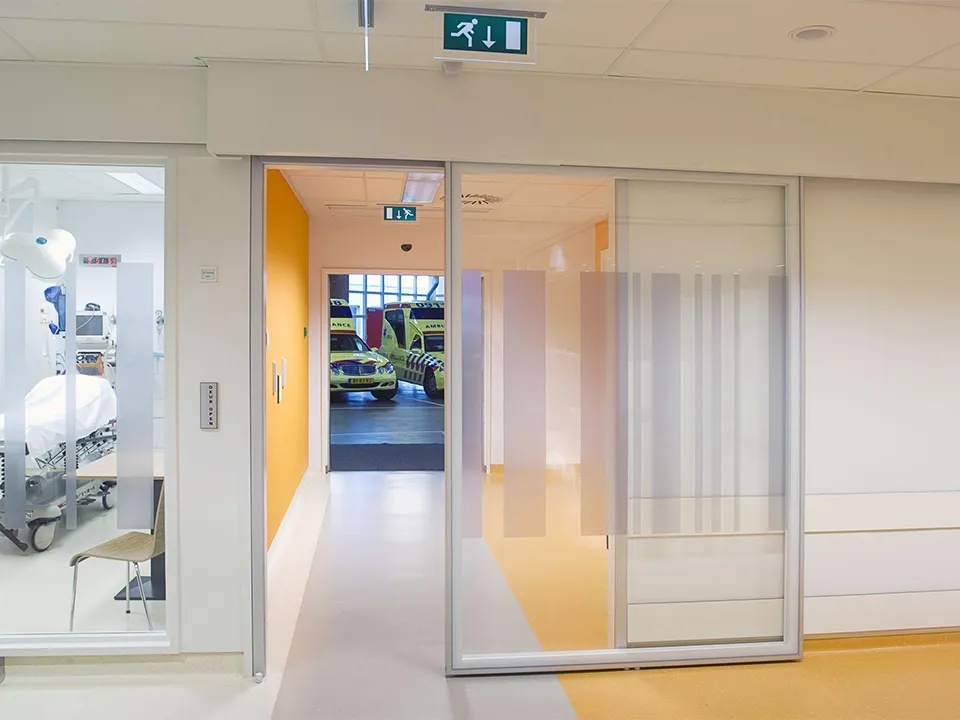
Because opening and closing them causes limited airflow, the recommendation here too is to use automated sliding doors with contactless operation. An additional benefit is that they save space, making it easier to manoeuvre beds through the area.
Disclaimer
Metaflex has taken the utmost care in preparing this article. By compiling questions and answers relevant to our clients, we hope to support them as effectively as possible during this crucial time. We have also consulted the RIVM and other relevant sources, and conducted our own research, to provide as complete an overview as possible. Nevertheless, no rights can be derived from the text, and Metaflex cannot be held liable in any way. If you have questions about the COVID-19 virus and how it is being addressed in the healthcare sector, we always recommend contacting the experts at the RIVM. You are always welcome to contact us with questions about the required conditions in your spaces.
About HKS and Arup
HKS is a leading international architecture firm specialising, among other things, in hospitals, with its headquarters in Dallas, United States. Arup Group Limited is a renowned multinational service provider that acts as an engineering consultancy on construction projects, while also providing design, planning, project management and other construction-related advice. Arup operates from its headquarters in London, United Kingdom.
Would you like to know more about this article or Metaflex’s door solutions? Please contact us on +31 88 1414 900 or [email protected].
A business enquiry for Metaflex Doors Europe? Get in touch
Companies in this story

Keep following this
Get an email when a new story is published. No account needed.
- SubjectGeneral
- CompanyMetaflex Doors Europe







