











Coronavirus crisis boosts use of technology in healthcare
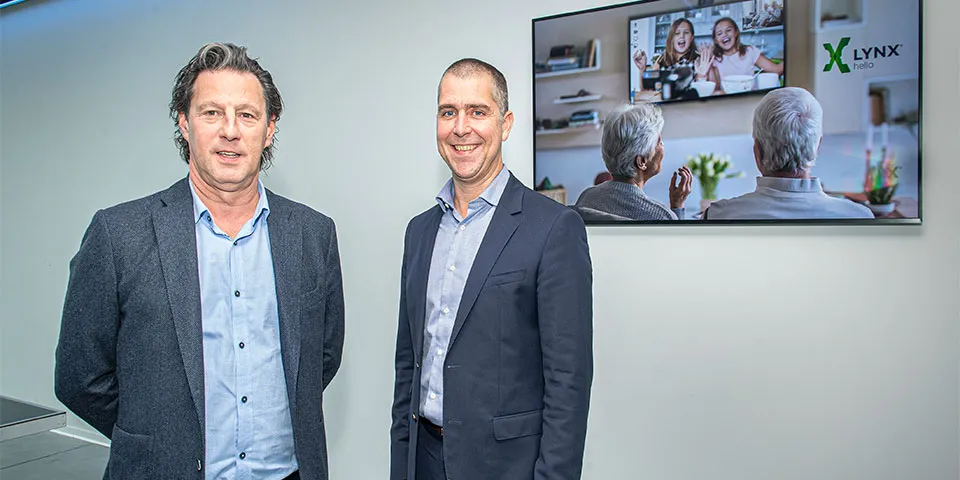
The use of technology in healthcare has been growing for some time. This is not only because technological tools improve residents’ comfort and the efficiency of care, but also because it is becoming increasingly difficult to find employees willing to commit to the sector for the long term, particularly in residential care homes. Bouwen aan de Zorg spoke to Filip Gelaude, founder of Telecom-IT Group (Aalter), Tom Messiaen, managing partner at 25-8, and experienced healthcare consultant Dominique Roodhooft.
Roodhooft has experience not only as an independent consultant. She also headed Zorg-saam for a time, a group with fifteen residential care homes, and lectured in entrepreneurship at Artevelde University of Applied Sciences in Ghent. 25-8 is part of Telecom-IT Group as an integrator. It is responsible for implementing the solutions developed for the healthcare sector by its sister company Unmatched. Today, 25-8 works with more than thirty hospitals and almost 450 residential care homes.
Lockdown
“The coronavirus crisis and the prolonged lockdown of care homes in Flanders made it painfully clear that technology, particularly communications technology, is no luxury in residential care,” says Messiaen. “Elderly residents went for months without visits from family members. Even afterwards, opportunities to visit remained very limited. More telephone calls offer only limited compensation. What’s more, many residents do not have a smartphone or cannot use one. Making calls with the help of a staff member and their smartphone is very time-consuming for that person and, because of the small screen, uncomfortable for most residents.”
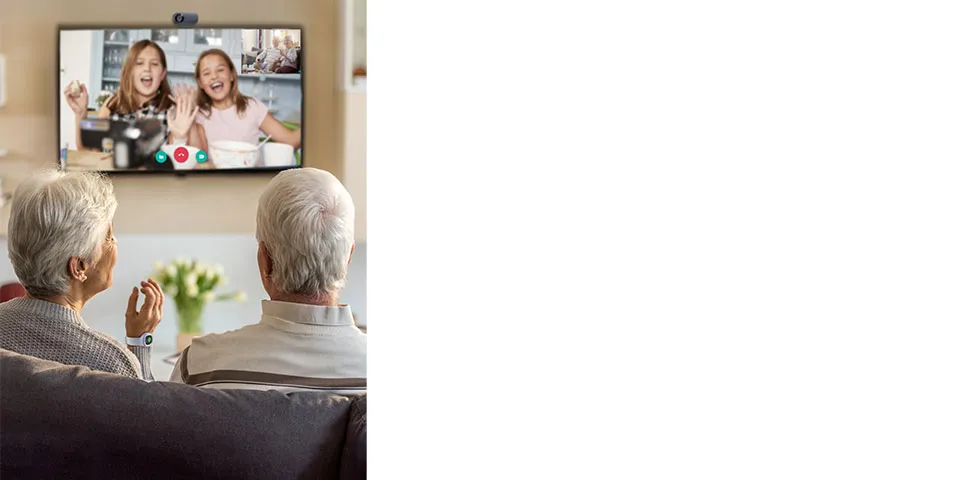
When the coronavirus pandemic broke out, 25-8 developed LynX hello to enable video calls via residents’ television screens. Residents use a wristband with a single button to accept an incoming call. They can adjust the volume using the television remote control. LynX hello is a video extension of the existing LynX alarm and communications platform for the healthcare sector.
Simplicity
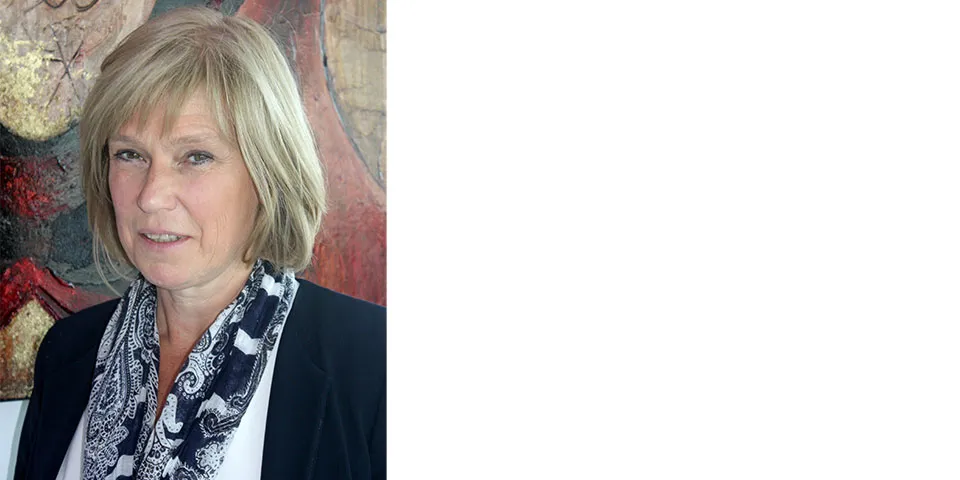
“Technology can therefore remove some of the restrictions imposed by lockdown,” says Roodhooft. “These restrictions are not only physical, they also affect people’s emotional wellbeing.” She also highlights the importance of keeping applications simple. “The number of residential care home residents who bring their own computer and are comfortable using modern technology is growing, but there will always be a group who need assistance. A one-button application allows us to limit that assistance and provide most of it from outside the resident’s room. The care home still retains control, so it can prevent video calls from coming through when, for example, a resident is being washed.”
A dual purpose
“Technology thus serves a dual purpose. It takes over some of the physical work of care staff while also combating loneliness,” says Gelaude. “This problem is growing ever more serious, not only because of lockdown but also because families are getting smaller.”
Affordable
“The technology also needs to remain affordable,” says Messiaen. “That is why it makes sense to bundle as many applications as possible into a single package for residential groups of a sufficient economic scale. As well as alarms and communications, this could include lighting control. A system using tags for people and mobile equipment, combined with sensors, Bluetooth Low Energy beacons, in the lighting, can detect wandering and quickly locate residents without dementia when, for example, their GP comes to visit.” Lighting with individually controllable elements can be used not only to indicate evacuation and other routes, but also to create different colour schemes. “The colour of the light above a door can also show whether a resident is receiving care, is asleep or does not wish to be disturbed for another reason.”
“Today, the challenge is to enable people to remain in their own homes for as long as possible,” Gelaude stresses.
“That is why healthcare technology is essential not only for hospitals and residential care homes, but also for home care. Homes need to be equipped to respond intelligently. Sensor technology is sufficiently advanced to signal when, for example, people with type 1 diabetes need insulin or sugar. Cardiovascular conditions can also be monitored remotely, allowing timely intervention when needed.”
Volunteers
“The lockdown really did mark a turning point,” warns Roodhooft. “Previously, there was an extensive volunteer programme, but volunteers were suddenly no longer welcome in residential care homes either. During lockdown they found other things to do, and some have not returned. As with professional staff, volunteers are becoming scarce too.”
“Outside residential care homes, the challenge will be to involve local volunteers alongside the additional technology,” says Gelaude.
“Care networks within a radius of 6 to 12 kilometres of a residential care home could play a part.” Messiaen believes that, as the population ages, there will be many more pensioners relative to the working-age population. “Europe will consequently become poorer, and active seniors will want and need to earn extra income.” “In the digital world, alongside the role of technology, we need to rethink the role of multiple players. Demographic change will make this essential,” concludes Roodhooft.
Question about this story? Ask your question
Companies in this story
Keep following this
Get an email when a new story is published. No account needed.
- SubjectGeneral
- Company25-8







