











How this researcher hopes to help cancer patients sooner
No more waiting for weeks
Is fluid around the lungs caused by a harmless infection or a cancer metastasis? Thanks to research by Hao Cao of the General Clinical Laboratory at Catharina Hospital, this question may soon be answered faster and more accurately. Good news for patients who often have to wait weeks for a diagnosis, or even undergo several invasive procedures.
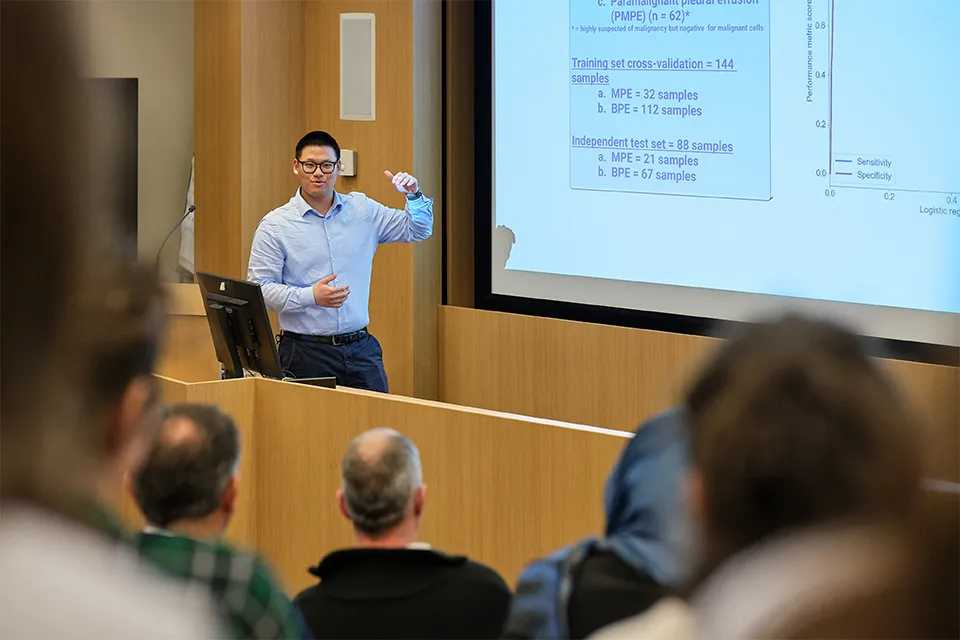
It is a regular occurrence in hospitals: a patient comes in with shortness of breath, and a scan reveals fluid around the lungs. Doctors then have the fluid examined to find out what is causing it. “Sometimes it is an infection or a complication following an accident, but it can also point to something malignant, such as metastatic cancer,” says ir. Hao Cao (27), a PhD candidate at the General Clinical Laboratory of Catharina Hospital.
At present, the fluid is usually analysed by a pathologist. “They look under a microscope to see whether there are any malignant cells,” Cao explains. “But that does not always work, especially if the fluid is thick or there are only a few tumour cells. In those cases, the chance of the pathologist finding anything is only 60%. This means that in 4 out of 10 cases, a diagnosis cannot be made at that point.”
The results are promising
Cao wondered whether there might be a better way. He focused his research on measuring specific proteins, known as tumour markers, in the fluid. “Some of these proteins are already used in other types of cancer, such as breast or bowel cancer. By applying them to fluid from the pleural cavity too, we may be able to find signs of metastases more quickly and reliably.”
The results are promising. Instead of waiting for microscopic examination, which can take weeks, the biomarkers can be measured in as little as half an hour. “If the protein levels are raised, that is a strong indication that something is wrong, even if the pathologist has not found anything yet,” Cao says. “The doctor can then decide more quickly whether to carry out further tests. This prevents unnecessary procedures and gives patients answers sooner.”
According to Cao, the benefits for patients are considerable. “At the moment, patients regularly have to come back several times to have fluid sampled again, because nothing is found each time. These procedures are burdensome. With our method, the doctor can make a better-informed decision after the first sample.”
Patients are often particularly vulnerable, including people who have previously been diagnosed with cancer. “Imagine someone who has been treated for bowel cancer and later presents with fluid around the lungs. You want to know as soon as possible whether it is metastatic, because that determines the treatment. The sooner you find out, the sooner you can start therapy or, if it turns out to be a false alarm, reassure the patient.”
Giving something back to Aruba
Although Cao is cautious about making big promises, he does see important benefits for patients: “I would not say this saves lives, because by the time cancer has spread to the lungs, it is often already at an advanced stage,” he says matter-of-factly. “But it can extend lives, because you can start appropriate treatment sooner or, in some cases, stop unnecessary diagnostic testing. That really makes a difference to quality of life.”
Cao’s interest in medical diagnostics was shaped by his childhood in Aruba, where he grew up as the son of Chinese parents. “The healthcare there is good, but it is also limited. For complex tests, you sometimes have to go to Colombia or the Netherlands. My uncle experienced that himself. It took months, even though he was seriously short of breath. Fortunately, it turned out not to be cancer, but things could have moved much faster.”
That experience inspired him to pursue a PhD at Catharina Hospital after completing his bachelor’s and master’s degrees in Biomedical Engineering at TU Eindhoven. “I want to develop something that can also be used in less high-tech settings. A biomarker test is relatively straightforward, but it can make a difference. As I said, I grew up in Aruba, and ultimately I would like to give something back there. You cannot implement everything we do here, but a relatively simple test like this, based on blood or fluid, could be very valuable. It would mean less dependence on large pieces of equipment or referrals abroad. That is also part of what drives me.”
Cao’s research builds on the work of his predecessor Esther Visser, who previously completed her PhD on so-called liquid biopsies and decision support in lung cancer. “Her research was really what prompted this project. She laid the foundations, and we are now trying to translate that into practical use.”
New project on lung cancer
Cao’s research, supervised by promotor prof. dr. Volkher Scharnhorst, was recognised at Catharina Hospital’s Wetenschapsavond 2025, where he won one of the awards. “I was genuinely surprised, but also proud. It was good to see that colleagues and fellow professionals recognise its value.”
The research is now in its final stages and will soon be incorporated into the laboratory’s routine practice. It is an example of how scientific research can directly contribute to better care. Cao says: “I hope this will ultimately mean less uncertainty, less of a burden for patients and, above all, more time for treatment when it is needed.”
Alongside his current research, Hao Cao is also working on a new lung cancer project. He received 45.000 euros from the Catharina Onderzoeksfonds for this work. “We want to use a new technique to look in blood for a wider range of DNA errors in tumour cells,” he explains. “That will help us determine which medicines are most effective. Thanks to this grant, we can test straight away whether it works and make sure it is actually used in the hospital.”
Question about this story? Ask your question
Keep following this
Get an email when a new story is published. No account needed.
- SubjectGeneral







