











Maarten Walravens (AZ Sint-Maarten): ‘The hospital of the future will be more deeply rooted in society’
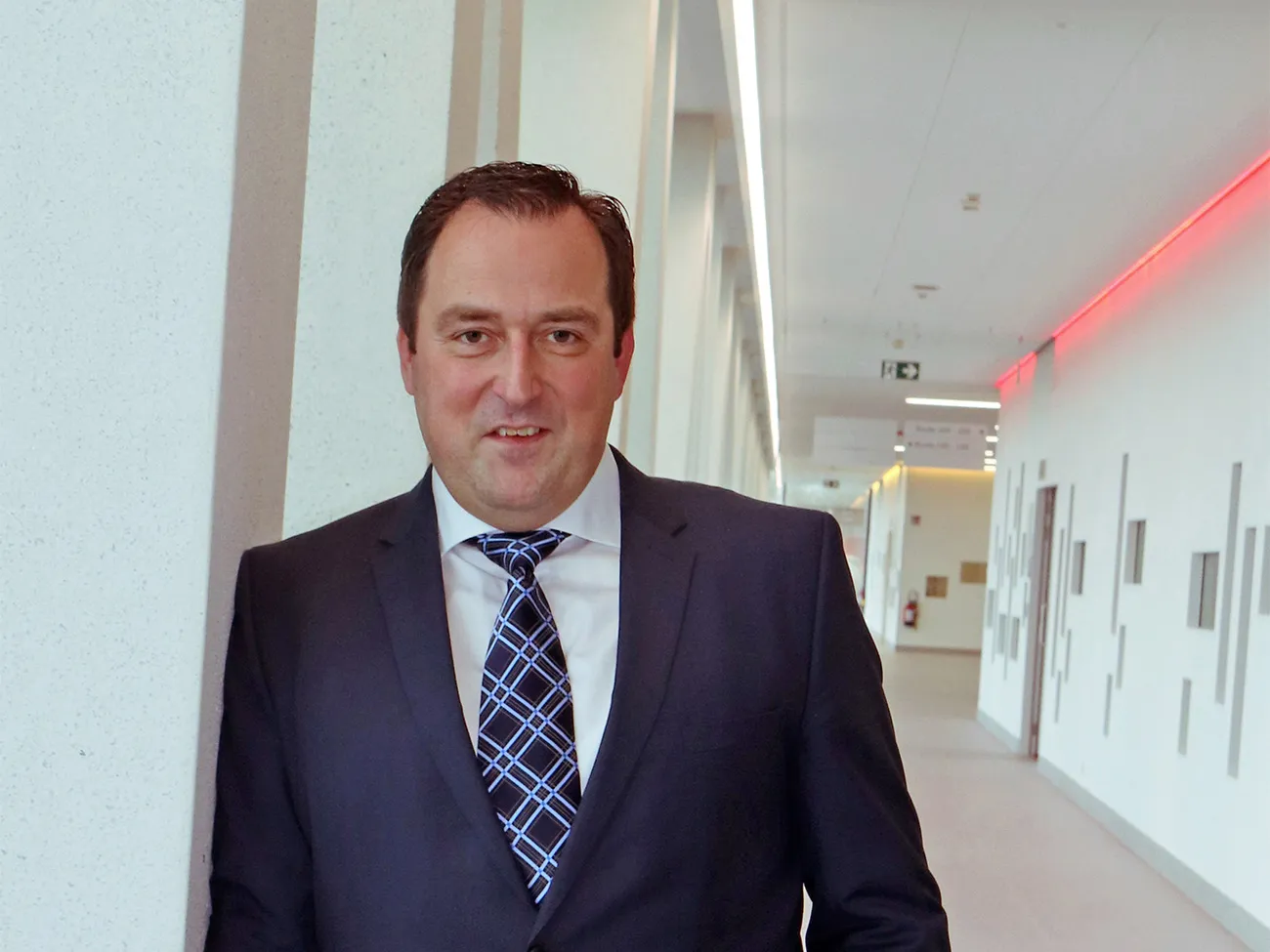
The consolidation of AZ Sint-Maarten’s existing sites in Mechelen into a new building on a single campus was the largest healthcare construction project in Flanders in recent years. The ten-year construction programme also yielded many valuable insights, says Maarten Walravens, deputy chief medical officer.
“For projects like these, we need to think at least 20 years ahead, not just 10. That makes flexible design essential. In practice, this means taking account not only of possible future changes of use for parts of the building, but also of the construction work these would require. This calls for a modular approach and vision. We are already significantly expanding our day hospital and outpatient clinic to meet growing demand. The key is to preserve and safeguard the hospital’s concepts and flows as much as possible.”
“I advocate making more efficient use of the healthcare infrastructure available. One example is making consultation rooms available to an integrated out-of-hours GP service, which is already based in our hospital. This means the space is also put to good use in the evenings and at weekends. Another example is keeping a pharmacy open. This is a service for our patients, visitors and staff, as well as a safe environment when the pharmacy is on duty.”
Walravens stresses the importance of involving all stakeholders: “That is more than a buzzword. Involvement also creates a sense of responsibility. The choice of patient monitors is a good example. In the past, each department and campus made its own choice. As a result, we had as many as 24 different types of monitor from five suppliers. Today, we use four types from a single supplier. This not only makes a difference to the procurement process and costs, but also makes it much easier to organise training in their use. The equipment can also be shared between departments more easily. To achieve this, we gave all stakeholders, including doctors, full transparency on costs. That created shared responsibility for the decision and for using the equipment.”
What will the key priorities be?
“The hospital of the future will be much more deeply rooted in society. This also means that services now taken for granted in other sectors will become standard in ours too. Examples include a hotel-style check-in service, with personalised messages about procedures and treatment, a real-time appointment flow, an app for the pay car park and a ‘bring me’ box for medical devices.”
Digital (r)evolution
“The hospital of the future will be digitally connected to its wider environment. This includes not only the patient’s home, but also other healthcare institutions. This requires the smooth and secure exchange of data between different systems. Connecting with the home environment is also part of providing preventive care alongside curative care. By monitoring people at home, you can respond more quickly to potential health problems. Access to the necessary data also applies to non-clinical internal services, such as administration and catering. But some aspects of care will never be possible to provide digitally.”
A smaller ecological footprint
“The hospital of the future will be regenerative and must find ways to reduce its ecological footprint and become as energy self-sufficient as possible. This needs to be considered throughout the entire construction process, from site selection to material choice, lifecycle and building management. A business continuity plan is also essential. We must not limit ourselves to standard tests of emergency generators, but also need detailed emergency plans. For example, we need to determine which care processes are essential and critical to continuity if the ICT system were to fail.”
“Alongside sufficient space, air quality, temperature and acoustics are at the top of the list of spatial and environmental qualities we need to consider. We address these through the use of heat pumps, a combined heat and power installation, BEO fields for seasonal heat and cold storage, an intelligent building management system for efficient temperature and humidity control, and the use of rainwater, combined with a controlled drainage rate via green roofs. For the landscaping, we chose plants that support biodiversity and can be maintained without pesticides.”
Funding for ICT & digitalisation
Are current Belgian funding models geared to this digital evolution? “No. The focus is currently mainly on salaries, depreciation and operating costs. There is too little discussion of, on the one hand, the catch-up required in electronic patient records and other ICT processes, integrating a business continuity plan and training staff in these areas, and, on the other, future needs and developments. These are currently underfunded.”
Maarten Walravens (43 years old)
Bachelor of Nursing, Katholieke Hogeschool Leuven (UCCL)
Master of Health Science, Universiteit Maastricht
Young Management Program, Vlerick Business School, Leuven, Ghent
More than 15 years’ experience in the hospital sector:
began as a nurse, OLV-ziekenhuis Aalst
6 years as transplant coordinator, OLV-ziekenhuis Aalst
2 years as CEO’s staff officer, UZ Brussel
4 years as chief medical officer’s staff officer, AZ Sint-Maarten, Mechelen
deputy chief medical officer at AZ Sint-Maarten since 2013
hospital emergency planning coordinator at AZ Sint-Maarten since 2016
member of the advisory board of the 5th Conference on (digital) Health Tech since 2018
expertise and consultancy in digitalisation and digital transformation in healthcare
Question about this story? Ask your question
Keep following this
Get an email when a new story is published. No account needed.
- SubjectGeneral







