











‘Use the coronavirus period to make investments more sustainable’
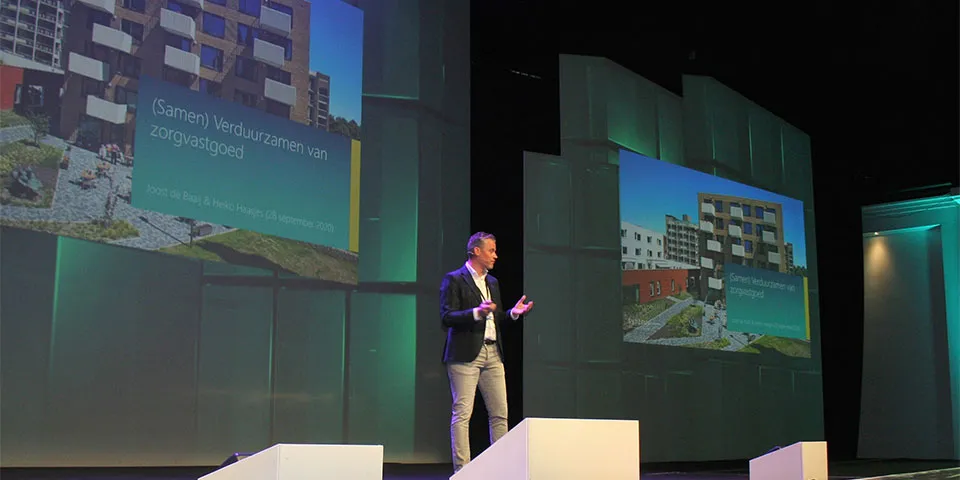
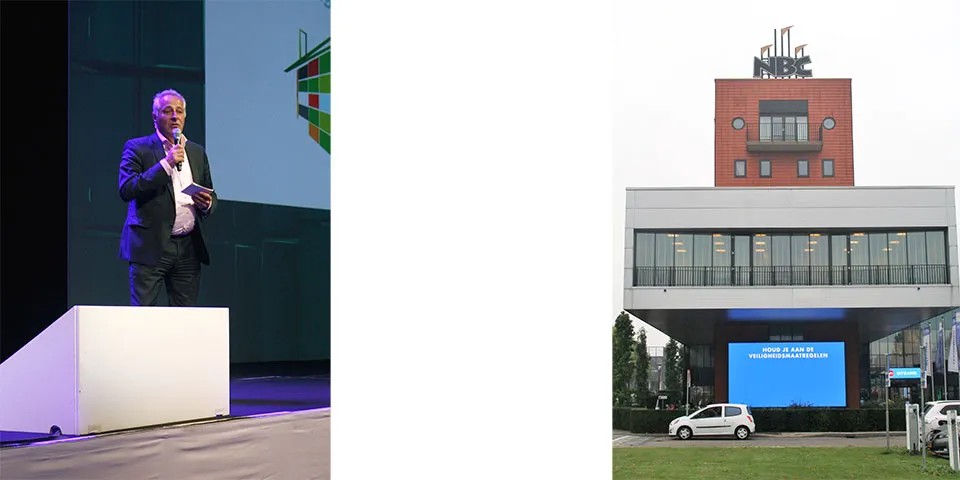
In response to the lockdown, many networking events scheduled for this spring were postponed and reconfigured. For example, the Zorgvastgoed Dag organised by the Instituut voor Vastgoed & Duurzaamheid (IVVD) was moved to late September, and from Nyenrode to the Nieuwegein Business Centre. This offered an additional opportunity to examine the new situation more closely, albeit at an appropriate distance. The coronavirus period is a burden for care organisations, but it also offers opportunities to deepen understanding of property, as became clear.
Traditionally, the balance between a people-centred approach and sound financial management has been a key concern in healthcare property. Teunis Stoop, Chair of the Executive Board of residential care organisation Cedrah and the first speaker, took the helm of a supra-regional care provider around five years ago. It had ageing sites in South Holland and Zeeland and a transformation agenda that was proving difficult to get off the ground, which Stoop attributed to a lack of commercial rigour. “Cedrah had a long history of building plans that never came to fruition, with €4 million in planning costs written off. There were no business cases, and the only focus was on extending the life of the buildings.” The shift towards providing care outside institutions was an external prompt to change course. “We started by setting out a mission, vision and corporate strategy, not a technical approach. Quality of life must come first, with demand-led care based on small-scale provision and independence. We then developed business cases for property transformations based on financially viable operating models.” The outcome was the sale of residential property to an investor, following investment. “We did this on the basis of a structured property strategy with a step-by-step plan, which I would recommend to all of you,” Stoop told his colleagues in the room.
Inclusive neighbourhoods
Creating inclusive neighbourhoods is another hot topic in the care sector. The institutional community has fragmented as a result of the separation of housing and care. FAME Groep develops housing concepts for care organisations and is therefore at the heart of this development. Anneke Nijhoff: “We are used to talking to one another in institutional terms, for example about ‘places’ or ‘residential stays’. Now the focus is on individuals and their housing preferences, which raises the question of whether healthcare property still exists as such.” We need to make this shift in how buildings are used together, and establish new relationships between stakeholders, she says. For example, FAME is coordinating a partnership between mental health institutions and housing associations in Nijmegen, where plans are being developed for dispersed housing, potentially with a physical meeting place and “in any case, a greater variety of homes”. One idea is to establish housing associations in which tenants commit to making a contribution to the community, “for example, putting the neighbour’s bins out or keeping an eye on things,” adds Anneke de Vocht of the mental health organisation involved, Pro Persona. “Stakeholders need to ensure that arrangements are properly safeguarded, including with the police on safety matters.”
Energy transition
After a presentation by Academy Het Dorp, which developed domotics to help clients live more independently at the Arnhem care site of the same name, it was time for the smaller afternoon sessions. Investor Syntrus Achmea Real Estate & Finance has a growing healthcare property portfolio and is focused on the energy transition. “Clients such as pension funds are asking for sustainable investment,” says Joost de Baaij. The challenge is to make the sustainability task less abstract. His colleague Heiko Haasjes advises care organisations on this. “The coronavirus period has shown that a good indoor climate is essential for care institutions. Renovating the ventilation system is a tangible task that could be brought forward.” There are also legal obligations: in addition to reducing energy consumption, organisations must carry out all sustainability investments with a payback period of 5 years, even though research shows that buildings dating from before 1990 cannot be made suitable for the energy transition. And this accounts for as much as 59% of healthcare property in the care sector, De Baaij points out. That is a substantial task. Strategic adviser Rinus Vader of Royal HaskoningDHV wants to add something from the audience. “For buildings more than 25 years old, the building envelope needs to be replaced anyway, and that cannot be done while the building is occupied.”
Circular demolition
Healthcare property stakeholders therefore face a great deal, including both obligations and obstacles. A motivating approach can be seen at Erasmus MC, which put the demolition of its former hospital out to tender on the basis of circularity. The project team, comprising Taco van Iersel of Erasmus MC and Laura Sandwijk of Synarchis (the consultancy that guided the tender process), gained new insights along the way. “A separate demolition tender was required in any case, and we knew we wanted to do something with circularity,” says Sandwijk. “Ultimately, we developed an entirely new relationship with the contractor.” Van Iersel: “We structured the project around quality. A materials passport was drawn up; the materials from the demolition are available for the successful bidder to reuse. The best plan was then selected on the basis of an assessment.”
The buildings to be demolished are the 3,000 m² IFD building and the former 65,000 m² hospital. “The first building was constructed to be demountable in the 1990s, making it a good case study.” It has now been demolished; most of the work will be carried out over the next three years. “This is a good deal for the contractor selected. He receives several hundred thousand euros for the demolition work, and can use or resell the materials himself. 80% of his new office will be built using materials from the hospital buildings. On balance, demolition is therefore cheaper.” Erasmus MC is developing its campus, and the new insights will be incorporated into its property strategy. “We can now assess the condition of our buildings more effectively, partly thanks to the materials passport. Building B, which is currently on the books for demolition, could potentially be transformed in future while retaining its structural frame.”
Slotervaart
Another interesting development is the transformation of Slotervaartziekenhuis into Centrum voor Zorg Slotervaart. Under agreements with the Municipality of Amsterdam, Zadelhoff took definitive ownership of the property of the bankrupt MC Groep this spring. “The aim is to preserve the site’s social care function in Amsterdam, accommodate a wide range of care services in the modernised cross-shaped building, and create an attractive live-work environment with good facilities on the surrounding site,” says project director Geertjen Pot. The initial focus is on primary and intermediate care. The former hospital building will receive a new climate control system, new entrances and a refurbished outdoor area, while the façade will be cleaned and impregnated.
Have a business enquiry for IVVD? Get in touch
Companies in this story
Keep following this
Get an email when a new story is published. No account needed.
- SubjectGeneral
- CompanyIVVD







