











Water quality in central heating systems in accordance with VDI Standard 2035: ‘Take Germany as an example!’
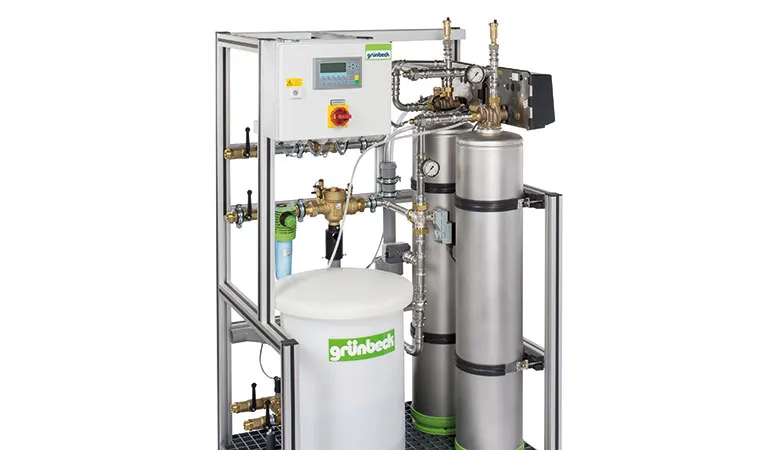
Valves becoming blocked, control and instrumentation systems malfunctioning, leaks in heat exchangers and/or pipework, and additional energy costs. As heating systems become ever more modern in their design and construction, heat generators are becoming increasingly sensitive to hard, corrosive fill water. Faults are a constant risk, with all the consequences that entails.
In the Netherlands, too little is done to treat the fill water in heating systems, partly because end users lack knowledge, says Nick Liebrand, country manager at Grünbeck Waterbehandeling BV. “A heating system is like a black box. The fill water is invisible, and people know too little about it. Yet they experience the consequences of hard, corrosive water. Did you know, for example, that energy consumption rises by 10% when 1 mm of limescale builds up on a heat exchanger?” Installers nowadays often compete on price, he says. “As a result, low-salt and softened heating water is often overlooked, unless the end user specifies it. In that respect, we could take Germany as an example, where VDI Standard 2035 is used as the benchmark for water quality when heating systems are commissioned and maintained.” The aim of the standard is to prevent limescale and corrosion damage, says Liebrand. “Heating system manufacturers stipulate that fill water must meet the specifications of VDI Standard 2035. If it does not, the warranty is often void.”
German thoroughness
Since December 2005 (when Part 1 of VDI Standard 2035 was amended), planners and installers in Germany have been required to check for every installation whether the hardness of the water supply is suitable for filling the heating system. The results of the check must be provided in writing to the contractor/operator. “With the introduction of Part 2 of VDI Standard 2035 in 2009, operators became responsible for the quality of their heating water. They must check this quality at least once a year.” This responsibility is shared with the planner and installer, who must provide the operator with appropriate advice. Part 2 of VDI Guideline 2035 covers the recording of, among other things, the quantity of alkaline earth metals/total hardness, the system volume, the total heating capacity and water treatment additives (type and quantity). The VDI standard has now become standard practice in Germany. Everyone complies with it, says Liebrand. “That is not only because of the hardness of the water in Germany (up to 30°dH), but also because the standard is stipulated in all warranties. If the operator cannot provide the documents mentioned above after damage occurs, the insurer and the manufacturer of the defective components may refuse to pay compensation.”
Savings on energy and maintenance
Unlike in Germany, water treatment in the Netherlands is still optional when a system is purchased and maintained. “Water hardness in the Netherlands ranges from 5.6 to 14°dH,” says Liebrand. “Our water is nowhere near as hard as in Germany, but it is hard enough to warrant action. Many building services systems are experiencing problems that can be resolved relatively easily. By changing the composition of the water to prevent limescale and corrosion, the system’s service life can be extended, while users can also make substantial savings on maintenance costs and energy consumption.” He believes the VDI standard should therefore be added to certification lists, including the BREAAM criteria list. Grünbeck supplies only systems and filters from its parent company in Germany that ensure water quality continuously meets VDI Standard 2035.
Text: Lieke van Zuilekom
Photography: Grünbeck Waterbehandeling BV
Question about this story? Ask your question
Keep following this
Get an email when a new story is published. No account needed.
- SubjectGeneral







