











Working with informal carers to care for our patients
Monday 10 November is Carers’ Day. At Franciscus, we are working increasingly closely with informal carers to make patients’ stay in hospital as pleasant and appropriate to their needs as possible. Nicky Lam, geriatrician at Franciscus: ‘It is no longer acceptable for an informal carer who was closely involved in someone’s care before their hospital admission to see their loved one only during visiting hours. Working with informal carers means you can provide truly tailored care.’
At Franciscus, informal carer participation is now possible on almost all wards. During the first conversation with the nurse following admission to hospital, patients and informal carers can say what they need. Taking part in care during the hospital stay is an option, but only if both the patient and the informal carer feel comfortable with it. A relative may also prefer to hand over care for a while and take some time to rest. It is important to agree on what works best for the patient and informal carer at that point. Franciscus is a national frontrunner among hospitals in this collaboration with informal carers.
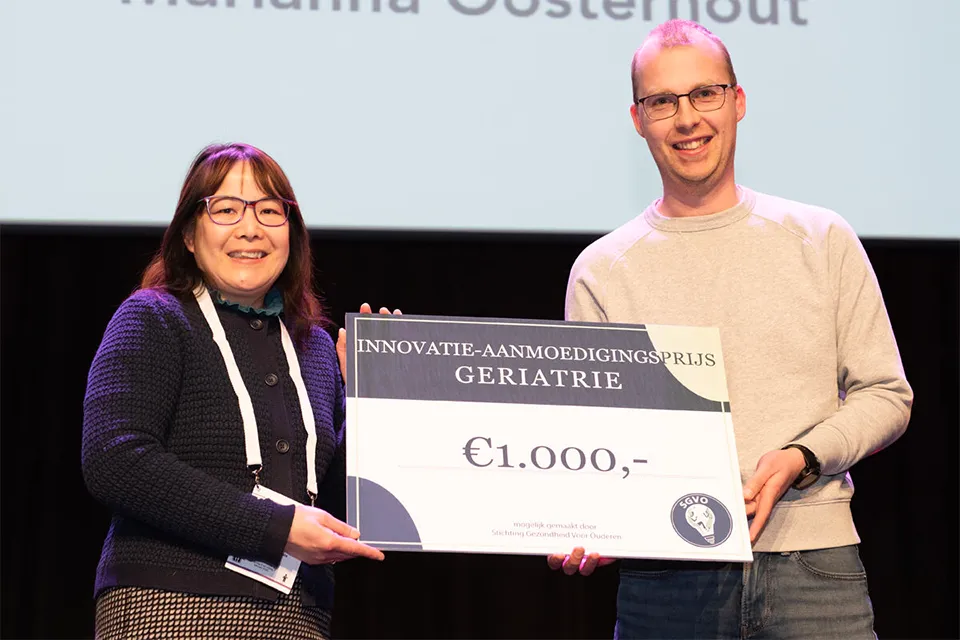
Geriatrics Innovation Encouragement Award 2025
Last year, geriatrician Nicky Lam won the Innovation Encouragement Award, presented by the Dutch Association for Clinical Geriatrics, for the Informal Carer Participation at Franciscus project and for establishing an innovative approach to active collaboration with informal carers in everyday care at our hospital. Patients, informal carers and healthcare staff consider this way of working together highly valuable. The prize money was used to fund a day of activities in which healthcare staff and informal carers could experience what it is like to live with dementia.
Clear agreements based on needs and what is feasible
For care teams, informal carer participation is a new way of working together and delivering care. It often takes time to work out what is best for each patient and their relatives. That is why it is important to agree clearly on what is and is not possible. The patient, their relatives and the care team need to be clear about their needs and wishes, and what is feasible.
Preparing for care at home
Patients appreciate having someone they know with them and being cared for by someone familiar. This can help them feel more at ease and focus fully on their recovery. Informal carers also appreciate having time to adjust to changes in their relative’s health. With guidance from the nurse, they can practise caring for their relative in the new situation, so they can continue providing care at home with greater confidence.
Question about this story? Ask your question
Keep following this
Get an email when a new story is published. No account needed.
- SubjectGeneral







