Erasmus MC and Maasstad Ziekenhuis launch world’s first multicentre ICU pilot of new ventilation method
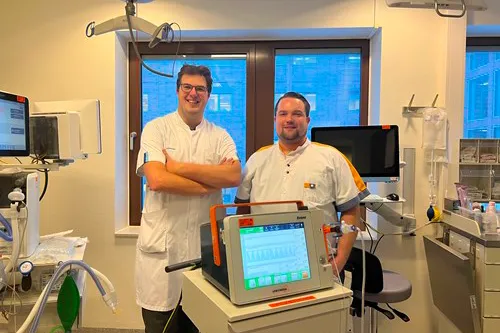
ICU patients with the serious lung condition Acute Respiratory Distress Syndrome (ARDS) will soon be able to take part in a study using a new ventilation method. Erasmus MC and Maasstad Ziekenhuis are the first multicentre team in the world to pilot flow-controlled ventilation. The study will assess whether the new form of ventilation may place less strain on the lungs, ultimately benefiting the patient.
Natural flow
Hospitals around the world use a standard form of ventilation based on pressure or volume. During inhalation, a machine blows air into the lungs through a tube. After inhalation, the expiratory valve opens and the lungs empty through another tube. The pressure involved can sometimes damage the alveoli. The new form of ventilation blows air in and out through the same tube. Air is blown in and then drawn out during exhalation. This creates a more natural ‘flow’, which may reduce the force exerted on the lungs. This may lower the patient’s risk of alveolar damage, with the aim of improving their quality of life.
Dolf Weller, ventilation practitioner and researcher at Maasstad Ziekenhuis, explains how the study works: “We have around two years to run the pilot. Patients taking part, 18 at Erasmus MC and 10 at Maasstad Ziekenhuis, will receive flow-controlled ventilation once for 90 minutes during a 24-hour period, under the supervision of the researchers. Before and afterwards, they will receive conventional ventilation, allowing a proper comparison to be made.”
Pilot of flow-controlled ventilation in cardiac patients
This is not the first pilot of the new form of ventilation in an ICU. Erasmus MC, which also initiated the study, recently completed a pilot involving cardiac patients. Julien van Oosten, internist-intensivist and researcher at Erasmus MC, says: “The pilot study involving postoperative cardiothoracic ICU patients showed that flow-controlled ventilation requires less energy and uses a lower minute volume. We therefore expect patients with ARDS to benefit from this method. Other patient groups may also be treated using the new form of ventilation following this pilot. The results of these pilots will help determine whether a larger follow-up study should be conducted.”
Time will tell whether this new form of ventilation becomes a groundbreaking method for use in practice. Many more years of research will be needed around the world to establish this.
Question about this story? Ask your question
Keep following this
Get an email when a new story is published. No account needed.
- SubjectHospitals