More efficient construction processes:
‘We bring every ceiling hoist requirement to life with BIM’.
At Lopital Nederland, they have no regrets about choosing to work with BIM, the 3D Building Information Model, just over five years ago. Roland Hommen of the Oisterwijk-based healthcare supplier says this has made the construction process much more efficient, translating into faster delivery and cost savings for the client.
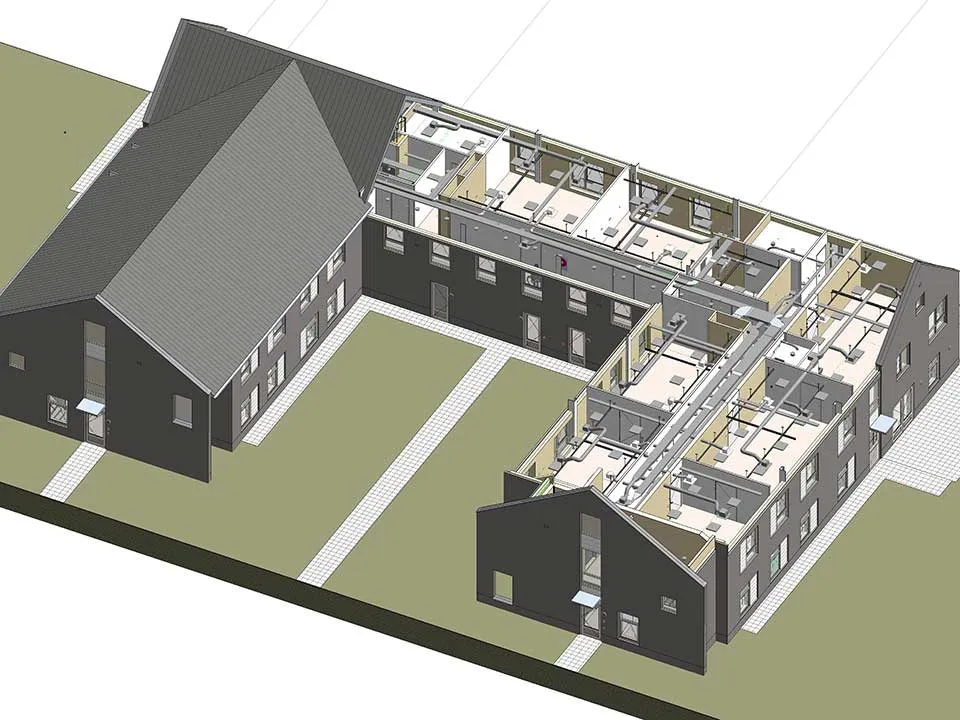
Hommen, who is responsible for Research and Development at Lopital Nederland, sums up BIM succinctly: “A working method in which various disciplines in the construction sector, from architects to building services companies, work together in an integrated way using a 3D Building Information Model. This means we can specify at an early stage what is required for the installation of our products.” He is referring, among other things, to the high-quality ceiling hoists. These require sturdy suspension points and electrical connections to charge the hoist batteries.
A ready-to-use plan
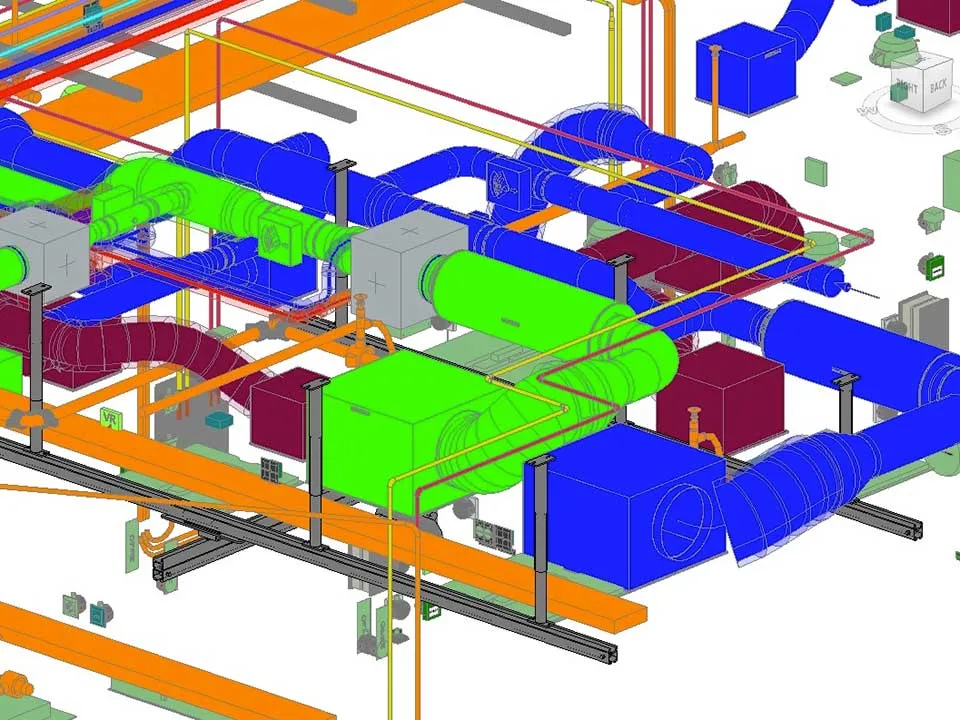
“Previously,” says Hommen, “Lopital Nederland was often the last party to join a hospital or care home project. By the time we presented our requirements for suspending the ceiling hoist rails, all the services were often already in the ceiling. This quite often led to additional work. We now submit our plans as a 3D model during the preparatory phase, and the BIM coordinator integrates them into the overall electrical and mechanical services plan. Construction can then start with a ready-to-use plan, with little or no need for changes at the end. In short, this saves a great deal of money, because it quite often used to lead to additional work.” To illustrate his point, Hommen shows a 3D drawing of a ceiling design for Amsterdam UMC location AMC. Amid a tangle of pipes and ducts, the fixing points and electrical connections for Lopital Nederland’s ceiling hoists are also meticulously incorporated. “Everything is fixed in advance. It really is quite a puzzle. Perhaps we should turn it into a Jumbo jigsaw,” he laughs.
Bespoke applications
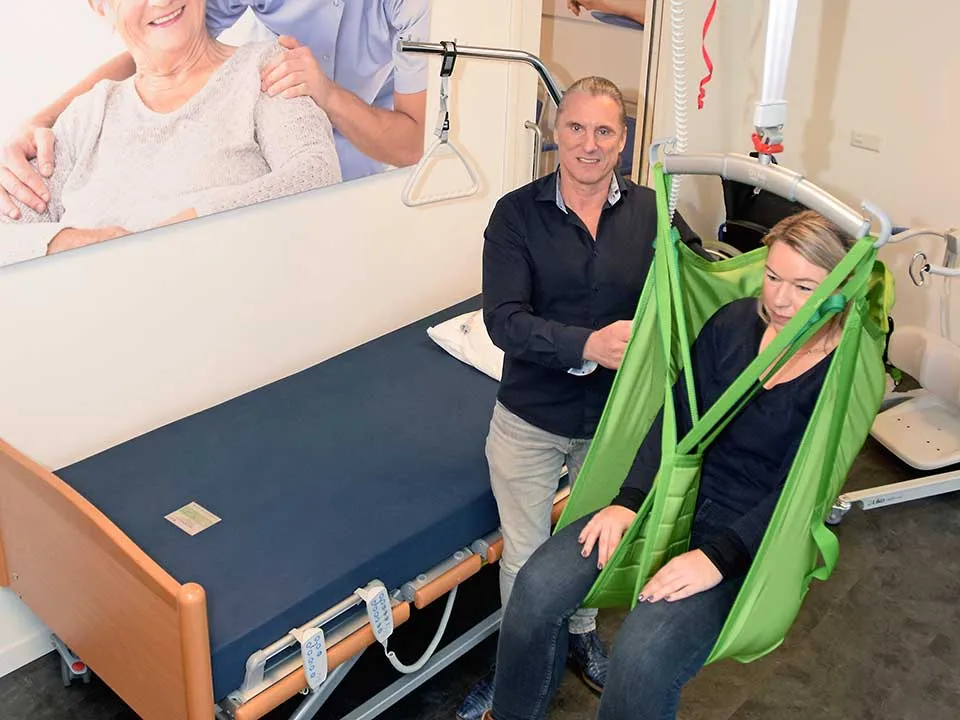
For more than forty years, Lopital Nederland has been developing, manufacturing and implementing hygiene and transfer solutions. Among the latter, ceiling hoists are a popular product thanks to their flexibility and range of applications. They are an ideal aid for moving clients safely and easily, including at home, for example from bed to bath or wheelchair. They also reduce the physical strain on care staff considerably. Hommen says: “We analyse the client’s requirements and provide bespoke applications accordingly. Our standard ceiling hoists already have a lifting capacity of 200 kilograms, and we go up to around 500 kilograms.”
The showroom at Lopital Nederland in Oisterwijk features numerous examples that demonstrate the efficiency of ceiling hoists. “From bed to bath and back again, or to another room. The rails can take us anywhere. The span from one fixing point to another is always two to five metres, depending on the type of hoist selected. That is the only requirement. Customers can choose between ceiling-mounted rails, often used in the home, or rails integrated into the suspended ceiling. For the latter, we have developed a plastic profile that neatly conceals the rails.” At the ‘end points’, the ceiling hoists need an electrical connection to charge the hoist motor’s battery. Hommen explains the different rails, from the H70 to the H100 and H180. “Depending on the application, whether turning left or right, going along a corridor or from the toilet to the sitting room, there are plenty of options. The client comes to us with a requirement, and we give shape to their ‘lifting needs’.”
Impressive reference projects
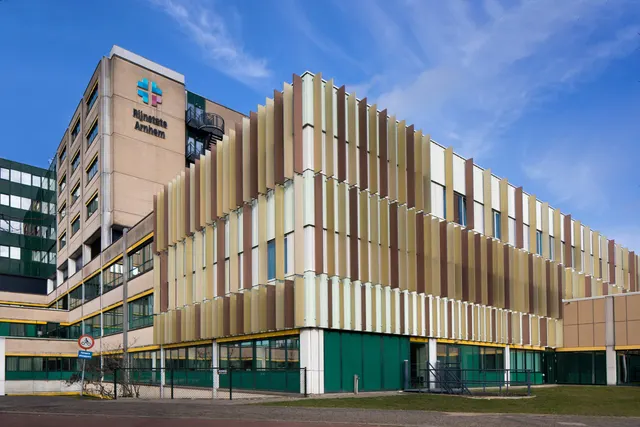
A list of examples from Hommen shows that Lopital Nederland takes great care when installing its ceiling hoists, as many leading hospitals have already discovered. At Amsterdam UMC location AMC, the hoists are installed in 155 rooms; at Radboud UMC in Nijmegen, in 270 rooms; at Rijnstate in Arnhem, in 70 rooms; at Algemeen Ziekenhuis Sint-Maarten, in 400 rooms; and at ZNA in Antwerp, in 125 rooms. The two most recent projects show that Lopital Nederland’s efficient approach has also won approval abroad. “These are just a few examples. We are also a hands-on partner for care facilities, such as Kempenhaeghe in Sterksel, a residential epilepsy care facility, and for care providers who supply our aids to private individuals.” He returns briefly to the renovation of AMC. “It was a major renovation of an existing facility, but we found a suitable solution despite that constraint. By combining our flexibility with that of our partners, we achieved an impressive result, even in a care facility that remained operational.”
Hommen stresses that Lopital Nederland offers more than ceiling hoists. The Oisterwijk-based company, which also has its own workshop, provides a wide range of sanitary, medical and rehabilitation aids for professional care, from hoists and chairs for comfortable showering to changing tables and bariatric care, all backed by servicing and maintenance. ′
Question about this story? Ask your question
Keep following this
Get an email when a new story is published. No account needed.
- SubjectHospitals