What does the increase in the NHC mean?
Text Gerjan Kampman Beeld AAG

After years of sharply rising construction costs and reimbursements failing to keep pace, healthcare property financing is finally moving forward. Long-term care, like mental healthcare and forensic care, will receive a substantial increase in the Normative Housing Component (NHC). The measure is intended to give care organisations more scope to create safe, sustainable and future-proof buildings.
The caretaker cabinet has decided to make €400 million a year available on a structural basis for accommodation from 2026. This will increase NHC rates for 2026 by 13%, on top of the regular 2.5% indexation.
Review of the NHC and NIC
Later this year, the NZa will launch a follow-up study into the basis of the NHC. It will examine:
- the number of square metres required per client;
- how construction costs have developed in recent years;
- the composition of the Normative Inventory Component (NIC).
The findings of this study are likely to affect rates from 2027 onwards.
An ongoing challenge
Despite this increase, construction costs remain a challenge. Costs have risen sharply in recent years and are expected to continue rising. Consulting firms use cost benchmarks per square metre to assess the feasibility of construction projects in advance. Before the NHC was introduced, these benchmarks were published for each care sector in the Bouwkostennota’s issued by the then Bouwcollege.
When preparing an estimate for a property project today, one question to consider is which cost trend to use. Should it be the ‘structural cost trend’ published by Bureau Documentatie Bouwwezen (BDB), based on increases in wages and materials, combined with the ‘cyclical cost trend’ that reflects the impact of market forces? It is also important to understand how changes to building specifications resulting from BENG requirements and gas-free (all-electric) construction affect the available benchmarks.
Cost trends
AAG investigated cost trends in the care sector and prepared a forecast for January 2026 based on four factors:
- According to BDB, the structural cost increase from 2010 to 2025 was approximately 58%, averaging 2.9% a year;
- The combined structural and cyclical cost increase over the same period was approximately 71.3%, averaging 3.4% a year.
- BDB’s provisional forecast (September 2025) indicates a 3.5% increase in structural and cyclical construction costs between January 2025 and January 2026.
- Changes to building specifications resulting from BENG requirements and gas-free construction have led to an additional cost increase of approximately 15%.
Investment costs as at January 2026
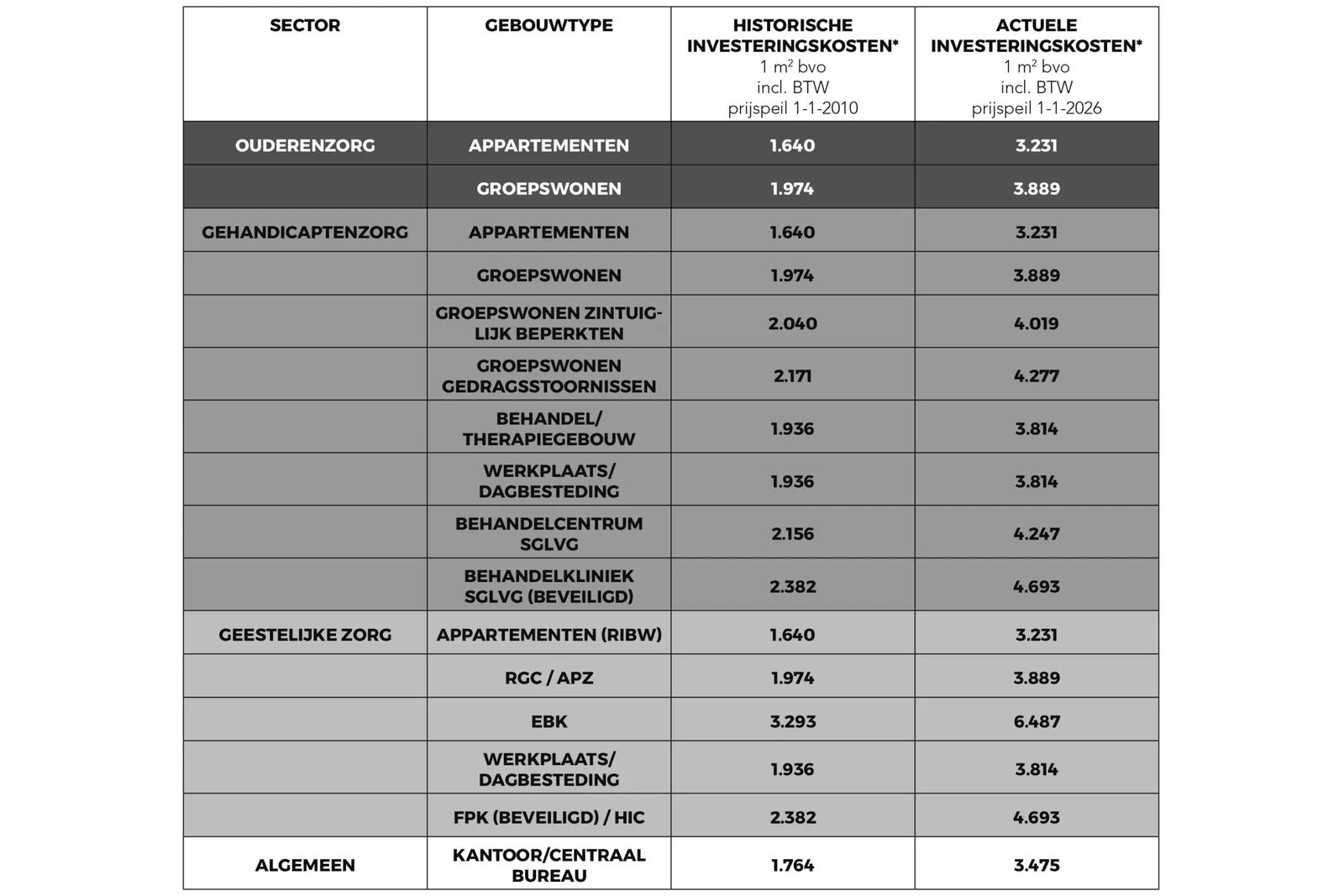
Based on these four factors, construction costs are expected to have increased by a total of 97.0% over the period from 2010 to 2026. The table shows the forecast investment costs per m² of gross floor area for elderly care, care for people with disabilities and mental healthcare, broken down by building function.
Investment costs comprise the total of construction costs, additional costs, director’s costs, interest during construction, changes to the programme and specifications during construction, wage and price increases during construction, and so-called start-up costs. Construction costs account for approximately 80% of investment costs.
Question about this story? Ask your question
Keep following this
Get an email when a new story is published. No account needed.
- ThemeFuture-proofing healthcare estates
- SubjectConstruction projects