











‘Hospital investment must be closely aligned with future care needs’
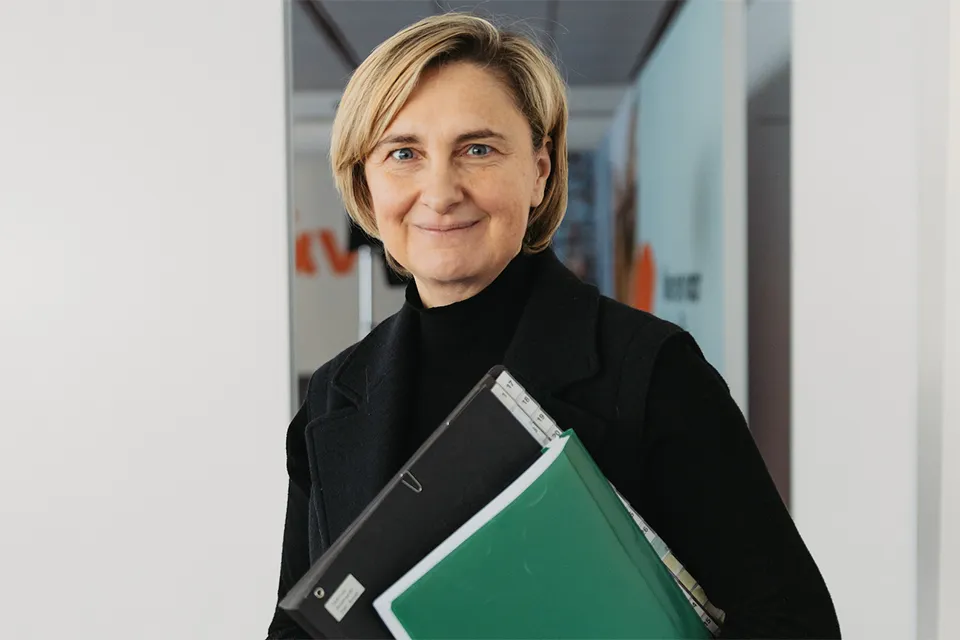
Flemish Minister for Welfare Hilde Crevits has already approved several strategic care plans for hospitals, either in full or in part. These plans describe the role of hospitals and hospital networks in the future provision of care in their catchment areas. To submit new construction projects and qualify for subsidies from the Flemish government, they must have an approved strategic care plan.
Hilde Crevits (56)
Master of Laws, Ghent University (1990)
Lawyer (1990–)
Assistant, Ghent University (1990-1996)
Staff member to the Mayor of Bruges (1996)
West Flanders Provincial Council member (2000-2004)
Alderman, Torhout (2001-2007)
Honorary Mayor, Torhout (2016-2019)
Chair of the Torhout Municipal Council ((2019–)
Member of the Flemish Parliament (2004-2007)
Flemish Minister for Public Works (2007-2014), Education (2014-2019), Economy (219-2022) and Welfare (2022–)
“The strategic care plans must ensure that investment meets needs on the ground,” says the minister. “This means that construction should be provided for only where it is necessary and on a scale appropriate to the region. We will continue to use them to set priorities for awarding strategic lump-sum grants. This should also lead to a well-developed core service offering and the concentration of expertise and high-tech care.”
Making the case for care provision
The plans assess regional care needs on the basis of health behaviours, demographic and socio-economic factors, urban development, morbidity and mortality. “Hospitals must justify the care provision they propose in light of regional needs and their specific role. In their case, they must identify the benefits of cooperation in terms of quality and finances, including the allocation of resources. Alongside their existing medical and staffing capacity and competencies, they must also submit a plan for further developing their capacity and competencies.”
The plans already approved are those of the Kempen network, Plexus (East Brabant) and Andreaz (Limburg), says the minister. “We are now examining the plans of the Gent and Mira (Dendermonde-Waasland) networks. These have already received an opinion from the Care Strategy Committee. Meetings of the Care Strategy Committee have already been held to discuss the plans of the Noord-Oost Limburg and E17 networks. A meeting for Helix (Antwerp) is likely to take place in the autumn. The Flemish Agency for Care and Health is preparing the evaluation report.”
The Agency for Care and Health is also currently reviewing the individual strategic care plans of several hospitals. “Those of Heilig Hart Tienen, Jessa Hasselt and Sint-Trudo (Sint-Truiden) have already been approved. We are now working on the plans of Ziekenhuis Oost-Limburg (Genk) and AZ Diest. The plans of AZ Turnhout and the Geel-Mol partnership have been submitted to the Agency.”
Responsibilities
“Building a new hospital requires a very long lead-in time. We understand that hospital management teams want clarity about subsidy opportunities as soon as possible. It is the Flemish government’s responsibility, within its overall budgetary framework, to ensure adequate funding for hospital infrastructure. We therefore need to assess needs regularly and, where necessary, provide additional authorisations. This allows us to support hospitals as fully as possible in delivering accessible, modern care. Infrastructure is an important factor in the quality of care. For smaller infrastructure projects, hospitals can decide for themselves how to use the available resources as efficiently as possible. These are funded through the so-called maintenance lump sum. Larger projects are covered by the strategic lump sum. Hospitals need the Flemish government’s approval to carry out such major works. With the exception of urgent or unavoidable projects, these works must be part of a regional and individual strategic care plan. We use this as the basis for new applications. In my view, this Flemish funding system for hospital investment works well.”
Planning replacement investment in good time
“Overall, the existing hospital infrastructure in Flanders is still in excellent shape, but we must of course plan replacement investment in good time. New buildings also meet the latest energy standards and create opportunities to organise patient flows more efficiently, thereby making better use of staff time.”
Question about this story? Ask your question
Keep following this
Get an email when a new story is published. No account needed.
- SubjectGeneral







