











St. Joseph-Stift Hospital in Dresden relies on a network solution that secures the building envelope and much more
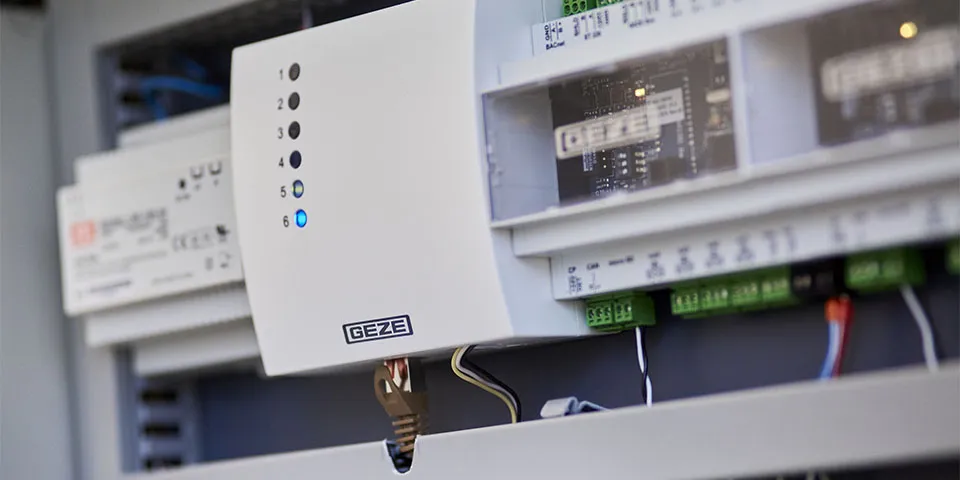
Technology from BMS manufacturer PcVue and door and window specialist GEZE provides better protection against unauthorised access, as well as improved monitoring and control. In time, the originally standalone PcVue solution will become a universal tool.
From standalone solution to multi-services platform.
In the Frankfurter Allgemeine Zeitung’s large-scale hospital survey in 2019, St. Joseph-Stift in Dresden was one of the top six in the ‘150 to a maximum of 300 beds’ category. The patients surveyed were not only more satisfied than average with the medical and nursing care, but the hospital also received top marks for the organisation of procedures and services. The hospital, which currently has 250 beds, treats around 35,000 patients a year. To enable nursing and medical staff to focus fully on patients, the hospital operator also invests regularly in its technical infrastructure. One example is the new, expanded control solution from PcVue and GEZE.
Initially, the visualisation and control functions of an existing intercom system were used to automate the building’s doors and locks. As requirements expanded, particularly in terms of planning and standardising data exchange with a heterogeneous field layer, the need for a comprehensive monitoring and control solution became clear.
This solution is available in the form of PcVue 12.0, which can connect doors and locks from different manufacturers via the OPC, ICX and BACnet communication protocols. This quickly generates a powerful abstraction layer. Connecting GEZE door systems via BACnet/IP is a particularly elegant solution, as the PcVue software includes a dedicated library of symbols and function blocks for various GEZE module types. This straightforward integration means the connection can be implemented on site by the technicians themselves.
PcVue enables the implementation of complex, building-specific logic, which is required because of the existing building layout. Sequential control and flexible networking capabilities are essential in such scenarios. The same applies to the special emergency button in the control room. When structural changes are made, escape routes must be adjustable at any time. With a PcVue developer licence, the intuitive configuration interface of the PcVue software and intensive on-site training, technical staff can reconfigure the system at any time.
A range of benefits for different user roles
System users include medical and administrative staff. Using web-based thin clients on 32″ flat screens at the entrance and in the control room, staff can continuously monitor the status of the building. During off-peak hours, medical staff in the control room and receptionists are authorised to acknowledge certain alarms independently. Torsten Klotzsche, head of building services, describes the system requirements as follows: “The aim is to […] make the day-to-day work of the operational departments easier.” This can be achieved in particular by reducing the workload in certain functional areas.
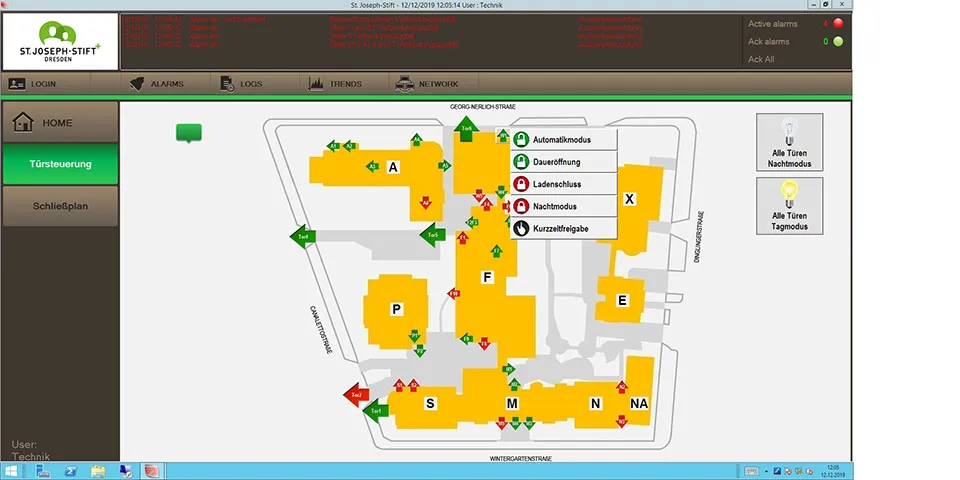
© Photo: St. Joseph-Stift Hospital/Technical Services Department)
His own department also benefits from the system’s versatile functionality. Since 2019, the building has had 100% Wi-Fi coverage, giving technical staff access to PcVue web visualisation (WebVue) via notebook and tablet, anytime and anywhere. This is a decisive advantage for mobile maintenance staff. An additional screen in the plant room also serves as an alarm monitor for the on-call team.
A unified architecture and extensive networking capabilities
Torsten Klotzsche’s vision of ‘achieving intelligent control of critical information and control points with manageable investment’ is becoming a reality with a solution that allows the facility’s four main buildings and four annexes to be monitored through a simple, flexible and future-proof architecture. The control system consists of a PcVue server station for up to 65,000 data points, five web clients, and a development and test station. All stations are networked, making it possible to create, deploy and distribute new project versions at any time. This happens virtually in real time, as PcVue projects do not need to be compiled before deployment. Data and control commands are currently exchanged via various communication protocols, including BACnet, OPC, Modbus, KNX and ICX. WebScheduler, the user interface for managing PcVue’s native schedules and BACnet schedule objects, is also integrated into the project’s web interface. PcVue now even monitors status messages from the intercom system using the ICX protocol.

© Photo: St. Joseph-Stift Hospital/Technical Services Department
Connecting the doors improves transparency, comfort and safety
Forgetting to close doors in the evening is a thing of the past. Unwanted visitors, for example, who could cause considerable damage in a building of this kind, can now be kept out. Instead, the system automatically locks the doors after a set time, according to a carefully designed schedule. Controlled access for people is possible at any time without difficulty.
Other functions changed as part of the integration include:
Temporarily switching internal doors to ‘permanently open’ mode; reducing door cycles (door movements)
Connecting the weather station so that doors can be opened and closed accordingly (for example, in strong winds), or switched to automatic mode.
The first GEZE doors have now been connected to the PcVue system thanks to the straightforward integration. This improves transparency, provides greater comfort and, above all, makes the building safer. This technology made it possible to change the conversion measures while the building remained in use, without affecting its normal operation. The technical team was able to install an intelligent door control system on site with manageable investment. In the first phase of the expansion, three door control units, three airlock systems, a revolving door and various other automatic doors were commissioned. This also reduces the workload for staff, as doors no longer need to be locked manually, unexpected visitors can no longer gain access, and the technician on site can manage the building more easily. During the next phase of door maintenance, the team will assess which door systems can be easily connected to the PcVue system via BACnet. This will simplify the step-by-step connection of the ‘doors’ subsystem.

Schematic representation of the door locking subsystem
Further expansion of the system
Following the planned handover of the control system to the hospital’s IT department and the associated virtualisation of the system, plans for the near future include connecting additional GEZE automatic doors, integrating blind and shutter controls, and connecting critical and non-critical power supplies via KNX. The technical team will also consider integrating external branches via the LoRa IoT protocol, as well as integrating video surveillance systems into PcVue. A new section of the building is also planned, with its entrance door to be connected via BACnet. All of this can be achieved easily with the versatile PcVue solution. Local technicians now have a comprehensive tool at their disposal.
A business enquiry for Geze? Get in touch
Companies in this story

Keep following this
Get an email when a new story is published. No account needed.
- SubjectGeneral
- CompanyGeze







